
In Saint-Étienne-de-Lisse, on the eastern edge of Saint-Émilion, the landscape itself tells a story. It takes just a few minutes’ walk to understand what sets La Maison Cardinale apart from a traditional Bordeaux estate: here, the landscape isn’t just a backdrop. It is the primary tool of production.
Founded in 2024, the estate brings together Château Fleur Cardinale and Château Croix Cardinale around a simple idea: to observe what a single clay-limestone plateau produces when cultivated on two opposite exposures. On one side, a cooler north-facing slope, shaped by the valleys that descend toward the Barbanne River. On the other, south-facing hillsides where sunlight plays a greater role in the growth cycle.
This interpretation of the region did not come about by chance. When Dominique and Florence Decoster left the world of Limoges porcelain to acquire Château Fleur Cardinale in 2001, followed by Château Croix Cardinale in 2011, the eastern part of the appellation remained relatively underappreciated. Successive Saint-Émilion classifications would eventually confirm the potential of these cool terroirs.
The next generation takes this approach even further. Starting with the 2023 vintage, the wines are crafted from plots grouped according to their north or south exposure in order to better isolate the influence of climate, light, and topography on the final flavor. This approach is more inspired by Burgundy than by the Bordeaux tradition of broad regional blending.
Two major geological features coexist beneath the vineyards: the Fronsadais molasse, a fluvial-lacustrine legacy from the Tertiary period, and the Asterian limestone, evidence of an ancient tropical marine environment. Their combination produces soils whose depth, texture, and water-holding capacity vary greatly from one plot to another.
Technical Director Ludivine Chagnon sums up this relationship with the soil in a revealing statement: “These brown soils, rich in heavy clay, are difficult to work with, but they speak through the glass.”
The northern slope of Fleur Cardinale promotes slower ripening and a flavor profile characterized by freshness and salinity. The southern slope of Croix Cardinale, on the other hand, produces wines with more sun-drenched profiles, shaped by more abundant sunlight and soils that are more prone to erosion. Comparing the two thus becomes an almost educational exercise in the influence of the landscape.
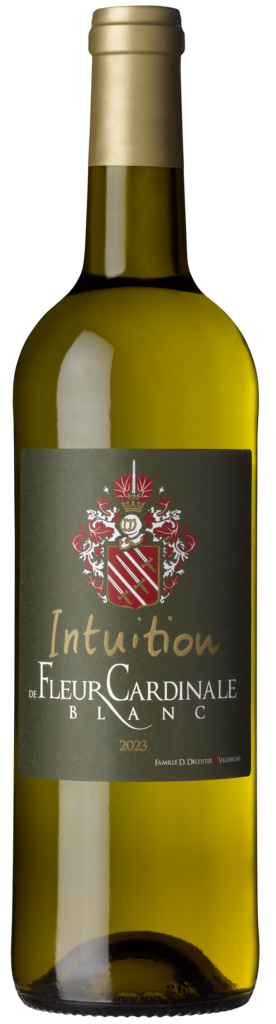
This approach is also reflected in the recent development of the white wines. In 2018, the family acquired 2.4 hectares located on the edge of a forest in the coolest part of the estate. This choice was no accident. At a time when global warming is reshaping European viticulture, exposure and water reserves are becoming strategic assets as much as agronomic qualities.
Detail
The first vintage of Fleur Cardinale white comes from a 2.4-hectare plot planted at a density of 8,350 vines per hectare. The blend combines Sauvignon Blanc, Sémillon, and Sauvignon Gris. The grapes are harvested by hand into small crates and undergo a double sorting process, followed by nine months of aging on the lees in 500-liter Burgundy barrels. Production totals approximately 9,000 bottles.
In the cellars, the same commitment to precision prevails. The estate has developed equipment that allows for increasingly refined winemaking, down to the level of individual plots. The new facilities also house an experimental winery designed to test different containers and winemaking protocols without compromising the wines’ identity.
However, the issue goes beyond mere technical considerations. Maison Cardinale illustrates a subtle shift in Bordeaux’s center of gravity. For a long time, a wine’s value rested primarily on its classification or heritage. Here, the narrative is built more around an understanding of the terroir, climate observation, and the ability to adapt.
In a region often viewed through the lens of its historical hierarchies, this approach is perhaps the most interesting lesson to be learned. Bordeaux’s future is not determined solely by the archives of century-old estates. It is also shaped by hillsides long viewed from afar, where a few winemakers have chosen to let the landscape speak for itself.
Cette publication est également disponible en :

