
In perfumery, white has long been treated as an abstraction—an idea of purity, a clean, almost clinical light. With White Blood, Maison L’Entropiste takes a more organic approach: that of a musky floral built not around transparency, but around a constantly evolving substance.
This creation, by Bertrand Duchaufour, is part of an interesting trend in contemporary perfumery: the return of textured floral accords—less decorative, more tactile. Here, the floral note is never treated as a bouquet. Rather, it acts as a shifting surface, traversed by contrasts between moisture, fruity brightness, and musky depth. The press kit refers to “opaline blood” and “a substance made of reflections.” Behind this sometimes emphatic wording, however, lies a genuine olfactory intention: to create a fragrance in which the physical states seem to be in constant flux.
The opening combines black pepper and bergamot. A dry, almost mineral-like opening quickly gives way to a more diffuse heart note, where star fruit, tiare, and pink lotus introduce a watery, milky sensation. The choice of star fruit, incidentally, deserves special attention. Rarely used as a central note, it brings not so much a recognizable exoticism as a translucent acidity, reminiscent of a fruit that is still green.
But it is above all in its core that White Blood finds its coherence. Here, Duchaufour revives two ingredients that have shaped much of his work over the past two decades: vetiver and musk. The former retains its dry, earthy intensity; the latter, more enveloping, acts here like a diffused light rather than a simple skin note. The perfumer himself describes the musk as “more discreet than before” in his collaboration with L’Entropiste.
This shift reflects a broader evolution in the niche market. For several years now, rich, saturated compositions—bold oud, heavy ambers, and overly indulgent gourmand scents—have been gradually giving way to more ethereal formulations, though not necessarily minimalist ones. Contemporary fragrance luxury now seems to be seeking something else: a presence that is less in-your-face, more elusive, almost atmospheric.
This is probably where White Blood becomes interesting beyond its own launch. The fragrance seeks to evoke a sense of diffraction rather than an immediately recognizable signature. Like the opal mentioned in the feature, the composition shifts depending on the angle and skin temperature. White is never uniform here; it becomes an accumulation of nuances, transparencies, and internal tensions.
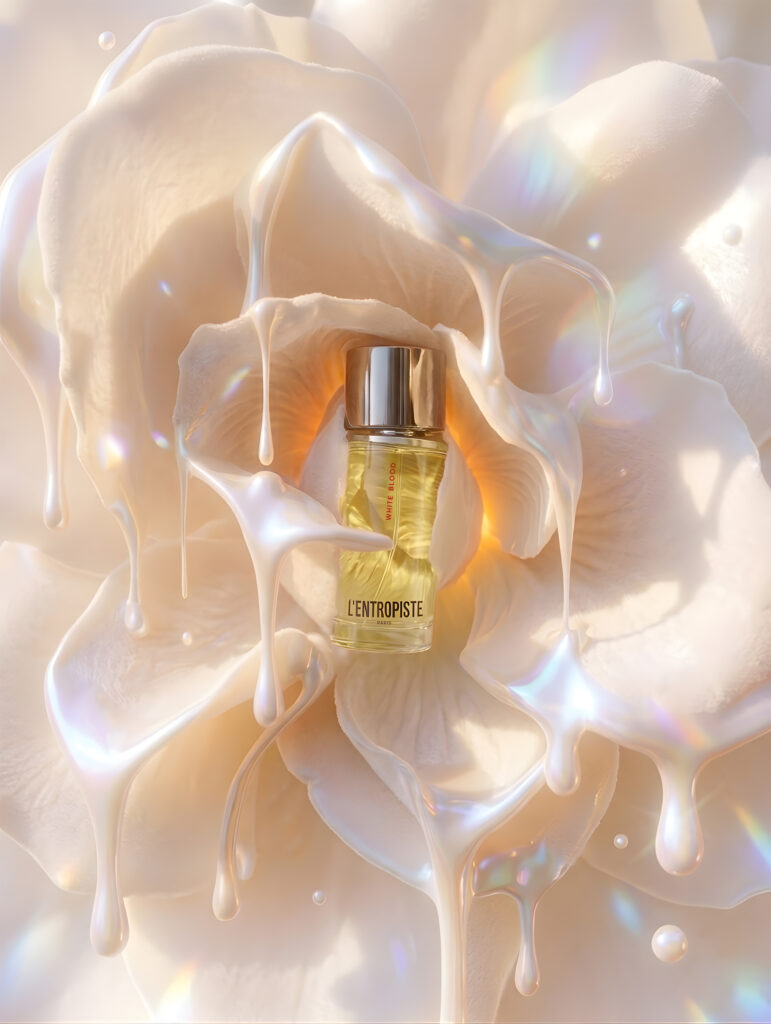
L’Entropiste’s artistic direction cleverly complements this concept. The visuals play on iridescent surfaces, pearlescent materials, and states that lie between liquid and solid. It’s an almost post-photographic aesthetic, where the fragrance is depicted less as an object and more as a luminous phenomenon. Here again, the current era partly explains this choice. In a world saturated with hyper-defined images, many independent brands are now seeking to recreate a sense of blurriness, instability, and sensitivity.
Bertrand Duchaufour ultimately sums up this approach quite well when he speaks of “sensations, colors, and emotions” rather than rigid labels. Behind this phrase lies a central question in today’s perfumery: how can we continue to evoke olfactory emotions in a market where nearly all fragrance families have already been overused?
With *White Blood*, L’Entropiste does not rely on sheer power. Instead, the House opts for a subtle shifting of materials—a more contemporary way of constructing memory.
Cette publication est également disponible en :

