
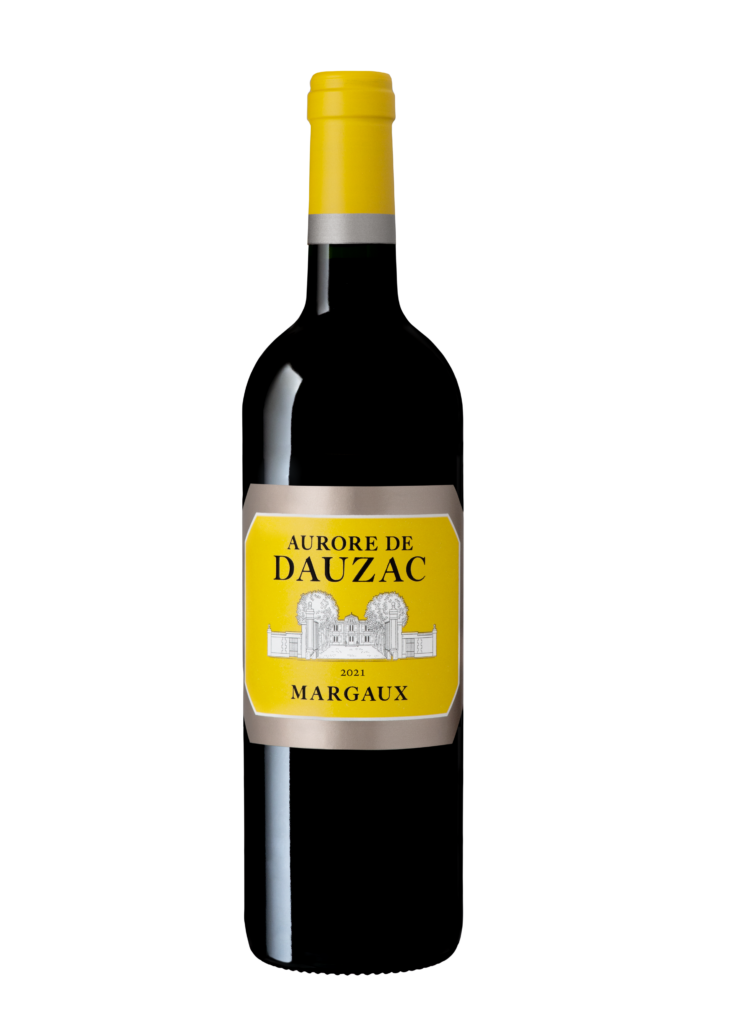
The 2021 vintage in Bordeaux was not the easiest. A cold spring, a wet summer, 20% less sunshine than usual, and persistent downy mildew pressure right up until harvest. Château Dauzac harvested its Merlot on September 22 and its Cabernet Sauvignon on October 13—a three-week gap that speaks to the care taken with each plot.The 2021 L’Aurore de Dauzac is the result of that patience.
This cuvée comes from a unique geological formation within the estate’s 49 hectares: mounds of fine, sandy gravel, distinct from the clay-limestone terroirs that make up the bulk of the Margaux appellation. This well-drained soil, planted at a density of 10,000 vines per hectare on 101-14, Riparia Gloire, and 3309 rootstocks, promotes the slow ripening of Cabernet Sauvignon—the dominant grape variety in the blend at 62%, complemented by 37% Merlot and 1% Petit Verdot. The vines are between thirty-five and forty years old: an age at which yields naturally decline and concentration develops without intervention.
Winemaking Details
Aurore’s winemaking process relies on a gravity-fed system, which eliminates the need for mechanical pumping of the grapes and allows for extraction by simple gravity. Alcoholic fermentation takes place in temperature-controlled wooden and stainless steel tanks at 28°C. Aging lasts twelve months, divided between 45% in French oak barrels—20% of which are new—and 55% in large oak casks. This high proportion of large oak casks allows for a gradual integration of oak without tannic saturation. Fining, if necessary, is performed using vegetable proteins. The wine is certified vegan.
What sets 2021 apart from sunnier vintages is precisely the adverse weather conditions. Flowering began on May 25 under hot, dry conditions, followed by June, which saw rainfall 127% above average—with signs of coulure and millerandage in some plots. The Dauzac vineyards benefit from their immediate proximity to the Gironde estuary, whose thermal inertia moderates temperature fluctuations: this natural regulator protected the vineyard during the April frost and maintained a viable ripening window despite the cold summer. Rigorous intra-plot selection, with sorting on the sorting table before and after destemming, focused efforts on harvesting the healthiest grapes.
The projected aging potential—between three and fifteen years, with the possibility of up to twenty or thirty years for the best bottles—is no small matter for a cuvée positioned as the second wine of an 1855 Grand Cru Classé. It signals that Dauzac treats Aurore less as an affordable product than as an independent expression of the terroir—distinct in its geology and produced according to the same technical protocol as the main cuvée.
In Bordeaux, where generic appellations are facing price pressure and a loss of direction, the 2021 Aurore de Dauzac raises a broader question: How far down the range can a 170-year-old classification go without diluting the quality it guarantees?
Cette publication est également disponible en :

