
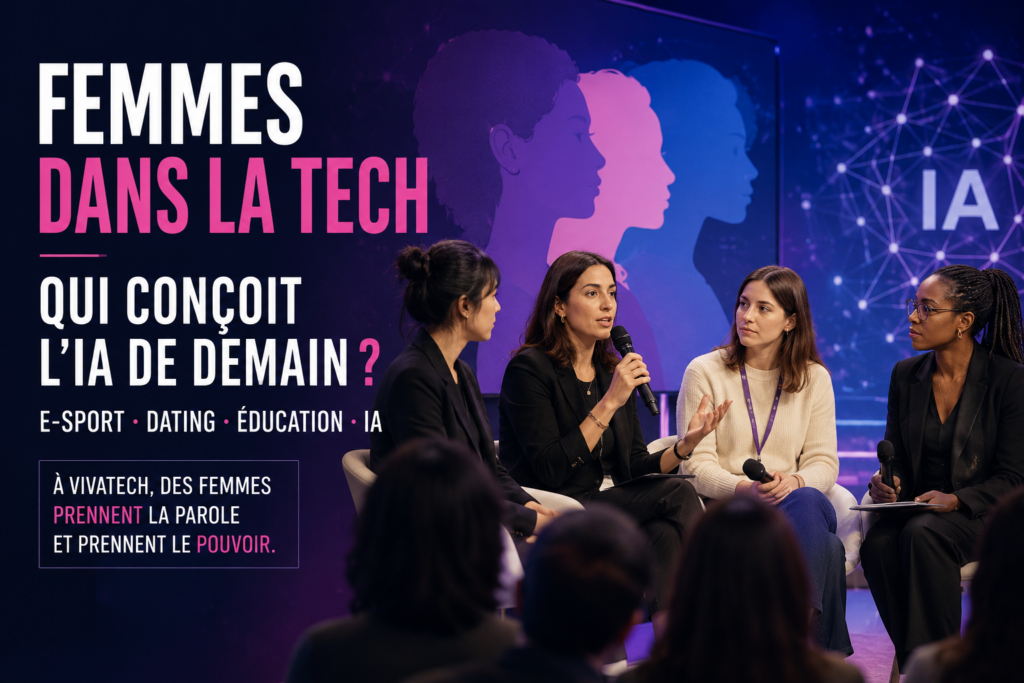
At VivaTech, a session focused on women in tech shifted the conversation: it’s no longer just about opening the doors to careers in digital fields, but about who designs the tools that shape how we connect, learn, and make decisions.
There are areas where absence is less noticeable than it is felt. A dating app can work perfectly for a man while, at the same time, creating an overwhelming experience for a woman. A video game can attract millions of male players while making female players feel like intruders. Artificial intelligence can respond in a matter of seconds and quietly reinforce the blind spots of those who trained it.
Perhaps that is where the real issue for women in tech lies today—no longer simply in securing positions, but in shaping the very nature of how technology is used.
At VivaTech, the session dedicated to women in technology—supported by the Caisse des dépôts—opened with a simple observation: technology is no longer just one sector among many. It permeates healthcare, education, finance, the public sector, entertainment, and human relationships. Staying on the sidelines, therefore, means letting others write the rules of a world in which we will all have to live.
Practice reveals what the organizational chart leaves out
Karima Benabdelmalek, president of Happn, provides a very concrete example. In the dating world, the product is never neutral. The ratio of men to women, the way messages are delivered, the frequency of messages, and the sense of control or security—all of these factors determine the actual experience.
The executive points out that 55% of Happn’s workforce is employed in tech, product, or data roles. Yet these fields remain predominantly male. The contradiction is obvious: how can you design an app that appeals to women when there are too few women with firsthand experience at the table?
At Happn, this issue has even been reflected in the app’s features. In response to female users feeling overwhelmed, the app has implemented a more gradual delivery of messages to give them back time and choice. This detail speaks volumes. Gender parity isn’t just a matter of representation; it changes the very fabric of the service.
The same logic applies to the rebranding of the digital platform that Happn has become. Karima Benabdelmalek explains that she moved away from a blue-and-white identity—which was deemed too cold and too corporate—to create a warmer brand image more closely tied to human connection. This move may seem purely aesthetic. In reality, it’s strategic: in the economy of intimacy, trust is an interface.
Enter the codes, then move them
In esports, Lou Henguelle describes another dynamic: that of late entry. Many female gamers start playing video games later than boys do, due to a lack of early exposure, family encouragement, or visible role models. This initial gap then leads to a gap in skill level, confidence, and legitimacy.
Once again, this issue isn’t just a cultural one. It touches on how markets are structured. When a publisher creates a women’s competition, establishes protected spaces, develops platforms for visibility, or includes more women on its teams, it isn’t just promoting inclusion. It’s expanding its own vision of what its products can be.
Lou Henguelle also describes the most subtle tension: learning the codes of a community without losing oneself in it. In esports, this involves vocabulary, rhythm, technical credibility, and sometimes even one’s voice. You have to be immersed enough to be heard, yet distinctive enough to shift the norm. The exception, through sheer persistence, can become the rule.
School as a Means of Correcting the System
With Ada Tech School, founded in 2019, Chloé Hermary is focusing specifically on this entry point. The school trains students with no technical prerequisites or degrees, and 60% of its classes are made up of women. The premise is clear: tech isn’t just for trained engineers or those with linear career paths.
This shift is crucial. Programming can be approached as a living language. Designing an app draws just as much on marketing, an understanding of user behavior, collaboration, and creativity as it does on the code itself. Here again, the myth of the lone developer obscures the reality of a collaborative profession.
This reevaluation of skills opens the door to candidates from the fields of education, communications, business, finance, and law. Above all, it shows that self-censorship remains one of the biggest barriers. Many women ask themselves not only whether tech interests them, but whether tech is “right for them.” The answer comes less from what people say than from personal experience.
Details
At Microsoft France, Hebrou Cornet notes that 50% of the executive committee is made up of women and that women account for 38% of the workforce in France. The company is focusing on mentoring, sponsorship, and training programs, with the stated goal of providing free AI training to one million people by 2027.
AI: Catalyst or Corrector?
The discussion becomes more sensitive when it turns to artificial intelligence. That’s because AI is where all the tensions converge. It can help people learn faster, automate repetitive tasks, open up access to code, and accelerate skill development. But it can also amplify biases if those who design it represent only a part of reality.
Chloé Hermary points out that facial recognition systems have historically been less effective at detecting people with darker skin tones when they were not sufficiently trained on those profiles. Image generators, for their part, still tend to associate certain professions with specific genders. The problem isn’t that AI “thinks incorrectly.” It’s that it learns too faithfully from incomplete human data.
The issue then becomes political in the noblest sense: Who trains the models? Who defines the datasets? Who decides what is acceptable, visible, recommended, or a priority? In the luxury sector, in healthcare, in education, and in recruitment, the answers to these questions cannot remain in the hands of a homogeneous group.
Generative AI, however, offers a rare opportunity. Because it operates using natural language, it lowers part of the barrier to entry. You can talk to it, test things out, try again, and learn through iteration. It lets you prototype a website, structure an idea, prepare a pitch, or explore a career path. But we still need to dare to embrace it before the digital divide becomes a new power divide.
The lesson from this session can perhaps be summed up in one sentence: tech isn’t just a sector that needs more women; it’s a grammar of the world that needs to be rewritten. And that grammar can no longer be written without the women who will live with its consequences.
Cette publication est également disponible en :

