
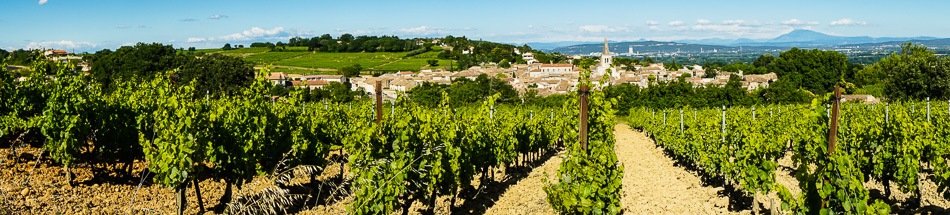
In Saint-Marcel-d’Ardèche, Mas de Libian continues to make a quiet name for itself in the world of biodynamic wines from the southern Rhône. With Cave Vinum 2025, the Thibon Macagno family blends Viognier, Roussanne, and Clairette grown on north- and east-facing clay-loam soils, in a region more commonly associated with intense sunshine than with crisp white wines. Here, the choice of exposure already speaks to an intention: to preserve acidity, slow down ripening, and let the wind do as much work as the sun.
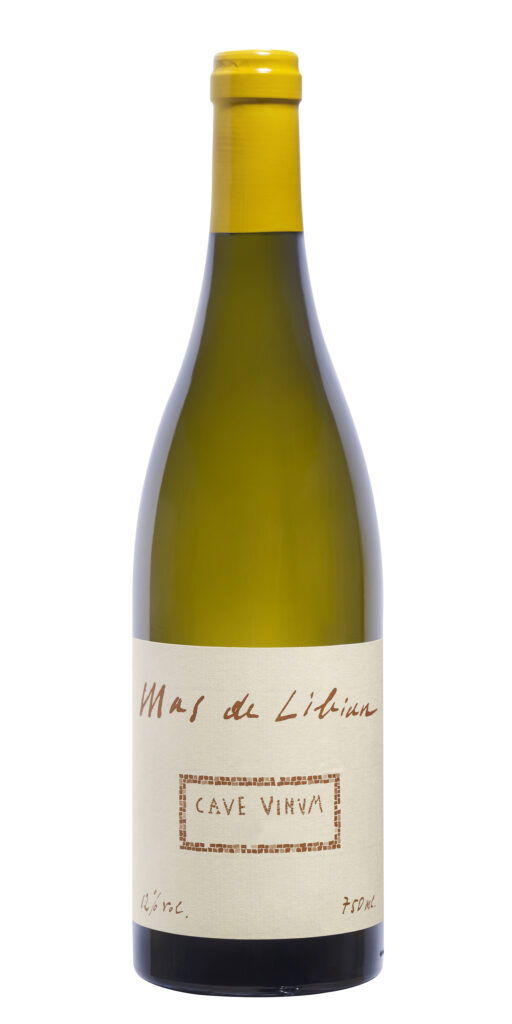
The name itself is worth a closer look. Cave Vinum is a play on the famous “cave canem” inscription found in the ruins of Pompeii. “Beware of the dog” becomes “beware of the wine.” A dry, almost Roman irony in an era when natural wine oscillates between cultural artifact, agricultural debate, and a sign of urban distinction. Yet Mas de Libian isn’t just putting on a show. The estate operates under Demeter-certified biodynamic practices, with hand-harvesting, rigorous sorting by plot, and minimal intervention during winemaking.
The blend varies slightly depending on the batches provided: the technical dossier lists 40 percent Viognier, 40 percent Roussanne, and 20 percent Clairette; the sample sent to wine merchants suggests a more sporadic presence of Chenin, Muscat, Rolle, and Chouchillon. This variation also speaks to the nature of contemporary artisanal wine: a pursuit of balance that is more organic than industrial, where the blend remains a living process rather than a fixed formula.
In the glass, the color leans toward a dense gold without feeling heavy. The nose unfolds in layers: ripe pear, quince, white peach, followed by a hint of light honey, then a touch of anise and a subtle note of white pepper. The palate is smooth but never soft. The Viognier provides body; the Roussanne, a waxy tension; and the Clairette, that salty bitterness that adds length to southern white wines when they avoid overripeness. The gently peppery finish surprises more than it seeks to seduce.
The winemaking process accounts for this texture. Pneumatic pressing, cold settling, reintroduction of the fine lees, followed by 12 days of skin contact for half the batch, before aging in demi-muids. The wine is unfiltered. These technical choices lend it depth without falling into the sometimes exaggerated characteristics found in certain natural white wines.
What’s particularly interesting here is the connection to the south. Many Mediterranean white wines today seek aromatic intensity or extraction. Cave Vinum 2025, however, focuses instead on subtlety, saltiness, and a sense of restraint. Even the suggested pairings—cheese soufflé, oysters au gratin, garlic shrimp, veal blanquette, or goat cheese from the South—point to a table wine rather than a wine meant for showy tasting. A wine designed to be served throughout the meal, capable of pairing with garlic without overpowering the dish—a quality that remains rare among Rhône whites.
With 9,700 bottles produced at the estate and a planned release in April 2026, Mas de Libian remains on a manageable agricultural scale. No heroic narrative, no fabricated mythology surrounding biodynamics. Just a family-run estate in the Ardèche that continues to explore the potential of a Mediterranean white wine when freshness is no longer a marketing gimmick but a cultivation choice.
Cette publication est également disponible en :

