
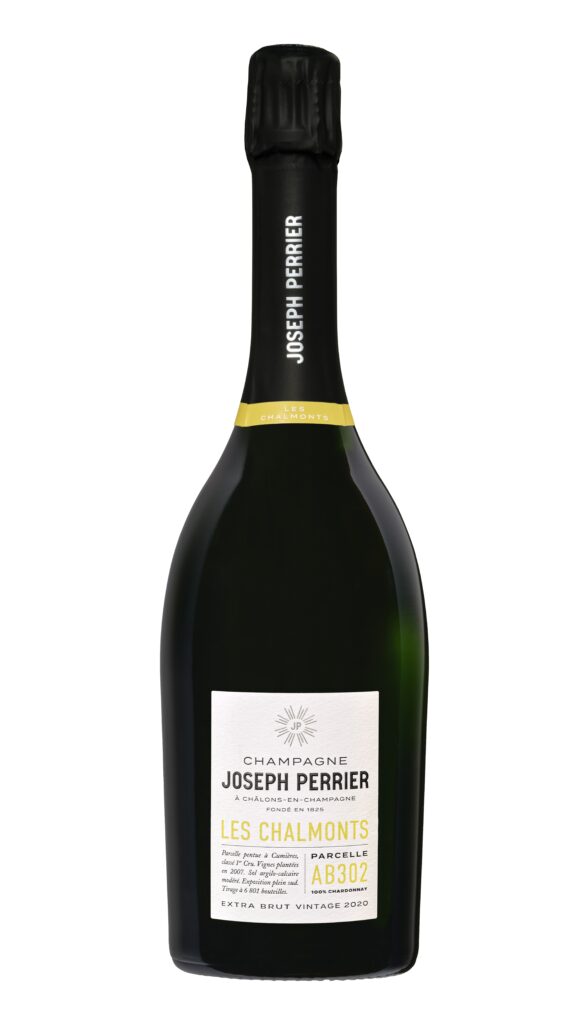
In Cumières, overlooking the meandering Marne River, a 50-are plot serves as a reminder that champagne is, first and foremost, a matter of precise geography. At Maison Joseph Perrier, Les Chalmonts 2020 is not presented as a spectacular new release, but rather as the continuation of a multi-year exploration of single-vineyard production. One location, one grape variety, one vintage. Nothing more. And in Champagne, this apparent simplicity often demands the greatest rigor.
Founded in 1825 in Châlons-en-Champagne, Joseph Perrier occupies a unique place in the Champagne landscape. The house remains one of the last still based in this city, historically linked to the Champagne wine trade, far from the more familiar Reims-Épernay axis. Its single-level Gallo-Roman cellars, stretching for several kilometers, bear witness to a long-standing commitment to the slow aging and preservation of wines. In the 19th century, the house was granted the right to use the designation “Cuvée Royale” after supplying Queen Victoria’s British court—a distinction that continues to shape its identity today.
With the “Les Parcellaires” collection, Joseph Perrier continues to explore his family’s vineyard in greater detail. Following La Côte à Bras, dedicated to Pinot Noir, and Le Ciergelot, devoted to Meunier, Les Chalmonts completes this trilogy with a Chardonnay from parcel AB302, located in Cumières, a village classified as Premier Cru.
The plot was planted in 2007 on a south-facing hillside. The choice of Chardonnay in this region—which is predominantly associated with Pinot Noir—speaks to the estate’s approach: seeking not so much to showcase the variety as to achieve the balance of a specific terroir. The clay-limestone soil plays a central role here. The roots delve into chalk that retains water while maintaining a constant mineral tension. Grass cover between the rows and mechanical tilling are used to preserve the soil’s biological activity and limit compaction.
The 2020 vintage also offers its own climatic perspective. In Champagne, the year was marked by a cool spring followed by a hot, dry summer, with one of the earliest harvests in the region’s recent history. This early harvest, often cited as a symptom of climate change in the Champagne vineyards, is now forcing the houses to rethink their approach to the ripeness and acid balance of the grapes.
In the case of the Chalmonts, Joseph Perrier advocates for a taut rather than opulent interpretation. The cuvée is vinified as extra-brut with a dosage of three grams per liter to preserve the expression of the terroir. The wine ages for sixty months before disgorgement, a cellaring period that helps develop a more subdued texture without diminishing the Chardonnay’s tension.
In the glass, the wine remains restrained overall. The notes of citrus, dried flowers, and white fruits described by Nathalie Laplaige—the house’s cellar master for over a decade—do not seek aromatic exuberance. The palate maintains a straight, almost saline line, supported by delicate bitter notes reminiscent of citrus zest and dry grains.
This plot-by-plot approach also reflects a broader evolution in contemporary champagne. Long built around blending as the defining hallmark of the great houses, the wine industry is now seeing the emergence of a more precise interpretation of terroir, inspired in part by Burgundy and by connoisseurs’ growing interest in micro-origins. At Joseph Perrier, this shift remains measured. Les Chalmonts does not deny the historic tradition of blending embodied by the Cuvée Royale. Rather, the cuvée serves as a counterpoint: a way to isolate a fragment of the Champagne landscape to better understand what ultimately shapes the house’s overall identity.
Behind this bottle lies a subtle reflection on the passing down of tradition. Benjamin Fourmon, representing the sixth generation of the family, carries on a tradition that seems to favor gradual evolution over sudden breaks in continuity. In a Champagne region sometimes tempted by aesthetic excess or ostentatious hyper-luxury, Les Chalmonts chooses a different path: that of unapologetic agricultural precision.
The AB302 plot thus appears less as a marketing gimmick than as a tool for understanding. It serves as a reminder that, beyond the packaging, limited editions, and stories of prestige, champagne remains a matter of slope, exposure, chalk, and patience.
Cette publication est également disponible en :

