
St-Germain cocktails are special in that they look easy, and they are – as long as you know what you’re dosing. Elderflower liqueur is unforgiving of approximations. Too present, it jams. Too absent, it’s gone.
What elderflower changes in a glass
St-Germain is a French liqueur produced from black elderflowers hand-picked each spring in the Alps, during the few weeks when flowering is at its peak. This timing is not a marketing ploy – it determines the aromatic profile of each vintage. Elderflower develops notes of lychee, grapefruit and fresh grass, which the alcohol suspends but does not transform. It’s this basic neutrality that makes the liqueur so adaptable.
St-Germain in the Alps is precisely this context of origin: a high-altitude harvesting landscape, constrained seasonality, a raw material that doesn’t wait. For prestige mixology, this chain is important – it gives the cocktail a traceable provenance, something that mass-market spirits can’t always offer.
Spritz as a register shift
The spritz was first introduced through bitterness. Campari, Aperol, Select – Venetian or Milanese vintages built on a bittersweet orange profile that pleasantly saturated a palate before dinner. St-Germain proposes another movement: floral where the classic spritz was bitter, sweet where it was salty, French where it was resolutely Italian.
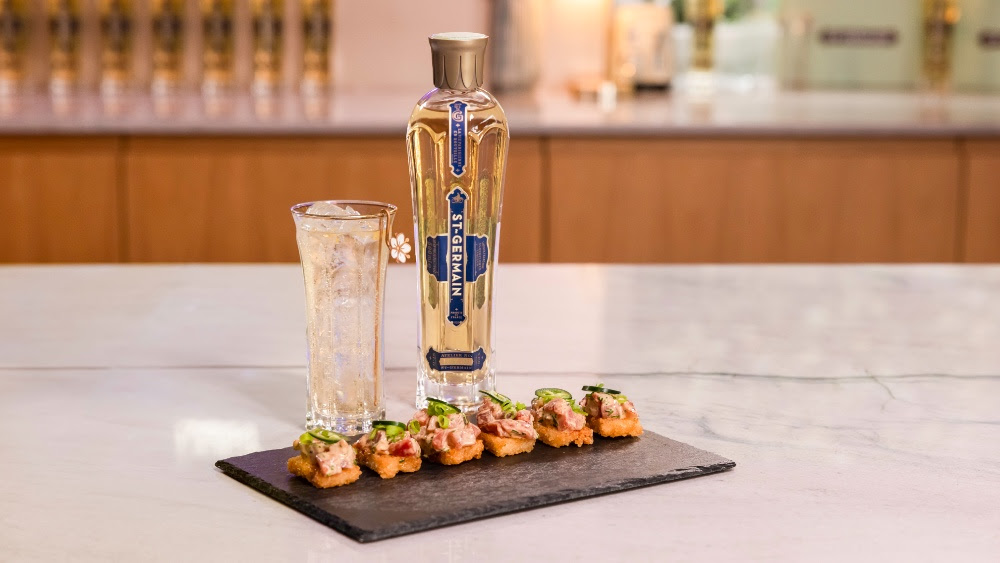
The official recipe for St-Germain Spritz is deliberately simple: two parts brut sparkling wine, one-and-a-half parts St-Germain, two parts very cold sparkling water, a tall glass filled with ice, a squeeze of lemon. This construction – acid, bubbles, floral, dilution – allows none of the four elements to dominate. That’s why the recipe works. Altering the proportions in either direction noticeably shifts the balance: more St-Germain, and the liqueur’s residual sugar begins to cover the acidity; less, and the sparkling wine takes center stage again without the floral signature having had time to express itself.
The choice of sparkling wine is also a decision of style. A very brut crémant holds up better than a lightly dosed prosecco. A non-dosed or extra-brut champagne gives a tauter, more upright version – best reserved for a precise aperitif service rather than a casual terrace. For everyday use, a dry sparkling wine with fine bubbles remains the most legible medium.
Three ways to work the floral
The classic sparkling wine version is the easiest to serve. It’s ideal for a group aperitif, can be prepared in advance, and requires no special bar technique. The gesture is minimal: first pour sparkling liquid over ice, then St-Germain, then sparkling water, finishing with zest. Preserve the bubbles by avoiding unnecessary remixing.
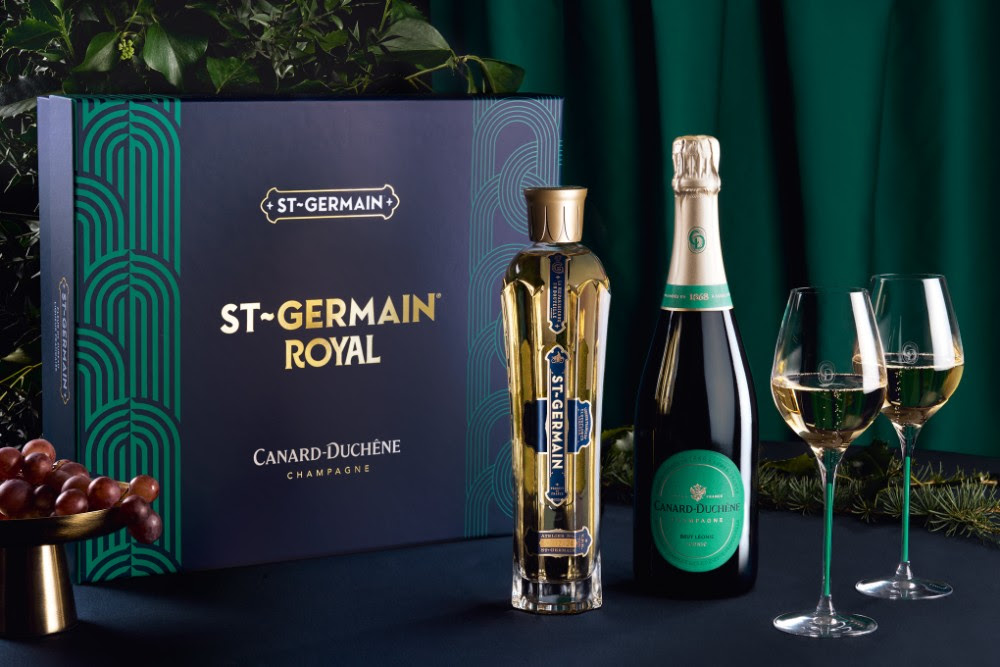
The champagne version is an elevation of the same principle. It works in a more formal context – an opening dinner, an ephemeral bar, an inaugural cocktail party – where the raw material justifies the precision of the service. The use of champagne here is not statutory; it’s technical: champagne’s higher acidity and finer foam give the liqueur clearer support.
The dry gin version is the most structured of the three. London-style gin or discreet botanical gin, St-Germain, sparkling water, sliced cucumber, basil or mint depending on the season. The liqueur no longer plays the role of base but of accent – rounding out the gin’s angularity without erasing its botanical profile. This is a long, late-afternoon drink, more than a pre-dinner aperitif. It calls for a tall glass, plenty of ice, and a sober garnish: a basil leaf or two cucumber slices, not both.
The grammar of light luxury
There’s a way of thinking of the cocktail as an object of light culture – not just as a recipe. The choice of glass, the quality of the ice, the serving temperature, the season, the light, the table: all these constitute the framework in which the cocktail makes sense or loses it.
St-Germain, the French liqueur with a thousand elderflowers, documents this genesis: a liqueur originally designed for the most discerning Parisian bars, whose international distribution has not altered its production profile. This consistency between origin and use is what allows it to be treated as a serious ingredient rather than a sweet convenience.
A successful St-Germain aperitif can’t be improvised in a hurry. It requires clear ice cubes, cold rather than lukewarm sparkling water, and a clean glass wide enough for the lemon zest to do its aromatic work. These are modest constraints. They make all the difference between a glass you put down after two sips and one you finish without a second thought.
This is perhaps the most sober definition of a quality aperitif: it doesn’t hold the attention. It prepares the palate for something else.
Cette publication est également disponible en :

