
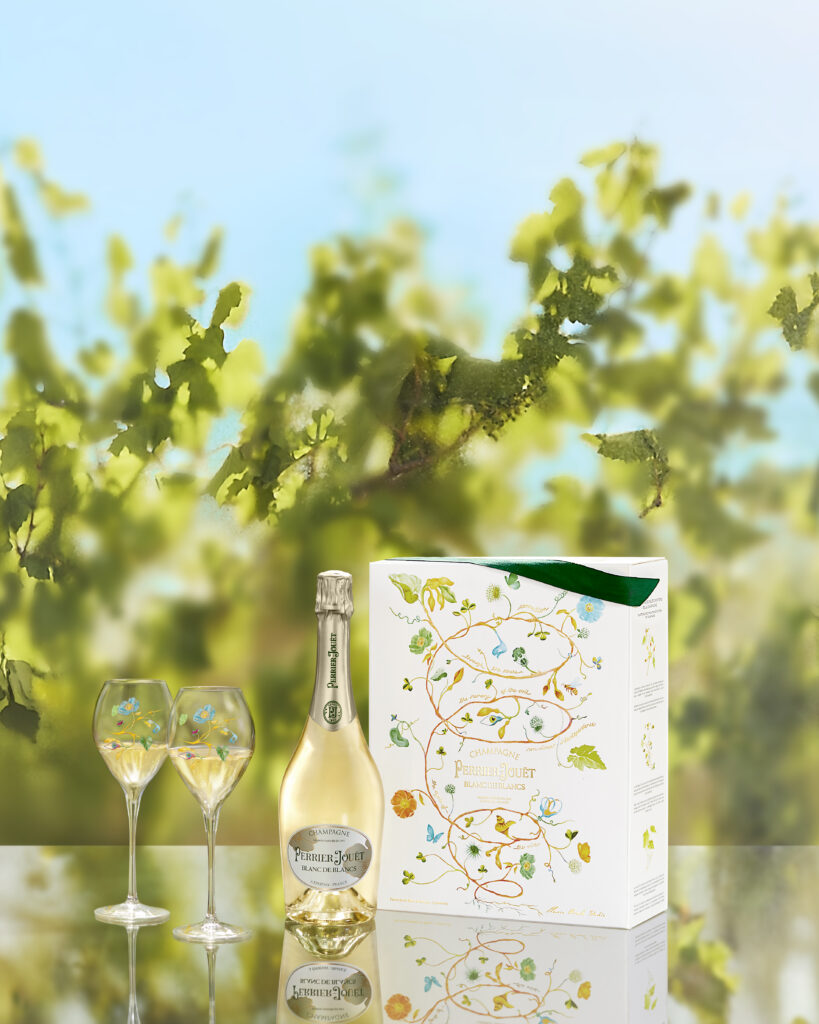
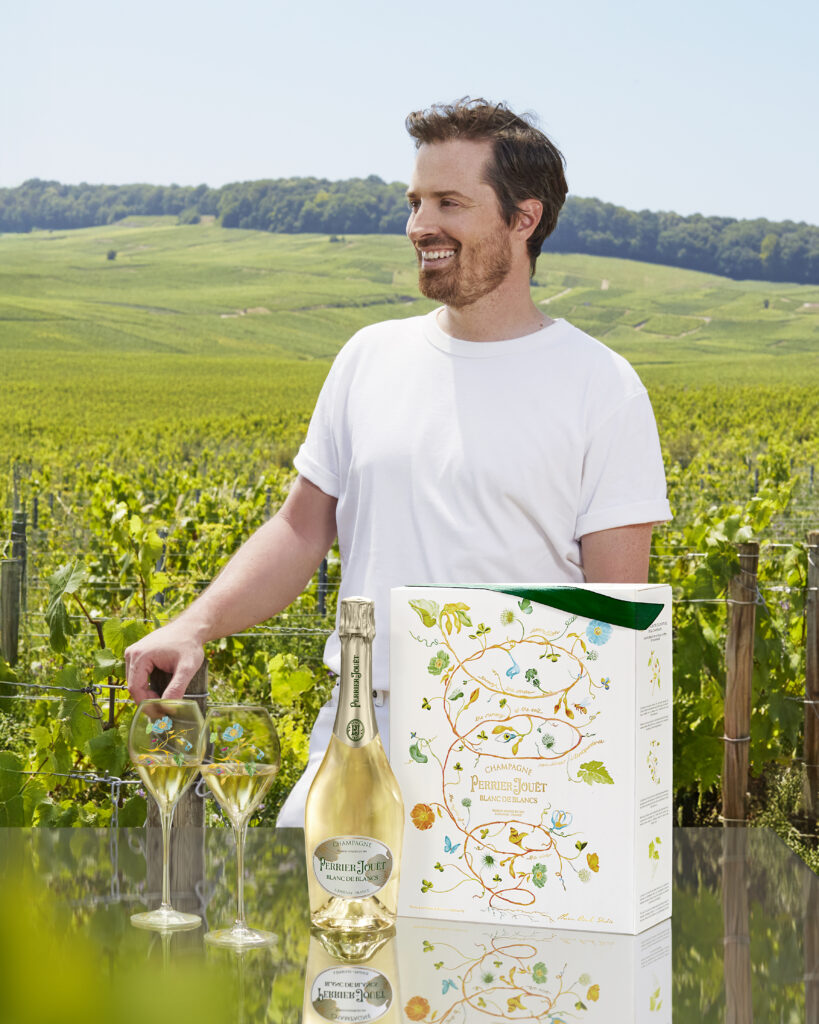
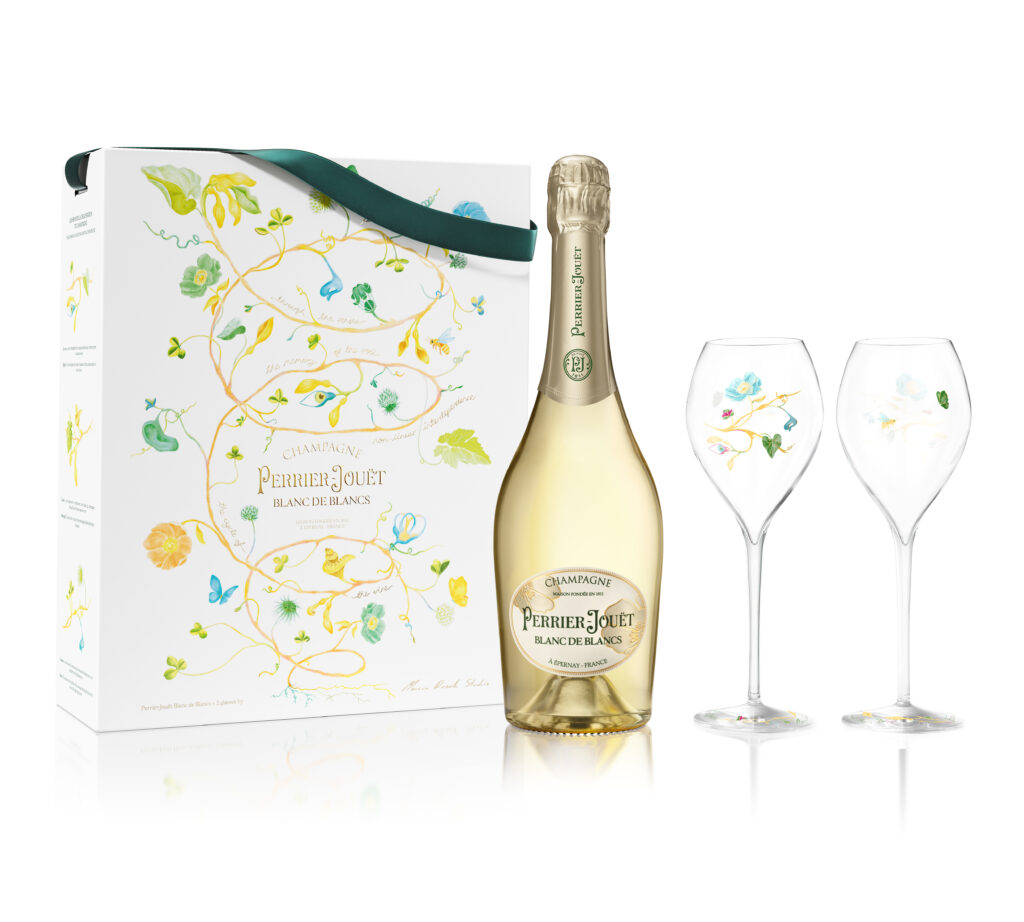
Wine is no longer just something to taste. It becomes a territory to be represented. With this edition of Perrier-Jouët Blanc de Blancs, the House of Perrier-Jouët entrusts Marcin Rusak with the most visible surface of its identity – the bottle – to inscribe a reading of the living.
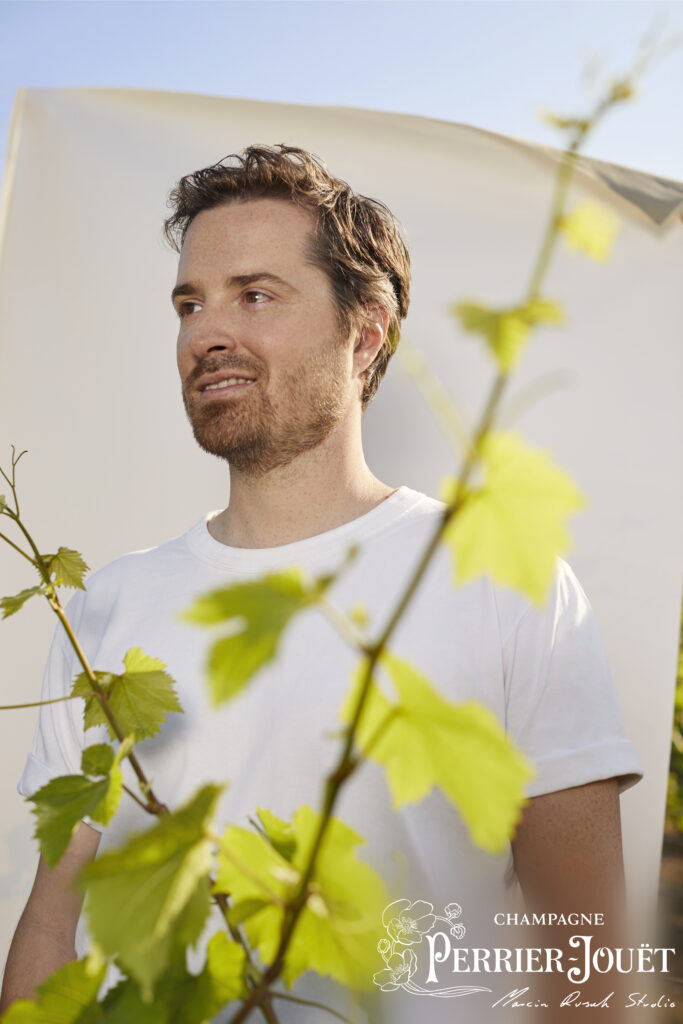
Rusak is not an illustrator in the strict sense. Trained at the Design Academy Eindhoven and then at the Royal College of Art, he has for several years been developing his work on organic materials, where botanical residues become structure. Here, he returns to a flatter form: a drawing inspired by the herbarium, composed of a trio of plants found in the Champagne vineyards.
The choice is not decorative. The plants represented are not isolated but intertwined, following a logic of interdependence. This composition reflects an agronomic principle: the vine is not an autonomous system, but a balance between species, soils and micro-organisms. The bottle thus becomes an almost didactic diagram of the Champagne ecosystem.
This reading ties in with the experiments conducted by Perrier-Jouët since 2021 on twenty-eight hectares of vineyards, where regenerative viticulture practices aimed at restoring soil structure and biodiversity are being tested. The graphic object acts as a visual extension of an ongoing agricultural transformation.
The choice of medium is not neutral. Blanc de Blancs, created in 2017, is based exclusively on Chardonnay, the grape variety central to the identity of the House founded in 1811. A grape that, in this context, becomes almost a medium: a vector for a style, but also for a discourse on the territory.
Detail
Grape variety: Chardonnay
Aromatic profile: peony, honeysuckle, citrus (lemon, grapefruit), white pear
Structure: lively attack, marked minerality, round finish
Visual expression: golden colour with green highlights, fine bubbles
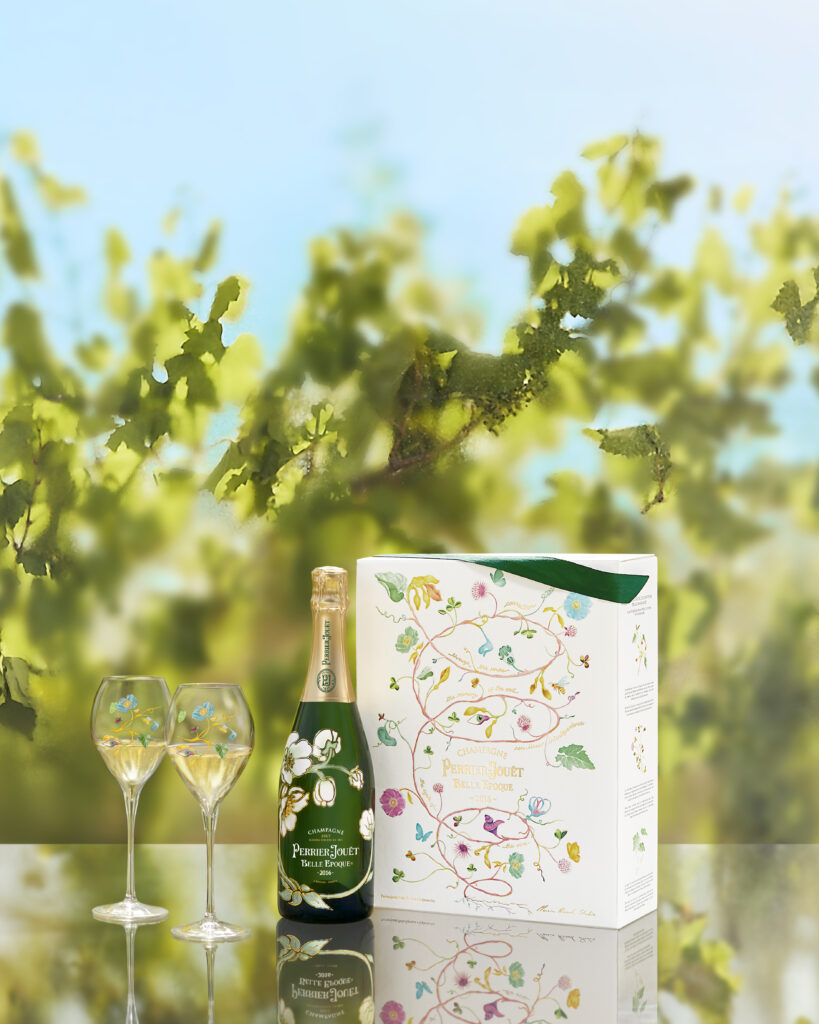
The coherence with the House’s Art Nouveau heritage is tangible. Ever since Émile Gallé, whose Japanese anemone adorns Perrier-Jouët bottles, nature has been not just a motif but a formal vocabulary. Rusak continues this tradition, but shifts it from decoration to system.
This displacement is perhaps the most contemporary aspect of this piece. Where Art Nouveau stylized the plant, Rusak recontextualizes it. Where decoration isolated the flower, he restores the network. The eye leaves aesthetics for ecology.
This could be seen as a broader evolution of winegrowing luxury. It’s less about scarcity than about the ability to produce meaning – technical, agricultural, cultural. The bottle ceases to be a container and becomes a surface for reflection.
An open question remains: how far can these objects translate, without simplifying, the complexity of the living things they claim to represent?
Cette publication est également disponible en :

