
There was a time when infertility was diagnosed late, often after years of waiting. It has now entered a new phase: one of anticipation, sequencing, and prediction. Reproductive medicine is no longer content merely to help couples conceive. It is beginning to identify, in advance, the biological vulnerabilities of a lineage.
In 1978, the birth of Louise Joy Brown—the first child conceived through in vitro fertilization—was enough to push the boundaries of what was possible. Nearly half a century later, that boundary no longer lies solely between natural conception and assisted reproduction. It now lies between treatment and selection, between medical prevention and the desire for optimization, between caring for life and the temptation to rewrite its next chapter.
This shift is subtle but significant. In vitro fertilization is no longer just a laboratory technique. It is becoming a decision-making arena where embryologists, geneticists, clinical decision-support software, parents, governments, cultures, and markets all intersect.
Diagnosis Before Loss
The first major shift is due to genetics. Twenty years ago, sequencing a human genome was a decade-long scientific endeavor costing $3 billion. Today, the process can be completed in a week for less than 1,000 euros or dollars. This change in scale has opened up a new field: understanding the specific causes of certain types of infertility rather than treating them as a single, indistinct category.
Primary ovarian insufficiency, which involves a loss of ovarian function in approximately 4% of women under the age of 40, illustrates this shift. About 100 genes involved in ovarian insufficiency or diminished ovarian reserve have been identified in recent years. In a large international cohort, a genetic cause was identified in 30% of patients whose infertility had previously been of unknown origin.
What matters here is not just the number, but the architecture. These genes are primarily organized around three major mechanisms: DNA repair, follicular growth, and ovarian energy metabolism. However, when DNA repair is involved, the scope extends beyond fertility. Some of these genes are also linked to a predisposition to cancer. Reproductive counseling thus has the potential to serve as a gateway to a broader field of preventive medicine.
The timing of care is changing. It is no longer just a matter of intervening when fertility has already been compromised, but of identifying vulnerable trajectories, offering egg preservation, or referring patients for appropriate monitoring. Reproduction is no longer an isolated event; it has become a long-term biological process.
The lab teaches students how to choose
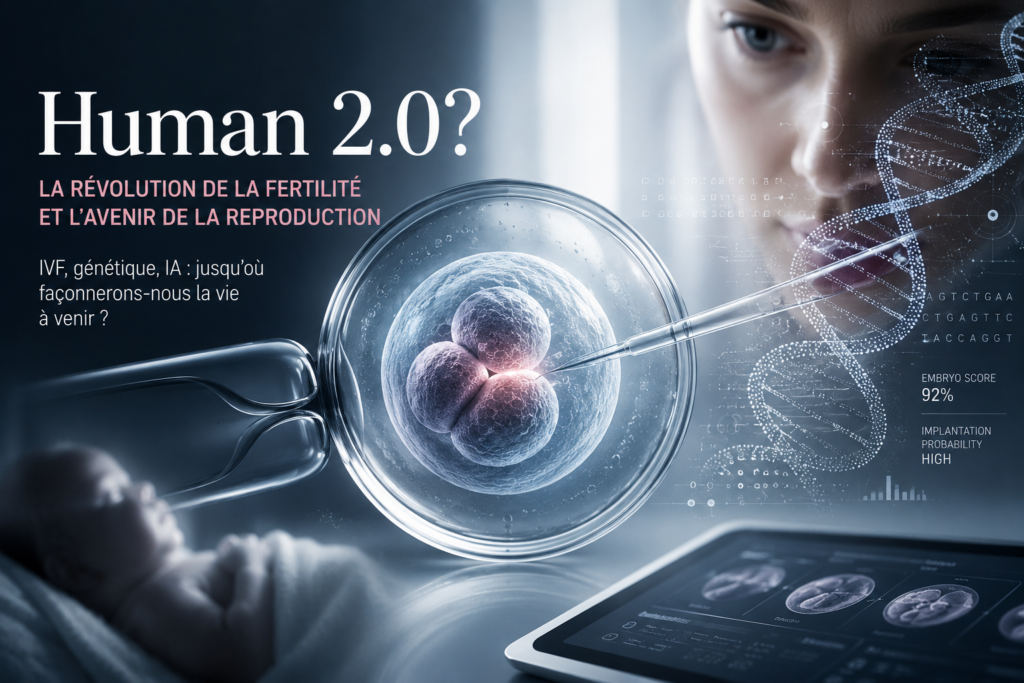
In the in vitro fertilization process, artificial intelligence is first being applied where data is abundant: images, videos, movements, and morphologies. Sperm selection, oocyte observation, and embryo development monitoring: the laboratory already generates visual data that computer models can analyze.
In a procedure such as ICSI, a sperm cell is injected directly into an egg, and the resulting embryo is cultured before being transferred to the uterus. Each step involves a series of decisions. Which gamete should be selected? Which embryo appears to have the greatest potential? Which medication regimen is best suited for a given patient?
AI does not yet replace medical judgment. It complements it. It categorizes, compares, flags, and predicts. Clinical decision-support systems are emerging to analyze data from previous fertility cycles. Their promise is less dramatic than one might imagine: reducing uncertainty, tailoring treatments more effectively, improving outcomes, and avoiding unnecessary cycles.
But the more the decision-making process is assisted, the more complex the responsibility becomes. If a model recommends one embryo over another, who makes the final decision? The doctor, the software, the clinic, the algorithm’s designer, or the parents? Reproductive medicine is becoming a testing ground for a question that will cut across the entire field of AI-assisted medicine: at what point does assistance become influence?
Details
When it comes to female infertility, research has now identified approximately 100 genes involved in certain forms of ovarian insufficiency or diminished ovarian reserve. These genes do not point to a single cause, but rather to several distinct biological mechanisms. It is precisely this distinction that paves the way for targeted treatments, following the model of what has happened in oncology.
The Temptation of the Best Embryo
The ethical boundary emerges when reproductive medicine moves beyond the realm of serious illness and approaches the selection of traits. Preimplantation diagnosis for severe conditions, such as Huntington’s disease or Tay-Sachs disease, follows a clear medical rationale: to prevent a devastating condition. But what should we do when we’re talking about predisposition, probability, polygenic scores, height, supposed intelligence, gender preference, or physical characteristics?
History calls for caution here. Techniques change, but certain old ideas have a way of resurfacing in more palatable forms. The ambition to be “better” born can quickly become conflated with the desire to select which lives are acceptable. The risk is not merely theoretical. Cultural norms, parental desires, public policies, and technical possibilities can reinforce one another.
A demographic example illustrates this with stark clarity: in South Korea in 1990, the ratio of third births was 193 boys to 100 girls, well above the natural ratio of approximately 105 boys to 100 girls. This was not a state policy comparable to China’s one-child policy, but rather a combination of cultural preference and access to fetal sex determination. When the ban on sex determination was enacted in 1994, the ratio began to normalize.
The lesson is clear: technology never makes decisions on its own. It amplifies what a society tolerates, desires, or refuses to acknowledge.
A revolution reserved for those who can travel
Assisted reproduction is also subject to geographical disparities. Regulations vary from country to country, as does infrastructure. Some patients and couples travel because their home country lacks the necessary facilities. Others travel because the legal framework in other countries allows what is prohibited in their own.
This form of reproductive tourism already exists. At some clinics, international patients account for a significant portion of business. The reason for seeking treatment is not always problematic: seeking better care when it is not available locally is a genuine medical need. But when traveling is used to circumvent ethical safeguards, the issue becomes more complicated.
This will be a decisive factor in the coming years. Advances are no longer limited to IVF. In vitro gametogenesis—the process of producing reproductive cells from reprogrammed cells—has already led to the birth of healthy baby mice. In humans, research is not yet ready for safe clinical application, but some researchers believe the technology could become available within the next decade.
Such a prospect turns everything upside down. It could offer people who are currently excluded from biological parenthood the possibility of having children. It could also create a global market for medically assisted reproduction that is legally fragmented and socially unequal.
Care alone is no longer enough
Perhaps the most pressing issue isn’t that of “enhanced” babies. It’s simpler, more medical, and almost less visible: why does reproductive medicine still have so few truly targeted treatments?
Infertility is not a single disease. It is a syndrome with multiple causes. Yet in many cases, the treatment remains largely standardized: hormonal stimulation, attempts to promote follicular growth, and in vitro fertilization. As the genetic causes become better understood, this one-size-fits-all approach appears inadequate.
The approach of targeted therapies is therefore becoming central. If an abnormality affects follicular growth, certain already-approved medications could be reevaluated. If DNA repair is the issue, antioxidant approaches such as resveratrol are being studied for their ability to support certain ovarian mechanisms. Organoids—mini-organs grown in the laboratory—already make it possible to test hormonal, toxic, or follicular mechanisms with unprecedented precision.
The future of reproduction will therefore not be solely algorithmic. It will also be biological, pharmacological, regulatory, and political. AI will be able to classify embryos, but it alone will not answer the fundamental question: What do we want to correct, what do we want to prevent, and what do we refuse to select?
Increased fertility calls for a rare form of collective maturity. It requires balancing the hopes of couples, the rigor of doctors, the caution of researchers, and the memory of past missteps. Conceiving a child has always been an act of looking toward the future. Nowadays, that future is sometimes chosen in a culture dish, in front of a screen, based on a score.
It remains to be seen whether our societies will be able to turn this precision into a form of compassionate medicine, or whether they will succumb to the age-old temptation to confuse progress with selection.
Cette publication est également disponible en :

