
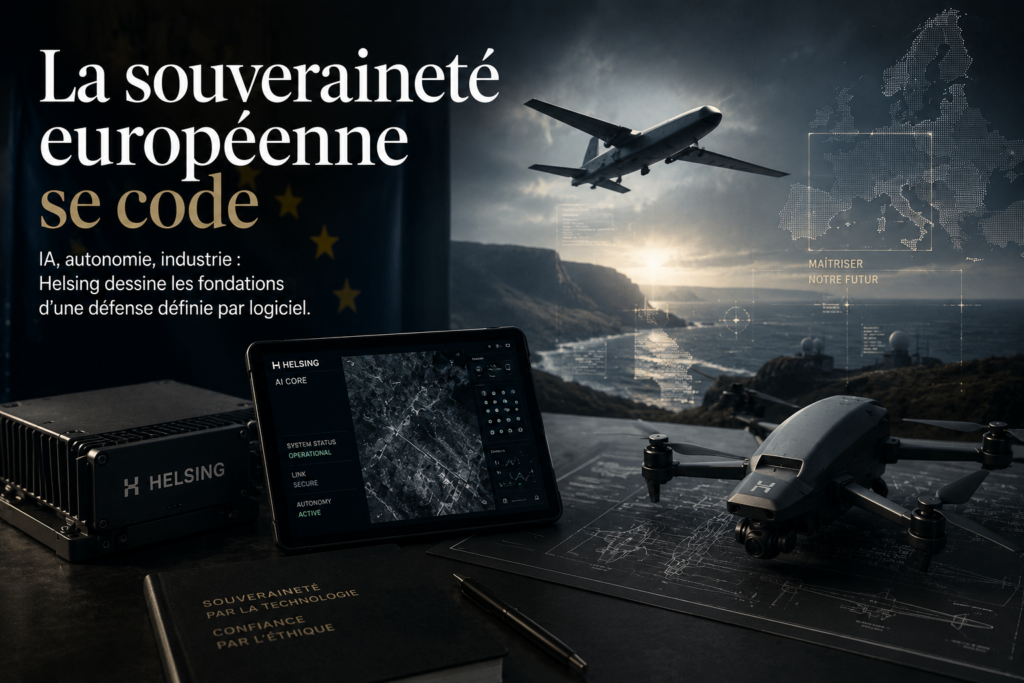
At VivaTech, Helsing reiterated a truth that is rarely stated so directly: Europe’s strategic autonomy will not be determined solely by treaties, budgets, or military doctrines. It will be determined by the ability to build, starting today, companies capable of translating AI into industrial power.
There are words that Europe likes to use with solemnity. Sovereignty. Autonomy. Resilience. For a long time, they were part of the vocabulary of summits, press releases, and doctrines. But on a stage at VivaTech, the word took on a new substance. It was no longer abstract. It had the weight of a drone, the fragility of a sensor, the density of a model trained on hard-to-obtain data.
European defense, long conceived in terms of steel, heavy platforms, and long industrial cycles, is entering a new era. Not one in which hardware disappears, but one in which hardware is no longer worth much without the software layer that makes it readable, adaptable, and autonomous. Tanks, aircraft, and ships are no longer enough to define power. The question becomes a more uncomfortable one: Who possesses the digital grammar that makes them function?
Helsing, founded in 2021, was built precisely to address this gap. The European company, with a presence in Germany, France, and the United Kingdom, works on AI systems applied to defense, onboard capabilities, drones, and architectures capable of operating in jammed, unstable, and hostile environments. Its vocabulary is straightforward: autonomy and scale. Two words that capture the shift currently underway.
The war in Ukraine has brought to light what many Western institutions still viewed as marginal. Low-cost systems, produced quickly and controlled or enhanced by software, can shift the balance of power. But the key point isn’t just the drone itself. It’s the ecosystem that makes it useful: data, production, operator training, the speed at which militaries adapt, and the ability to test, deploy, correct, and start over.
Europe knows how to produce. It knows how to certify. It knows how to build for the long term. But it has a harder time iterating quickly when it comes to critical sovereignty. That is where the tension becomes strategic. A software-defined defense capability cannot be purchased like a piece of conventional equipment. It requires ongoing dialogue among engineers, manufacturers, the military, investors, and governments. It demands that Europe bridge two timeframes that it has long kept separate: that of public policy and that of technology.
Antoine Bordes’ career path embodies this shift. A former research director in artificial intelligence at Meta, who previously worked at FAIR and was involved in the LLaMA project, he joined Helsing in 2023 to lead the group’s artificial intelligence efforts. The move is symbolic. It signals a return of European talent to projects that are more independent but also carry greater moral weight. One does not leave basic research or major American laboratories to apply AI to defense without facing questions of responsibility.
This is probably the crux of the matter. European technological sovereignty cannot be limited to a preference for buying locally. It must be an architectural doctrine. Where is the data? On what infrastructure do the models run? Who audits the decisions? How can we keep humans in the loop as systems become faster, more distributed, and more autonomous? At what point does assistance become delegation?
The partnership announced in 2025 between Helsing and Mistral AI sheds light on this new equation. It is not merely a matter of bringing together a young defense company and a European leader in language models. It is about integrating generative AI, vision, action, and physical systems. So-called Vision-Language-Action models hold a specific promise: to enable platforms to understand an environment, interact with an operator, and then assist in decision-making in situations where time is of the essence.
The Detail
In physical AI systems, data cannot be easily transferred from one platform to another. Data collected by a generic drone is not sufficient to effectively train another system designed differently. Sovereignty therefore depends not only on the model, but on the ability to produce one’s own platforms, test them on a large scale, and then establish a proprietary feedback loop between usage, data, and improvement.
This logic goes beyond defense. It affects the entire European industrial sector. ASML, Airbus, Siemens, German equipment manufacturers, precision engineering firms, and companies in the aerospace, energy, and robotics sectors possess assets that general-purpose platforms cannot replicate: sensitive industrial data, engineering know-how, physical constraints, certification chains, and a culture of security. Europe may not have won the first battle over digital platforms, but it can still make its mark in the battle over AI-enhanced physical systems.
But this requires letting go of an old habit: fragmentation. Every European country readily dreams of its own national champion, its own cloud, its own model, and its own doctrine. Yet critical capabilities can no longer be funded at the level of a single domestic market. European sovereignty requires a concentration of capital, public procurement, and trust. Otherwise, Europe will continue to buy American out of habit, Chinese for cost reasons, and European for the sake of rhetoric.
The question, then, is not whether Europe should develop defense AI. It already is. The real question is whether it is willing to make it a mature policy priority—that is, one that is funded, regulated, and fully embraced. The moral unease surrounding defense technology is understandable. It is even necessary. But it becomes dangerous when it serves as an excuse for inaction. Autonomous systems will not disappear simply because Europe views them with caution. They will simply be designed elsewhere, according to different values, different frameworks, and different interests.
In this new geography of power, trust becomes a form of infrastructure. It determines capital, recruitment, adoption by governments, and social acceptability. AI spreads at the speed of trust, not at the speed of demonstrations. For Europe, this means that sovereignty will not be won through slogans or industrial nostalgia. It will be won through verifiable architectures, companies capable of producing, governments capable of purchasing quickly, and an ethic robust enough not to slow down out of fear, but to guide through high standards.
The luxury industry understands this tension better than it might seem. A fashion house never entrusts its craftsmanship to a machine without imposing a set of rules on it. Europe will have to do the same with AI. It must not adopt it as is. It must not import it as a standard commodity. It must shape it according to its own constraints, uses, limits, and values.
Sovereignty, from now on, is no longer just a border. It is a way of thinking.
Cette publication est également disponible en :

