
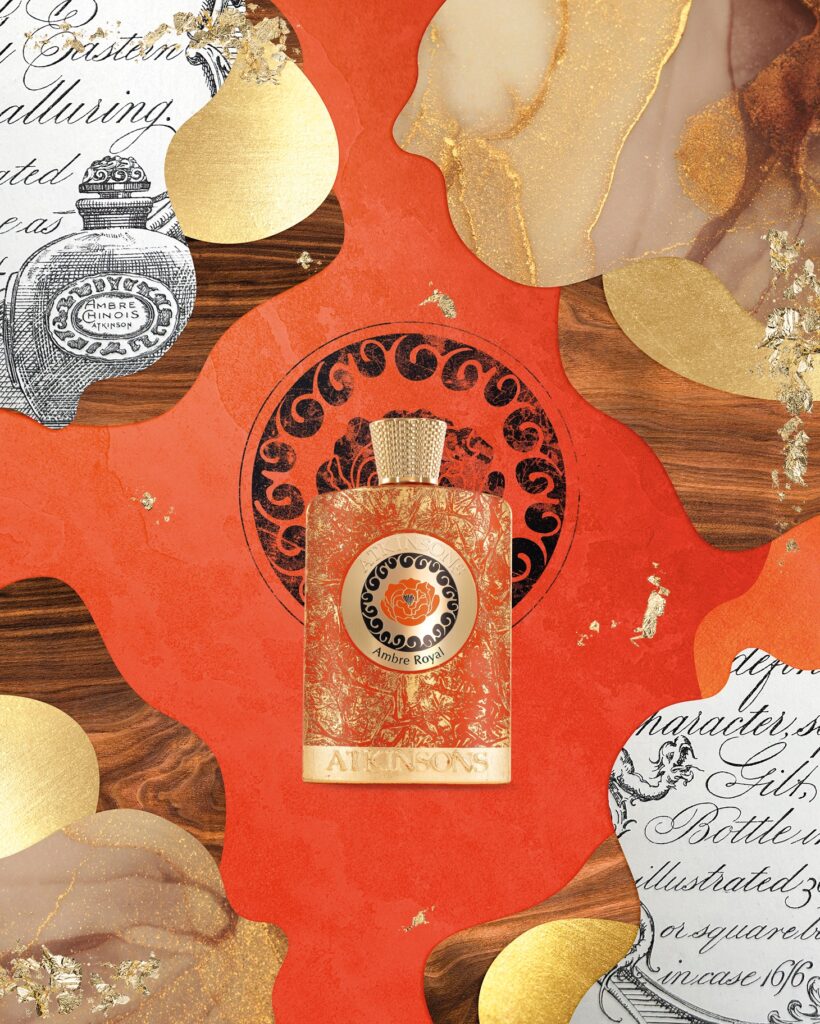
Some fragrances seek to evoke a particular era. Others prefer to trace the thread of a tangible memory. With Ambre Royal, Maison Atkinsons London 1799 does not merely draw on a familiar olfactory family from contemporary perfumery; it reopens a chapter that began in 1927, centered on a small, carved amber handbag-sized bottle from ancient Imperial China. The object, through both its material and its use, had inspired Ambre Chinois, presented as one of the first oriental fragrances introduced to the Western world. Two years later, in 1929, this initial interpretation gave rise to an “Essence Edition.” Today, Ambre Royal revisits this legacy—not as a literal homage, but as a richer variation centered on an amber accord.
The fragrance was created by Maurice Roucel, a perfumer whose signature style is often characterized by a structured sensuality that is never purely decorative. Here, the composition unfolds in three movements. The first combines ylang-ylang with magnolia in a floral register that sets the stage for amber without making it immediately opaque. The second brings the focus into sharp relief: Ambre De Laire 84, cistus labdanum, incense, Ambrostar, caramel, and natural woods. The third establishes a base of Madagascan vetiver and sandalwood, with a leathery, smoky nuance. The House classifies Ambre Royal within the Floramber Woody family, a contemporary term used to describe a floral, amber, and woody composition.
The most interesting detail is not amber as a concept, but the use of Ambre De Laire 84. De Laire bases are part of the technical history of modern perfumery: that of prepared compositions, blending natural materials and aromatic molecules, which have allowed perfumers to stabilize, amplify, or stylize certain olfactory effects. Symrise specifically highlights the seminal role of De Laire bases in 20th-century perfumery, particularly in amber accords. Ambre Royal thus traces its lineage to two sources: a sculpted amber bottle that became a source of inspiration, and the science of perfumery, which has profoundly transformed the way warmth, roundness, and the longevity of a scent are crafted.
In perfumery, amber is rarely a single ingredient. It is most often an effect: resin, balm, vanillin, labdanum, wood, sometimes incense, sometimes leather. What matters here is the tension between the ancient object and the contemporary formulation. Atkinsons does not merely reproduce an idea of the Orient as it was conceived in the 1920s; the House reworks it using today’s tools, at a time when perfumery is eagerly rediscovering historical foundations, archival ingredients, and less transparent signatures. Amber is no longer merely a vocabulary of warmth. It becomes a language of memory.
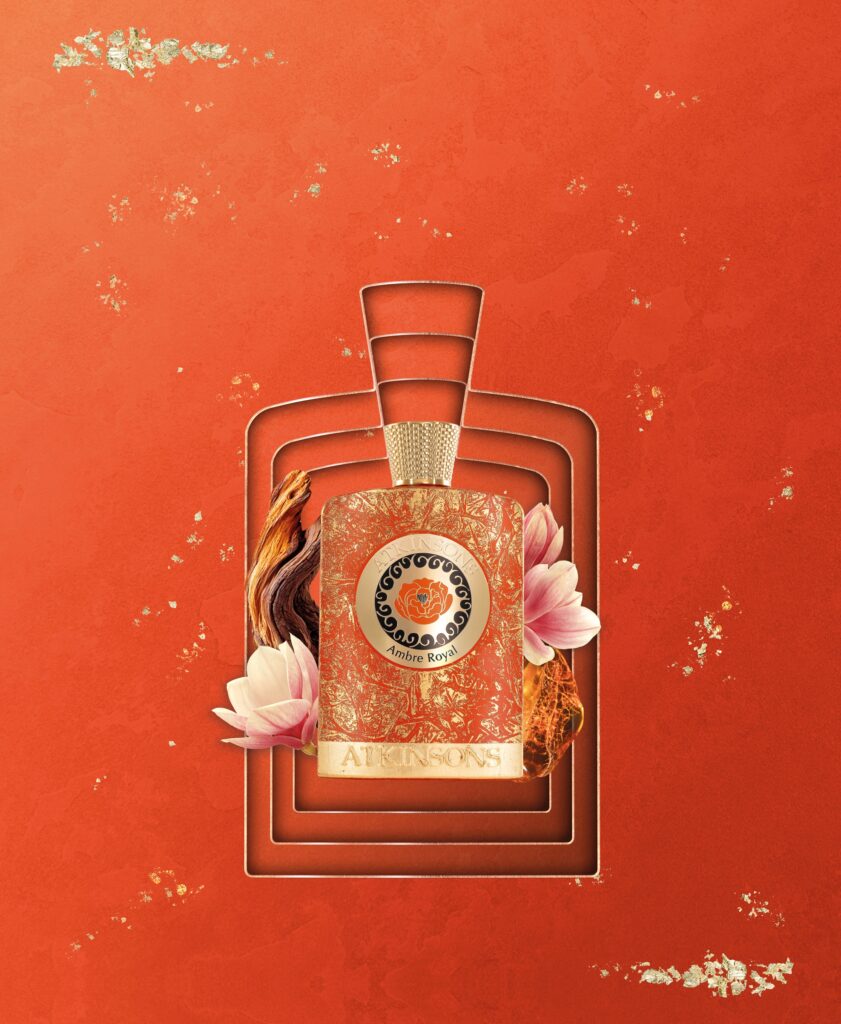
The bottle extends this material interpretation. It is hand-painted in Florence in a satin-finish orange hue, then adorned with gold leaf. The box echoes the idea of the lacquered medallion, a motif that engages with the original Chinese object without reducing it to a mere illustration. This choice is no accident: in a market saturated with fast-paced fragrance launches, the container once again becomes the vehicle for an artisanal narrative. It is not merely an afterthought, but a way of making visible the long process that precedes the fragrance.
Ambre Royal thus seems more meaningful when viewed as part of a continuum rather than as a seasonal novelty. The fragrance looks back to 1927, references 1929, draws on a foundation rooted in the technical history of perfumery, and entrusts its formulation to Maurice Roucel. It does not seek to break with tradition. Rather, it focuses on longevity: that of a material, a fragrance accord, and a London-based House that continues to treat “elsewhere” not as exoticism, but as an archive to be reinterpreted.
Cette publication est également disponible en :

