
On stage at VivaTech on June 19, L’Oréal’s chief innovation officer reiterated a rule that’s been around for five years: never show an AI-generated beauty face to the consumer. Standing beside her, two executives from the soft drink and consulting industries argued the opposite—that growth is fueled by what artificial intelligence and the public create together.
A boundary established in 2021
The panel featured Nigel Vaz, CEO of Publicis Sapient; Drew Panayiotou, Director of Marketing and Innovation at Keurig Dr Pepper; and Delphine Viguier-Hovasse, Director of Innovation and Foresight at L’Oréal. The moderator, Ana Rold of Diplomatic Courier, asked them a simple question: How can we balance speed and authenticity when artificial intelligence is accelerating everything?
Viguier-Hovasse responded by citing two of the six or seven principles established in 2021 by L’Oréal’s Artificial Intelligence Ethics Committee. The first: every major decision—a formula, a campaign, or content—is ultimately made by a human. The second, more unexpected principle: no representation of beauty is ever produced using a computer-generated image. A real woman, photographed by a real photographer, holds a real object. This rule applies in every country where L’Oréal publishes content, including for even the most minor visuals.
What Artificial Intelligence Is Allowed to Do
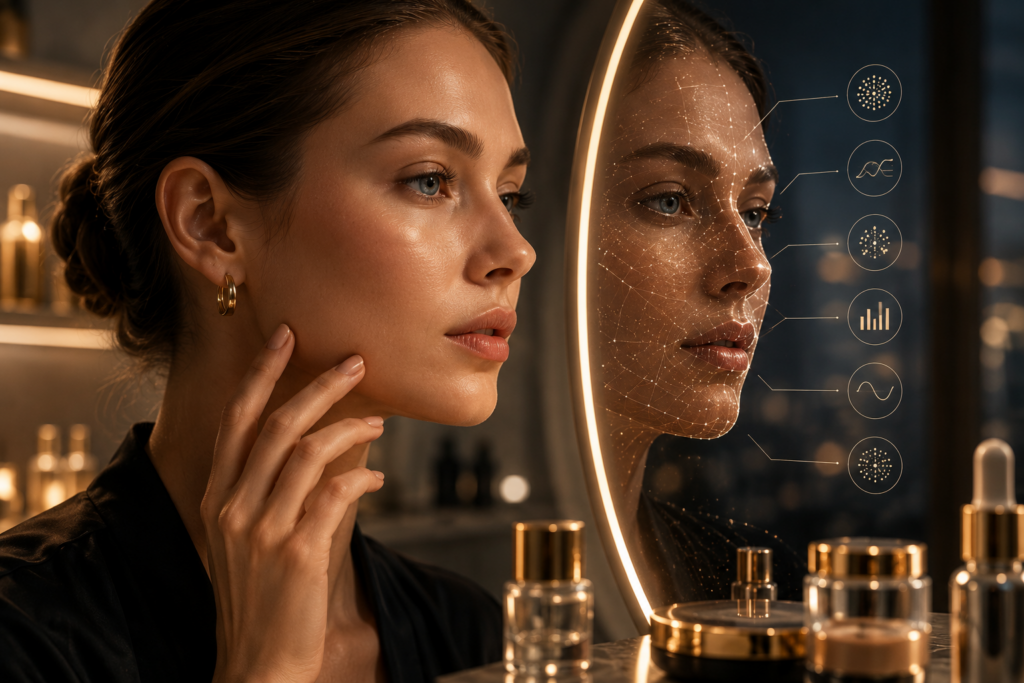
Elsewhere, artificial intelligence is working full steam ahead. L’Oréal aggregates its clinical trial data and internal correspondence from chemists into a single database to delve deeper into formulation questions—such as which sunscreen is most water-resistant or which one resonates best with a given market. Beauty Genius, the group’s conversational assistant, identifies wrinkles or imperfections to recommend a skincare routine, but never alters the user’s face: it advises, it does not design. A digital twin of a strand of hair simulates thirty years of hair coloring and sun exposure to predict a product’s performance before it is developed.
The pattern is consistent: artificial intelligence enhances analysis and prediction, but never the image of the body presented to the world.
The Detail — According to Delphine Viguier-Hovasse, AI-assisted testing has enabled L’Oréal’s teams to evaluate, in six months, a volume of candidate molecules that would previously have required twenty years of sequential laboratory work. She emphasizes that this is about depth rather than speed.
Alongside this, another economy of the image
Drew Panayiotou describes a reverse trend. Dr Pepper, the most active food and beverage brand on TikTok in the United States, owes its second-place ranking among American sodas—behind Coca-Cola and PepsiCo, which invest eight times as much in advertising—less to the scale of its campaigns than to how customers have embraced its product. The “dirty soda” and the coconut-Dr Pepper mix, both invented on social media, then make their way back into the innovation pipeline via each brand’s proprietary artificial intelligence agents, which are capable of simulating a market reaction in a matter of minutes rather than several months.
Nigel Vaz, for his part, cites a startling figure: only 10 percent of companies consider artificial intelligence central to their operations, even though 73 percent already use it on a daily basis. The gap, he says, isn’t due to the technology itself but to the willingness—or lack thereof—to reorganize the company around it.
Two Uses of the Word “Image”
While L’Oréal maintains a fixed boundary around the depicted face, the soda ad and the advice piece treat the image—and the data it generates—as raw material that the public is invited to reshape for itself. Neither approach is wrong: each aligns with what the company is selling. A beauty brand sells the confidence a face inspires; a beverage sells engagement with a news feed.
Viguier-Hovasse, in fact, prefers to speak of “augmented intelligence” rather than “artificial intelligence”—a choice of vocabulary that maintains the boundary by simply naming it differently. But Panayiotou points out, backed by statistics, that a Gen Z customer switches drinks nearly seven times a month. It remains to be seen whether a rule established in 2021 based on a photographed face will withstand a pace of desire that the very tool meant to protect it is, in other ways, helping to accelerate.
Cette publication est également disponible en :

