
A few months after earning his second Michelin star, Rémi Chambard unveils the first menu of this new chapter at Le Corot restaurant, at the Étangs de Corot, in Ville-d’Avray. It carries neither poetic titles nor technical descriptions: each dish takes the name of a commune in Île-de-France.
A Map of Geography More Than a Menu of Dishes
Versailles, Montmorency, Saâcy-sur-Marne, Thoiry, Sèvres: the names that make up Rémi Chambard’s menu trace less a menu than a territory. Each commune invoked points to a specific producer, an encounter, a season, or a landscape that nourished the dish bearing its name. The chef thus builds what he presents as a gastronomic stroll at the heart of a ‘countryside Paris’ — a way of recalling that the Paris region, beyond the ring road, remains a fully-fledged agricultural territory.
This choice of geographic rather than descriptive titles shifts the diner’s gaze: instead of wondering what a dish contains, one is invited to wonder where it comes from. The menu functions as a signature of provenance, dish after dish, rather than as a simple list of compositions.
Starred Gastronomy as a Relay for Local Proximity
Through this menu, Rémi Chambard asserts a conviction that runs against a stubborn received idea: the one holding that great cuisine must necessarily feed on products from far away, rare because distant. The chef chooses the opposite, highlighting the market gardeners, foragers, fishermen, and artisans of the Île-de-France region who feed his work every day. His second Michelin star, earned a few months earlier, has therefore not distanced him from his local roots; it seems, on the contrary, to have confirmed him in this choice.
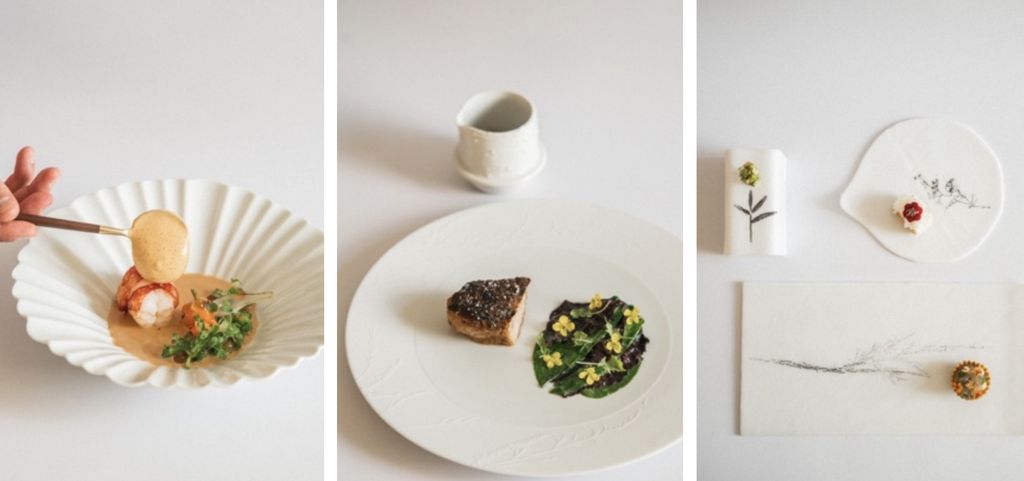
Les Étangs de Corot, a Setting That Bears His Name
Le Corot restaurant occupies a setting that is far from incidental to this approach: the Étangs de Corot, in Ville-d’Avray, that landscape of water and light which inspired painter Camille Corot to create some of his best-known canvases. The place has long maintained a bond between landscape heritage and gastronomy, and the chef’s new menu extends this continuity — that of a cuisine which looks out the window before looking into recipe books.
By linking each plate to an identifiable place in the region, Rémi Chambard implicitly invites his guests to an exercise in gourmet geography: to recognize, in the name of a dish, that of a village they may have already passed through without knowing that it fed, somewhere, one of Île-de-France’s most demanding tables.
Cette publication est également disponible en :


