
Seven watches, none for sale. For a private commission for OpenAI, Vanguart turns its Orb Flying Tourbillon into a medium for a language rarely inscribed in haute horlogerie: Python code, the vocabulary of scaling, and a formula attributed to Sam Altman. The project’s interest lies less in the logo than in the way a thirty-three-person Manufacture devoted nearly a third of its team to translating a technology culture into a mechanical object of three hundred ninety-five components.
The series was commissioned by Sam Altman and produced in seven numbered pieces, each intended for a selected OpenAI member. It is not sold commercially. The base remains the Orb, a model launched in 2024 after three years of development by Vanguart, an independent Manufacture based in La Chaux-de-Fonds.
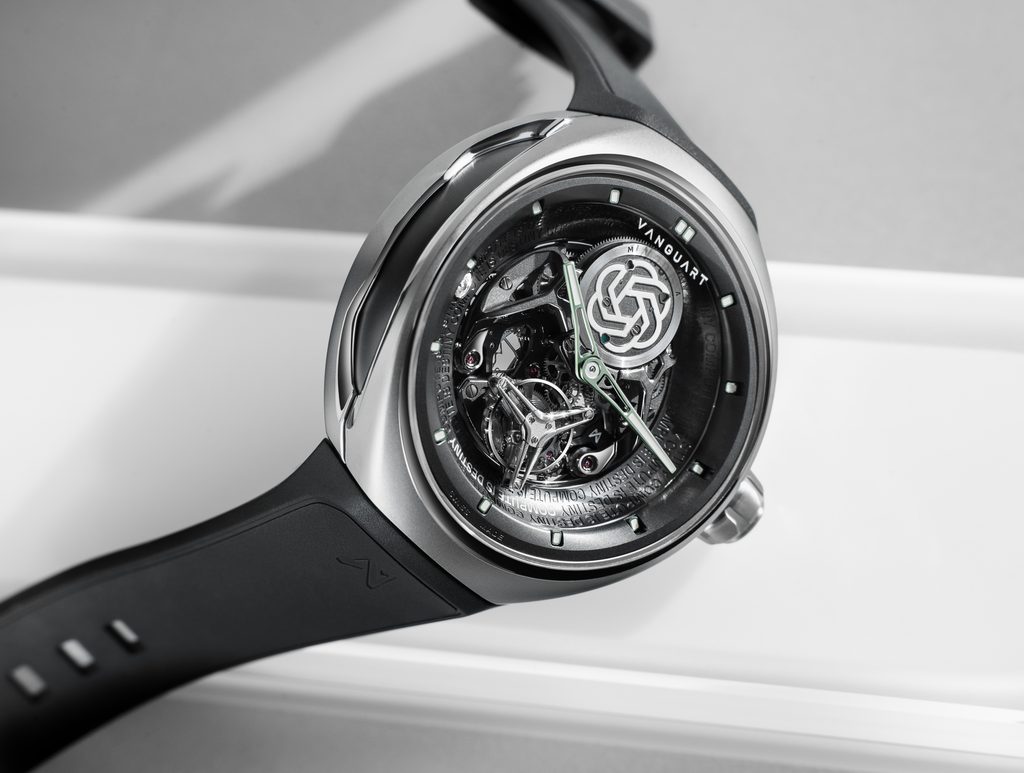
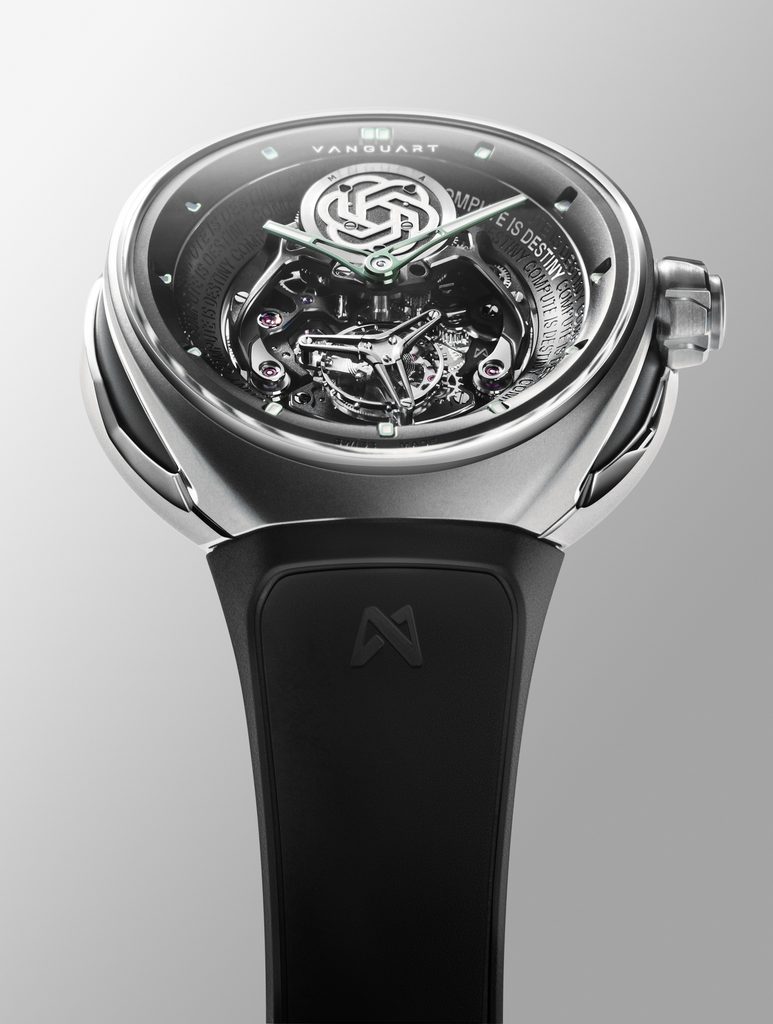
The movement retains its architecture: an automatic flying tourbillon at six o’clock, a barrel at twelve o’clock, and an orbital oscillating mass. A selector on the crown allows switching from automatic to manual winding; in this second mode, the oscillating mass freezes in place. The movement and case are made of grade-5 titanium. The case measures forty-one millimeters in diameter by 10.5 millimeters thick. The caliber brings together three hundred ninety-five components and thirty-five jewels, beats at 21,600 vibrations per hour, or three hertz, and offers sixty hours of power reserve.
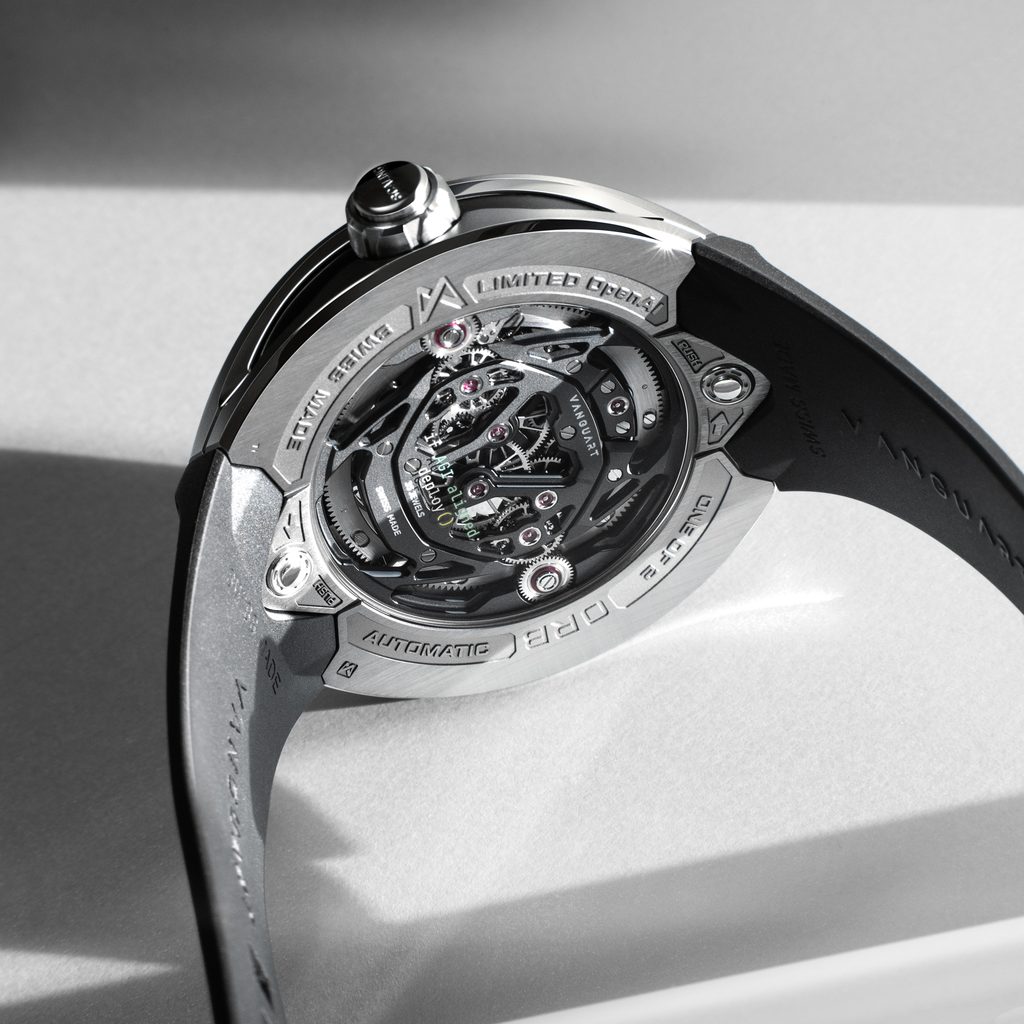
It is onto this architecture that the OpenAI commission adds its markings. The company’s logo appears on the barrel cover. Around the rotor is engraved the phrase ‘Compute is destiny,’ attributed to Sam Altman. The word ‘Scaling’ occupies the crown pusher. On the back, a line of Python code — if AGI.aligned: deploy() — was suggested by Axel Leuenberger, CEO of Vanguart. Each piece also bears the inscription ‘Limited OpenAI.’
Taken separately, these details could pass for simple co-branding. Their accumulation, however, tells a different story: an attempt to inscribe in mechanical matter some of the concepts that today structure the culture of artificial intelligence. Mehmet Koruturk, president and co-founder of Vanguart, states that nearly a third of the Manufacture’s thirty-three employees worked on the project. ‘We systematically build in subtle details, reserved for those who know where to look,’ he explains.
This disproportion between seven pieces and the energy mobilized is probably the most interesting fact. Vanguart has produced fewer than two hundred watches since its founding in 2017. The OpenAI series is therefore nothing like a volume exercise. It functions as a cultural prototype: an extremely traditional object in its mode of manufacture that welcomes the language of an industry built on computing power, software, and scale.
Axel Leuenberger sums up this intent by explaining that the Orb’s architecture allows ‘new meanings to be integrated while preserving its identity.’ It is precisely there that the project goes beyond mere personalization. The mechanics remain unchanged; it is the signs that shift. Watchmaking does not seek to imitate artificial intelligence, but to give it a material, lasting form.
In a few years, these seven pieces may be less interesting for what they say about technology than for what they will have captured of a precise moment: the one when the vocabulary of AI began producing its own symbols of power, even within the slowest objects to manufacture.
Cette publication est également disponible en :


