
The quantum computer does not promise to replace our machines. Rather, it forces us to rethink what it means to compute, measure, calculate, and make decisions in a world where complexity is becoming strategic.
In the contemporary technological imagination, there is a constant temptation to confuse power with speed. The quantum computer is thus often portrayed as a faster, more powerful, almost magical machine, capable of solving in a matter of seconds what our best supercomputers would struggle to process for millennia.
The reality is more interesting. Quantum computing doesn’t calculate faster. It calculates differently.
This nuance changes everything. It allows us to move beyond the hype and look at what is really at stake: not the arrival of a universal computer superior to all others, but the emergence of a new framework for computation, measurement, and security. A framework that is still fragile, demanding, and difficult to scale up, but already advanced enough to mobilize governments, militaries, industry, research labs, and startups.
The physics of the infinitesimal, the real-world consequences
Quantum physics arose from a simple yet mind-boggling question: How does matter function at the most fundamental level—that of molecules, atoms, electrons, and photons? At this scale, the laws that govern our everyday lives are no longer sufficient. Objects no longer behave like particles, but rather as entities described by mathematical waves, capable of interfering with one another, superimposing, and then yielding a result only at the moment of measurement.
This theory is not new. It is about a century old. It has already shaped part of the modern world: semiconductors, lasers, medical imaging, electronics, and civil nuclear technology. What is now called the second quantum revolution is therefore not based on unknown physics. It is based on a new capability: manipulating individual quantum objects—an atom, a photon, an electron, a superconducting circuit cooled to near absolute zero—to turn them into units of information.
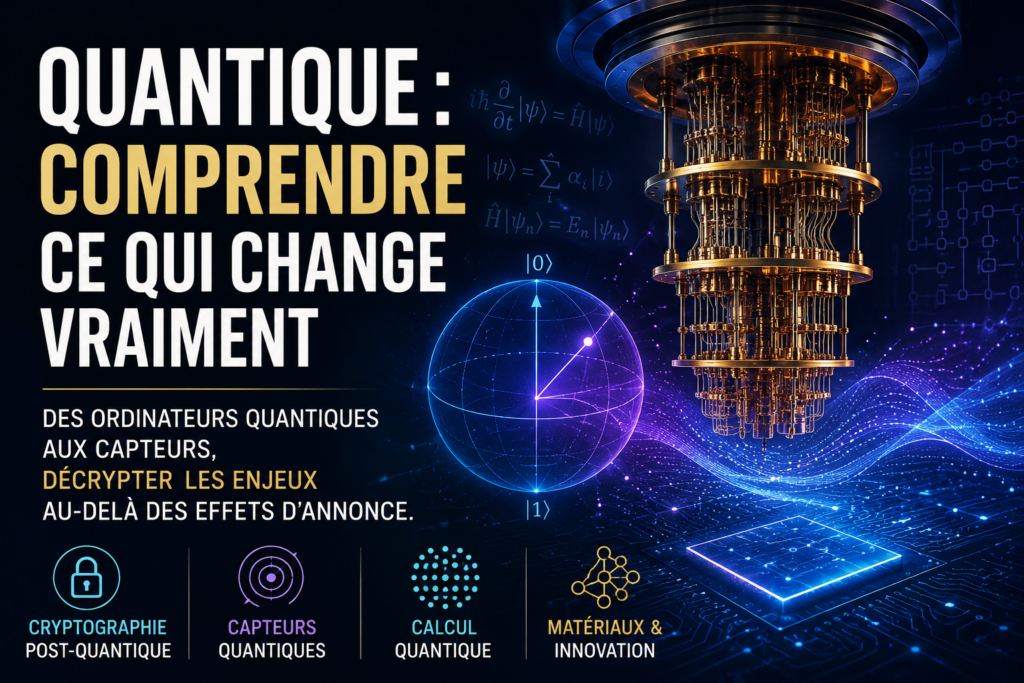
The key term is the qubit. Whereas a classical bit can be either 0 or 1, a qubit can be described by an infinite number of possible states, represented mathematically on the surface of a sphere. But this richness comes at a price: fragility. The qubit is hypersensitive to its environment. What gives quantum computing its potential power is also what makes scaling it up so difficult.
The Details
A useful quantum computer is not measured solely by the number of physical qubits it contains. The decisive factor is the logical qubit: a more robust unit of information, constructed from multiple physical qubits to correct errors. Today, the best machines handle several thousand physical qubits, but only a handful of logical qubits. It is this difference that still separates scientific promise from industrial reality.
Three breakthroughs, three horizons
The first paradox is this: post-quantum cryptography is not a quantum technology. It refers to classical encryption methods designed to withstand future quantum computers. The risk is already a reality: sensitive data can be intercepted today, stored, and then decrypted later when machines are powerful enough. This “harvest now, decrypt tomorrow” logic is forcing banks, governments, militaries, and large corporations to make an urgent transition.
The second breakthrough has received less media attention, but may be closer at hand: quantum sensors. Their sensitivity could be 100 to 1,000 times greater than that of equivalent conventional sensors. Gravity, magnetism, time, navigation—the applications span both industry and defense. A sensor capable of enabling autonomous navigation without GPS—underwater, in the air, or in space—immediately becomes a strategic issue.
The third breakthrough is quantum computing. It remains the most spectacular, but also the least understood. A quantum computer will not replace classical computers or smartphones. Rather, it will function as a complement, within hybrid architectures combining supercomputers, artificial intelligence, and quantum processors to tackle certain extremely complex problems.
This is where the most promising use cases lie: molecular modeling, new materials, fertilizers, finance, weather, climate, industrial optimization, and artificial intelligence. AI excels at processing large amounts of data; quantum computing could excel in certain areas of complexity. The two are not substitutes for one another. They complement each other.
The race is global, but the scarce resource is human.
The United States, China, and Europe: the major technology hubs are investing heavily. China is moving forward with a strong state-led approach. The United States relies on its private-sector giants and its ability to set standards. Europe has world-class research, but remains fragmented.
France, for its part, has opted for technological diversity. Several startups—Pasqal, Quandela, C12, Alice & Bob, and Quobly—are being supported as part of a strategy to ensure technological sovereignty, with the goal of fostering industry leaders capable of developing machines with more than 100 useful logical qubits by 2032.
But perhaps the most important point isn’t financial. It’s human. The quantum ecosystem lacks talent: physicists, engineers, computer scientists, hybrid professionals—minds capable of translating abstract science into architectures, products, applications, standards, and decisions.
It is here that quantum technology resembles less a laboratory promise than a challenge for industrial civilization. It is not enough to simply fund machines. We must cultivate the ability to distinguish between hype and actual capabilities, between prototypes and real-world applications, between physical qubits and logical qubits, and between apparent speed and the actual complexity being processed.
Quantum computing doesn’t just need investors. It needs interpreters.
And this is perhaps where its first transformation takes place: even before changing our computers, it forces us to change the way we understand power.
Cette publication est également disponible en :

