
SpaceXAI’s new tool accepts specialised terms and distinguishes speakers. To document know-how, the precision of the text must remain accompanied by contextual and validation work.
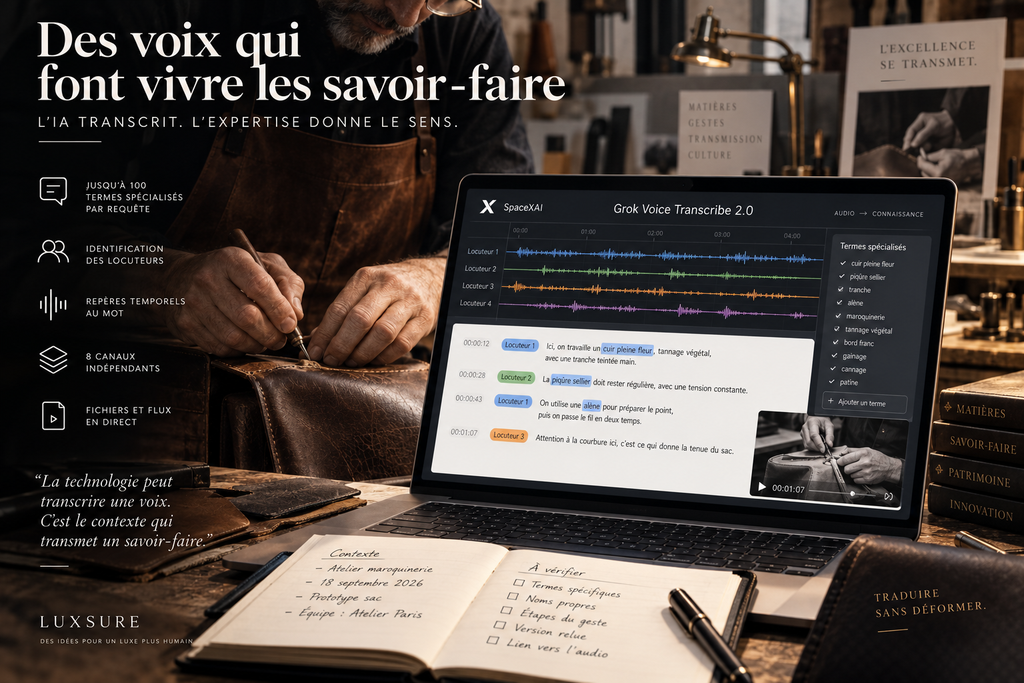
A misheard material name can change the meaning of a workshop explanation. Grok Voice Transcribe 2.0, announced by SpaceXAI on 18 September 2026, lets users supply up to one hundred specialised terms per request. The service also offers word-level timestamps, speaker identification and the processing of eight independent channels.
Useful functions, a quality yet to be tested
The vendor announces transcription of files and live streams. It publishes accuracy improvements drawn from its own evaluations, notably on short multilingual phrases. These results must remain attributed to their test context: they do not prejudge the exact rendering of a particular craft vocabulary.
Relevance for a house is verified on its own recordings, with its accents, its machines and its proper names. A good trial sets the transcription against a human listener able to recognise the terms of the trade.
Preserving speech without flattening it
Turning an oral explanation into text eases search and transmission. It can also erase what gave meaning to a hesitation, a gesture shown or a correction. A useful archive must be able to retrieve the original recording and distinguish the automatic text from the proofread version.
The choice of what is recorded also belongs to the organisation. A team must define the people concerned, the intended uses and access to the corpus. These decisions cannot be deduced from the mere availability of a tool.
The heritage value of a transcription thus lies in what accompanies it: the speakers’ identity, the date, the context and explicit corrections. AI can speed up a first draft in text. Passing on know-how still requires understanding what the words designate and what the recording does not show.
Cette publication est également disponible en :


