
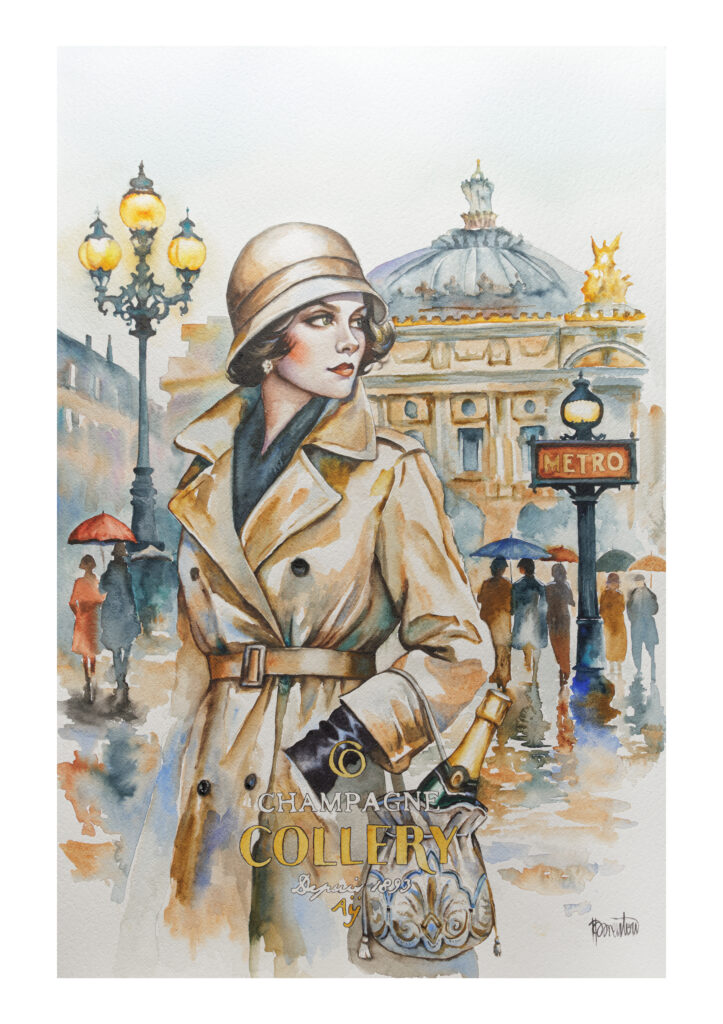
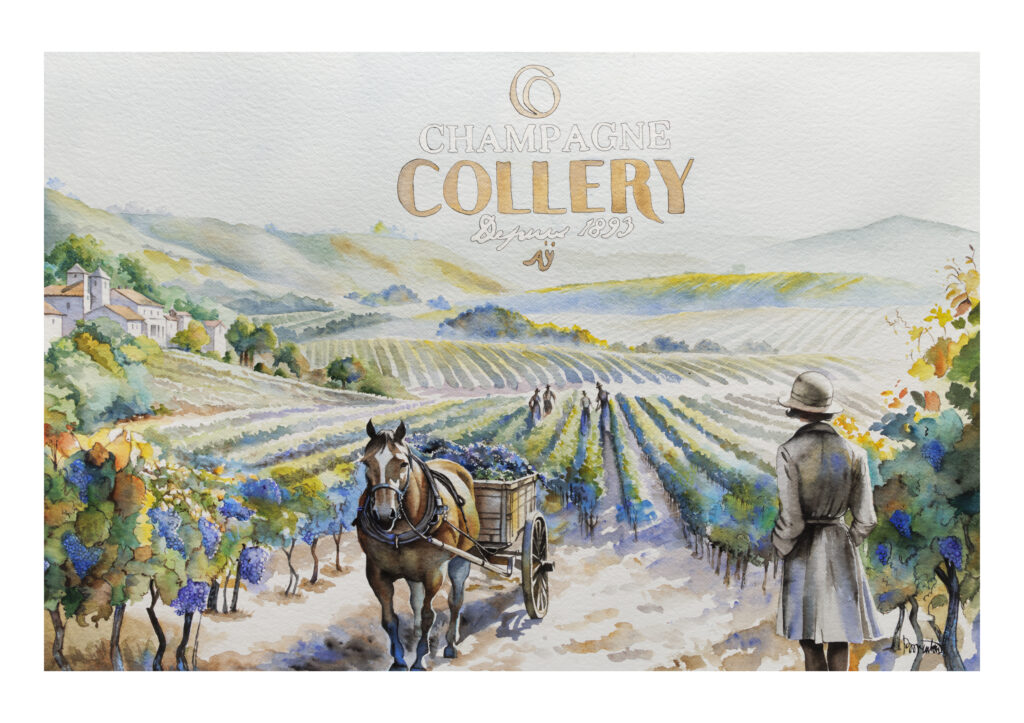
The Champagne house Collery pays tribute to an interwar pioneer through eight watercolours by Helen Barenton. A limited edition to tell what press releases usually forget.
In the history of Champagne, women have often carried the houses on their shoulders without appearing on the labels. Geneviève Collery-Herbillon is one of them. The house of Collery has decided to give her what is due to her.
“Pierre goes to the vines and I sell my wine”
The phrase is hers. Geneviève Collery-Herbillon, wife of Pierre Collery — son of the founder Jules-Anatole — spoke it between the wars with the quiet nonchalance of women who had understood, before the world put it into words, that trade is also a form of nobility.
It was she who criss-crossed Paris to sell the family Champagne. She can be found at the Hôtel Lutetia, at the Terminus Saint-Lazare, at Potel & Chabot, which placed an order with her in 1936. In an era when commercial representation was a man’s affair, Geneviève Collery-Herbillon opened doors through sheer personality.
Helen Barenton, the gaze of a contemporary
To tell this story, the house of Collery chose painting over the archive. The Reims artist Helen Barenton has created eight watercolours inspired by the Roaring Twenties — that moment of joyful reconstruction after the Great War, when women wore their hair short, their skirts at the knee and their ambitions in the open air.
What struck me when I discovered Geneviève was her freedom and her energy — she did not ask permission to exist in a world that was not made for her.
Barenton’s watercolours do not seek to reconstruct. They evoke, suggest, leave space. One senses an era more than one sees it — which is perhaps the right way to speak of Champagne: it is never really represented, it is felt.
2014: transmission as rebirth
Nicolas Gueusquin took over the house of Collery in 2014. His presence in this tribute project is not insignificant. He speaks of “heritage transmission and rebirth of the brand” — a formulation that says the essential: one can only move forward on condition of knowing where one comes from.
The limited edition planned for the end of 2026 will be physically linked to these watercolours. The exact terms have not been revealed, but the intention is clear: to make a bottle of Champagne the vehicle of a memory. This is not so common in an industry that often prefers myth to history.
What Champagne sometimes forgets to say
Champagne is a very masculine industry in its founding narratives — the great houses bear men’s names, the chronicles celebrate patriarchal dynasties. Yet Veuve Clicquot, Mathilde-Émilie Perrier known as “Pommery”, Lily Bollinger: women have shaped what we drink today as much as men have.
In bringing Geneviève Collery-Herbillon out of the shadows, the house is not doing politics. It is simply doing history — and that is already a great deal.
Cette publication est également disponible en :


