
68% of French people could slip a touch of Italy into their year-end festivities: that is the result of an OpinionWay survey commissioned by Disaronno, conducted online at the end of August among more than a thousand people representative of the French population. The Italian brand welcomes the figure as confirmation of a taste it has cultivated for five centuries. Publishing a survey of this kind just before the festive season is common practice in the spirits industry, but here it takes on particular significance: it lends legitimacy, through a figure external to the brand, to a positioning that Disaronno has claimed for decades without necessarily measuring it publicly.
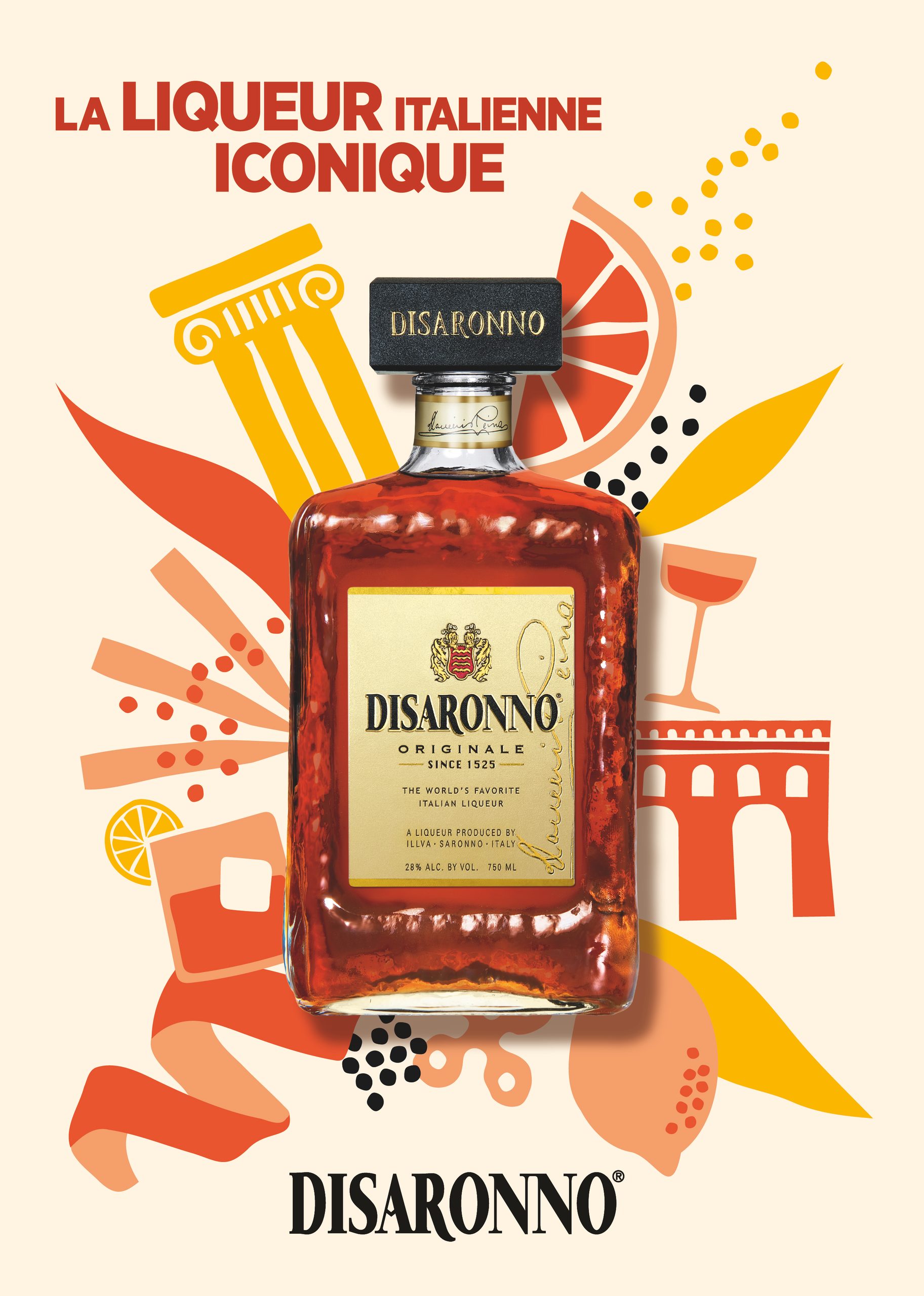
Disaronno Originale, an almond-scented amaretto born in Saronno, is indeed part of a history that goes back to 1525. A rare longevity for a spirit, which the brand chooses to tell not through a new product, but through the object that has held it for more than half a century: its square bottle of faceted glass, topped with a black dome-shaped stopper, designed in 1971 by a Murano master glassmaker. A design choice that anchors the liqueur as much in the world of Italian glass as in that of mixology.
On the palate, the amaretto stands out for its almond aroma, its warm and indulgent profile, and its persistence in the mouth — served neat, over ice, or in the Disaronno Sour, a cocktail that pairs the liqueur with lemon juice and, according to the brand, reveals another facet of the product during the festive season.
This versatility of use — pure sipping on one side, mixology on the other — allows the brand to position itself at once on two quite distinct moments of consumption: the traditional after-dinner digestif, inherited from a more classic image of Italian spirits, and the contemporary cocktail, closer to the codes of the fashionable bar than to the family buffet. A double life that partly explains the commercial longevity of a recipe nonetheless unchanged for five centuries.
Available in mass retail, in La Maison du Whisky boutiques and on whisky.fr at 23 euros for 70 centilitres, at 28% alcohol, Disaronno Originale relies on an accessible positioning to occupy a place that other, more expensive spirits sometimes leave vacant on year-end tables. This accessibility, combined with a distribution as wide as supermarkets, clearly distinguishes Disaronno’s strategy from that of the rarer spirits showcased elsewhere during the same festive period, often reserved for a circuit of wine merchants or specialist shops.
What this survey reveals indirectly is not so much the French appetite for Italy — a classic of year-end campaigns — as the way a brand almost five centuries old chooses, season after season, to make its bottle an argument as solid as its recipe. Few spirits can claim a visual identity so stable for more than half a century without ever having needed to modernise it deeply — a kind of fidelity that contemporary mixology, often geared towards permanent renewal, treats as an exception rather than a rule.
Also on Luxsure: Gosset Celebris 1998: the family reserve in magnum · Santa Teresa 1796: when Venezuelan rum finishes its maturation in Ireland · Arlett Kentucky: a Charentais single malt tested by American oak · Laphroaig and Arnaud Larher: winter through peat and chocolate
Cette publication est également disponible en :


