
In Listrac-Médoc, Château Fourcas Dupré continues to reinterpret the terroir through a unique cuvée: a “blanc de noirs” made exclusively from Cabernet Sauvignon. This technical experiment challenges both traditional tasting conventions and the historical boundaries of the Médoc.
The Médoc is a region of certainties.
For two centuries, its identity has been rooted in a few constants: Cabernet Sauvignon, Bordeaux blends, aging, and the cultivation of red wine. It is precisely this tradition that Château Fourcas Dupré is now setting out to reinterpret. Since its acquisition by Gérard Jicquel in 2019, the estate has embarked on a sweeping transformation centered on a plot-by-plot reassessment, a new gravity-fed fermentation facility, and an exploration of the potential offered by its terroirs of gravel, clay, and limestone.
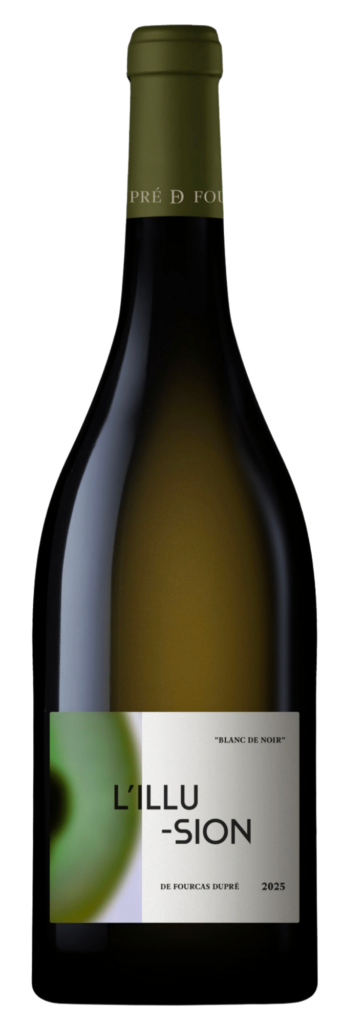
In this context, *L’Illusion* holds a special place.
This wine is a “blanc de noirs,” that is, a white wine made from red grapes. Here, the choice falls on a grape variety rarely associated with this style: Cabernet Sauvignon. Usually reserved for the great reds of the Médoc, it is vinified in such a way as to avoid any color extraction from the skins. The result is a clear wine whose appearance deliberately contradicts its origin.
The appeal of this project goes beyond aesthetics. It lies in highlighting certain characteristics of the grape variety that are rarely perceived in a red wine. Stripped of its tannins and its usual structure, Cabernet Sauvignon reveals other dimensions: its natural tension, its freshness, and its aromatic precision. Fourcas Dupré describes a profile built around these three concepts.
The terroir, however, remains that of the Médoc. The grapes come from a sixty-hectare vineyard planted on clay-limestone soils. The average age of the vines is thirty-five years, a sign that the vines are already well-established in their environment.
The winemaking process follows the same principle of restraint. Unlike many experimental approaches that seek to maximize technical effects, L’Illusion opts for aging carried out entirely in small stainless-steel tanks. The choice of this material aims to preserve the fruit’s expression and the clarity of the grape variety. The press release also notes that part of the winemaking process is carried out in amphorae, confirming the estate’s commitment to exploring different containers depending on the desired outcomes.
Detail
Appellation: Wine of France
Grape variety: 100% Cabernet Sauvignon
Soil type: clay-limestone
Average age of the vines: thirty-five years
Aging: small stainless steel tanks
Production: 2,650 bottles
Alcohol: 12.5% vol.
pH: 3.17
What makes L’Illusion relevant today goes beyond the bottle itself. The wine is part of a broader movement affecting several European regions: the reevaluation of traditional categories. Producers are no longer simply seeking to perfect an existing style; they are questioning the very way in which a terroir can express itself.
At Fourcas Dupré, this approach remains deeply rooted in the vineyard. The new vintages stem directly from the work of mapping the plots and from the new winery’s ability to isolate the winemaking processes. Behind the project’s apparent uniqueness lies, above all, an agronomic question: what do we learn about a terroir when we radically change the way we interpret it?
L’Illusion offers an unexpected answer. It reminds us that a grape variety is never a fixed identity but rather a raw material. And that in the heart of the Médoc—a region often associated with the permanence of traditions—experimentation can sometimes become a tool for understanding the terroir.
Cette publication est également disponible en :

