
The word “zen” carries an almost immediate risk: that of becoming mere decoration. A pebble, a white flower, filtered light—and the language quickly veers into the realm of a soothing postcard. With Zen Essence, however, Shiseido chooses to return to this vocabulary with a certain restraint: not to illustrate a vague idea of calm, but to anchor a women’s fragrance in an olfactory language of stillness, breath, and refocusing.
Presented as a women’s eau de parfum, Zen Essence is built around a clear structure: bergamot and jasmine at the top, iris at the heart, a mineral musk accord, followed by vanilla and cedarwood at the base. The composition is the work of perfumer Florian Gallo, who draws inspiration from the Japanese garden—not as an exotic setting, but as a space governed by light, air, and pauses. The press kit describes a fragrance designed for the five senses, with a quantifiable emotional benefit: 83% of the 107 people surveyed reported that the fragrance evokes a sense of harmony and balance. This data should be taken for what it is: a self-reported indicator, not physiological proof. But it captures the spirit of the times quite well. Perfume is no longer viewed merely as a scent trail; it has become a personal ritual, an intimate tool for regulating one’s mood.
Shiseido is no stranger to this market. Founded in 1872 in Ginza, Tokyo, as Japan’s first Western-style pharmacy, the company has built its identity on a fruitful interplay between science, aesthetics, and Japanese culture. Its official history emphasizes this hybrid origin: a company born from a pharmaceutical endeavor that has become one of the world’s leading players in the beauty industry. From this perspective, Zen Essence is less an extension of a wellness trend than it is a continuation of Shiseido’s long-standing legacy: that of beauty conceived not only as a discipline of the body, but also as a form of presence.
The name itself evokes a fragrant memory. Shiseido’s Corporate Museum notes that Zen, launched in 1964, was developed in the context of the Tokyo Olympics, a time when Western interest in Japanese aesthetics surged. The fragrance was named after a religious philosophy widely associated, in the West, with the essence of Japanese culture. Six decades later, Zen Essence revisits this evocative term, but in a less overt manner: white flowers, serene woods, mineral musk, and a bottle with soft curves. Modernity here does not lie in a break with tradition, but in a sense of lightness.
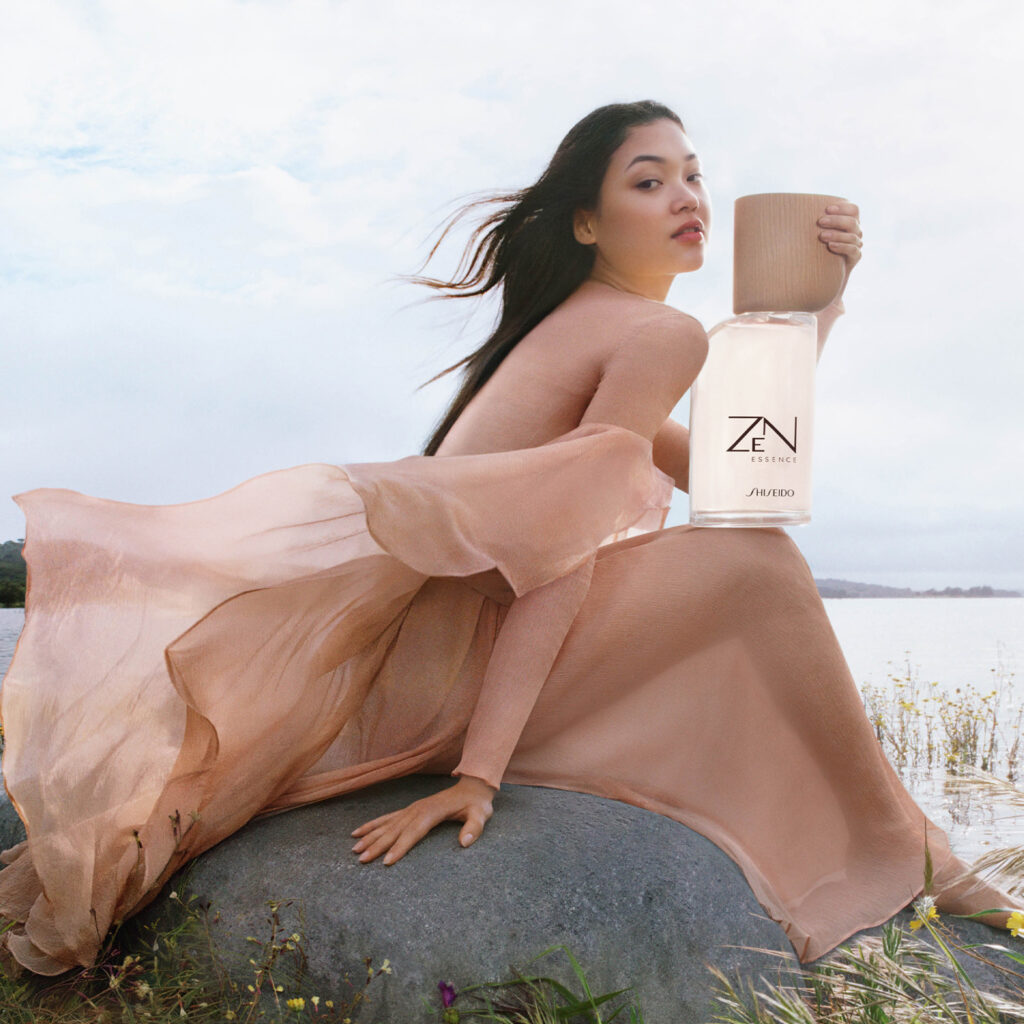
The bottle is worth noting. According to the brand, its slightly asymmetrical silhouette echoes the “S” in Shiseido. The clear glass reveals the fragrance inside, while a solid wood cap adds a tactile, almost homey quality. The design lacks the theatricality of grand collector’s bottles; instead, it seeks a form of visual balance between softness and verticality. The press kit also highlights a vegan formula, a recyclable glass bottle, and an FSC-certified, plastic-free cap. While these elements alone do not fully encapsulate a comprehensive environmental approach, they position the product within a now-essential expectation: a contemporary fragrance must also be mindful of its packaging.
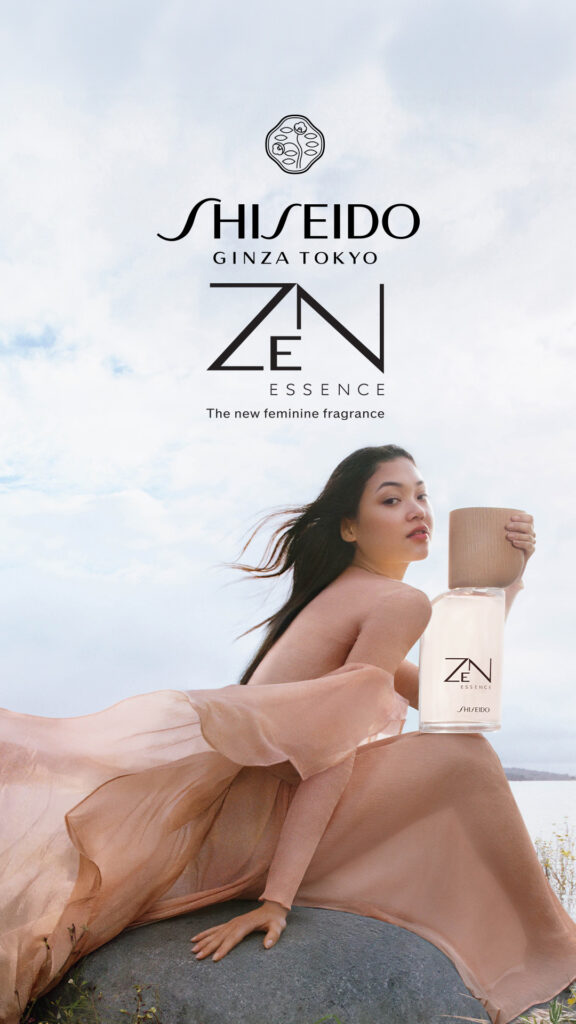
Mika Schneider’s presence as the face of the campaign adds an interesting cultural dimension. A Franco-Japanese model, she embodies a fluid, international femininity, linked as much to fashion as to a contemporary concept of well-being. The chosen image—a body at rest, nature as a threshold, light as breath—avoids overt glamour. Instead, it presents a figure of openness: a woman who pauses long enough to reconnect with her senses. This is perhaps where Zen Essence finds its most accurate angle. Not in the promise of absolute calm, but in the more subtle idea of a return to oneself—brief, portable, and everyday.
Available in 30 ml, 50 ml, and 100 ml sizes starting in April 2026, Zen Essence enters a market where women’s fragrances are shifting toward more emotional expressions—less strictly seductive and more closely tied to self-care. Shiseido responds to this trend without overdoing it. The floral, woody, musky formula remains accessible; the narrative, however, seeks a more understated depth. One might still be wary of the word “zen,” given how overused it has become in Western marketing. But at Shiseido, it at least has a history, a precedent, and a cultural resonance. And that makes a big difference.

Cette publication est également disponible en :

