
VivaTech 2026 – Glenn Fogel, CEO of Booking.com
Travel is one of the last industries where AI must grapple with the real world
Listening to Glenn Fogel speak on stage at VivaTech, one idea quickly becomes clear: the future of travel won’t be a battle between travel agencies and artificial intelligence. It will be a battle against friction.
Flight delays, missed connections, incompatible reservations, fully booked restaurants, and sudden changes in the weather. Travel remains one of the most fragmented experiences in the digital economy. And it is precisely this fragmentation that explains why Booking.com is investing heavily in generative AI.
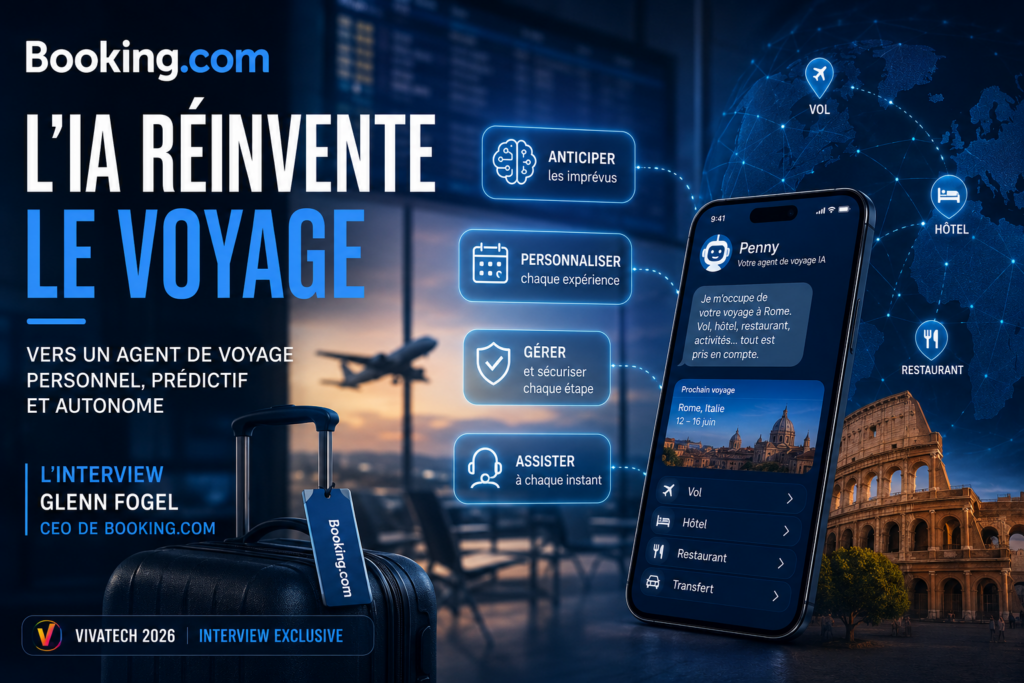
The stated goal is the “Connected Trip”—a journey entirely orchestrated by artificial intelligence, from the initial inspiration all the way back home. In this vision, the smartphone becomes a personal travel agent capable of understanding a user’s preferences, anticipating problems, and taking action before they even arise.
But behind this technological promise lies a more interesting reality: the competitive advantage is no longer the algorithm. It has become the ecosystem.
Travel isn’t a matter of recommendation
For the past two years, one question has been on the tourism industry’s mind: If ChatGPT or Claude can already recommend hotels, restaurants, or itineraries, why bother using Booking.com anymore?
Glenn Fogel’s response is revealing.
Recommending a hotel is relatively simple. Booking a trip is not.
The executive points out that behind every reservation lies an invisible infrastructure consisting of payment systems, national regulations, supplier contracts, consumer protections, cancellation management, and after-sales services.
In other words, large language models excel at conversation but not yet at task execution.
This is probably the most important distinction right now. Conversational AI reduces the value of search. It does not necessarily reduce the value of the infrastructure.
With this in mind, Booking.com does not consider OpenAI or Anthropic to be its main competitors. Its true advantage lies in twenty-seven years of technical and commercial integration with millions of travel partners around the world.
Trust is becoming the true strategic asset
One of the most striking figures mentioned during the discussion concerns the source of the traffic.
According to Glenn Fogel, 65% of Booking.com users arrive directly on the platform, without going through Google or a conversational search engine.
This figure reveals something fundamental.
For years, digital platforms have built their dominance through visibility. In the age of generative AI, they will have to defend it through trust.
The CEO actually compares Booking.com to Amazon—not because their businesses are similar, but because both companies benefit from a tendency that has become rare: when a user has to make a decision, they instinctively turn to a brand they already know.
In an environment where information is abundant and generated on demand, trust becomes a cognitive shortcut.
And that may be where the real threat lies for AI-powered new entrants: they can replicate the recommendations, but it’s much harder for them to replicate the reputation.
The Paradox of Independent Travel
Glenn Fogel’s vision, however, takes automation to a whole new level.
He envisions a future where AI knows he needs to go to London even before he realizes it himself. The system would automatically book the flight, choose the appropriate airport, arrange transportation, and manage the entire trip without human approval.
A form of total autonomy.
Yet, in the same breath, he acknowledges that the majority of travelers will continue to want to retain the ability to make their own decisions.
This tension is indicative of the current state of AI.
Technically, we are moving toward greater automation. Psychologically, we remain attached to our freedom of choice.
In the tourism industry, this contradiction is even more pronounced. A trip isn’t just a transaction—it’s an emotional journey. You’re not just booking a room; you’re envisioning an experience.
Even if an algorithm objectively identifies the best option, many users will still want to use their own judgment.
Travel could thus become one of the sectors where AI acts more as a co-pilot than as a pilot.
Innovation According to Booking: Taking More Risks Rather Than Seeking Certainty
Another interesting insight concerns how Booking Holdings approaches innovation.
Rather than imposing a single strategy on his various subsidiaries—Booking.com, Priceline, Kayak, Agoda, and OpenTable—Glenn Fogel advocates a strategy of diversification.
Every company is experimenting with its own AI approaches.
Better yet, the group is currently funding several initiatives that operate as true independent startups.
This approach highlights an often-forgotten truth: when a technology evolves as rapidly as generative AI, centralization can sometimes become a risk.
No one really knows which interface, agent, or model will dominate in five years.
In this context, the advantage isn’t in being right right away. It’s in keeping enough options open so you don’t end up stuck with a bad decision.
Details
Perhaps the most interesting idea put forward by Glenn Fogel has less to do with travel and more to do with regulation.
The executive criticizes the proliferation of European regulations—the DMA, DSA, AI Act, and other national measures—arguing that they are piling up without always being subject to rigorous evaluation.
Its comparison with A/B testing is particularly revealing.
According to him, technology companies systematically measure the effectiveness of a product change before rolling it out on a large scale. Regulators, on the other hand, rarely apply the same logic to their own rules.
Beyond the political debate, this remark highlights a central issue for Europe: how to protect without slowing down, and how to regulate without discouraging.
The Travel Industry Enters the Age of Prediction
At the end of the discussion, Glenn Fogel sums up his vision in a simple sentence: In five years, traveling will be less frustrating than it is today.
The statement seems modest. In reality, it is ambitious.
Because the goal is no longer simply to book faster or more cheaply. It’s about eliminating irritants before they even arise.
AI applied to travel is therefore not just about conversational assistance. It represents a shift toward systems capable of anticipating needs.
And that may be where the industry’s next frontier lies: no longer helping travelers solve their problems, but preventing those problems from arising in the first place.
The true luxury of tomorrow’s travel will not be personalization.
It will be the absence of friction.
Cette publication est également disponible en :

