
An abundant file can remain locked inside an initial hypothesis. To inform a decision, the inquiry must make visible the alternatives and the elements that would weaken the preferred option.
Asking how to carry out a project already assumes that it deserves to be carried out. Asking whether it should be launched opens a different inquiry.
Keeping the question open
For a house studying a venue, a partnership or a new offering, the initial instruction can steer the whole file. An overly affirmative formulation pushes towards accumulating favourable arguments, whereas the decision also requires reasons to give up.
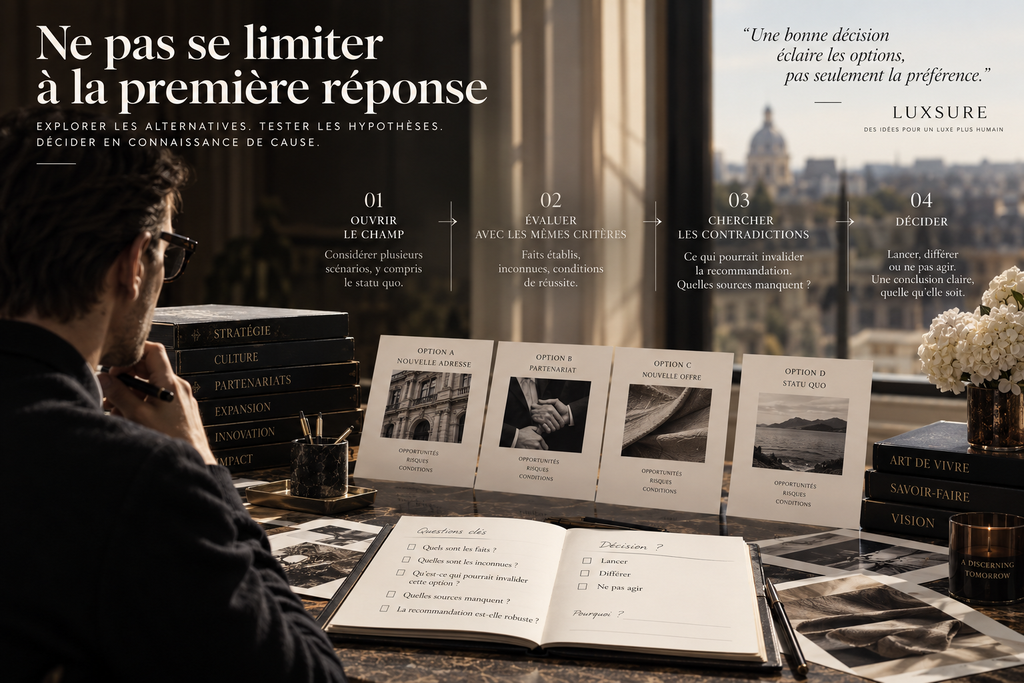
One method proposed by Luxsure consists in asking for several options, including keeping the existing situation. For each, one must distinguish established facts, unknowns and the conditions on which success would depend. The same criteria must be used to examine all the options.
Looking for what could invalidate the recommendation
The second task concerns contradictions. What information would change one’s mind? Which source is missing? Does an apparent confirmation come from an independent inquiry or from several repetitions of the same account?
AI can help organise this research, but the volume of text produced does not prove the breadth of the possibilities examined. Human review must be able to go back to the documents and identify what is absent, as much as check what is present.
This discipline is particularly useful when the project already has narrative force: an appealing address, a prestigious partner or an anticipated technology. Enthusiasm does not invalidate the idea; it makes an explicit comparison all the more necessary.
The file must ultimately allow a decision, including the decision to defer or not to act. An inquiry that contradicts the initial intuition may have fulfilled its role. Its quality is judged by what it makes discernible, not by its ability to confirm a wish.
Cette publication est également disponible en :


