
In a Haussmannian apartment filmed like an elegant chamber piece, Berluti entrusts Victor Belmondo and Lee Jun-ho with sketching the contours of a man who refuses to take himself too seriously.
There is a very French way of wearing luxury with nonchalance — and another, arriving from Seoul, that observes it and reinterprets it. It is this encounter that Berluti’s new institutional campaign stages, shot within the volumes of a Parisian Haussmannian apartment where traces of an older art of living still linger. Before the lens of photographer Estelle Hanania, French actor Victor Belmondo and South Korean actor and singer Lee Jun-ho cross paths, answer one another, and occupy the space in turn, never quite settling into a pose.
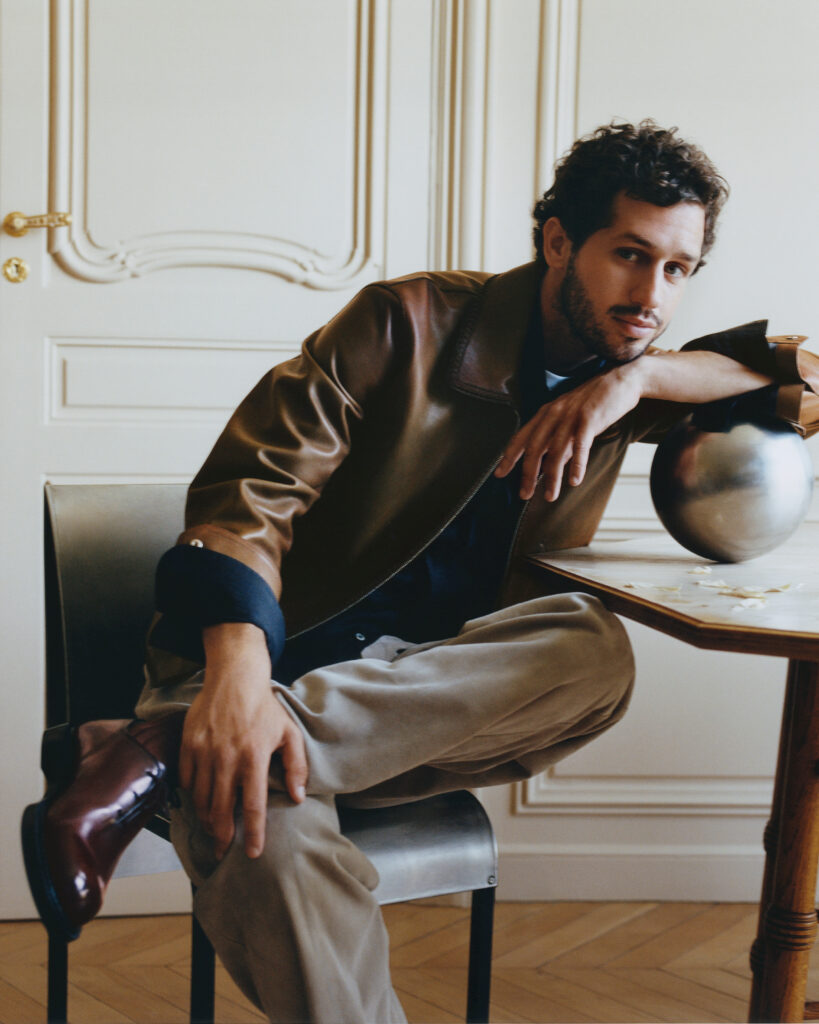
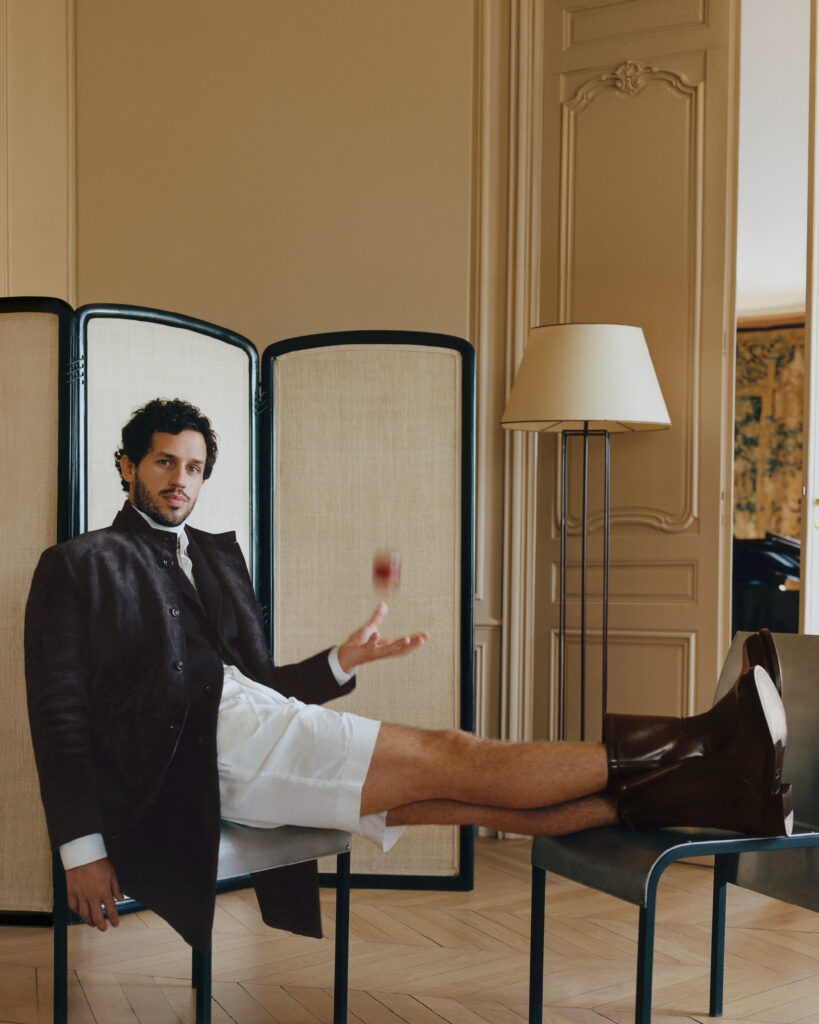
The house speaks of a “Berluti man” who inhabits the world on his own terms, cultivates an offbeat gaze and wears his elegance lightly, refusing to be confined to any single mould. The visual narrative chosen to embody him owes less to demonstration than to a scene of life caught unawares: Victor Belmondo, leaning against a wooden table where a metal sphere rests, breaks into a knowing smile, dressed in a patinated leather Un Jour jacket and shod in Alessandro 1895 derbies with mahogany reflections. Further on, seated in an armchair, legs resting on a second seat, he bounces an apple in the air, a Forestière jacket thrown over his shoulders, incongruously revealing a plain pair of boxer shorts beneath.
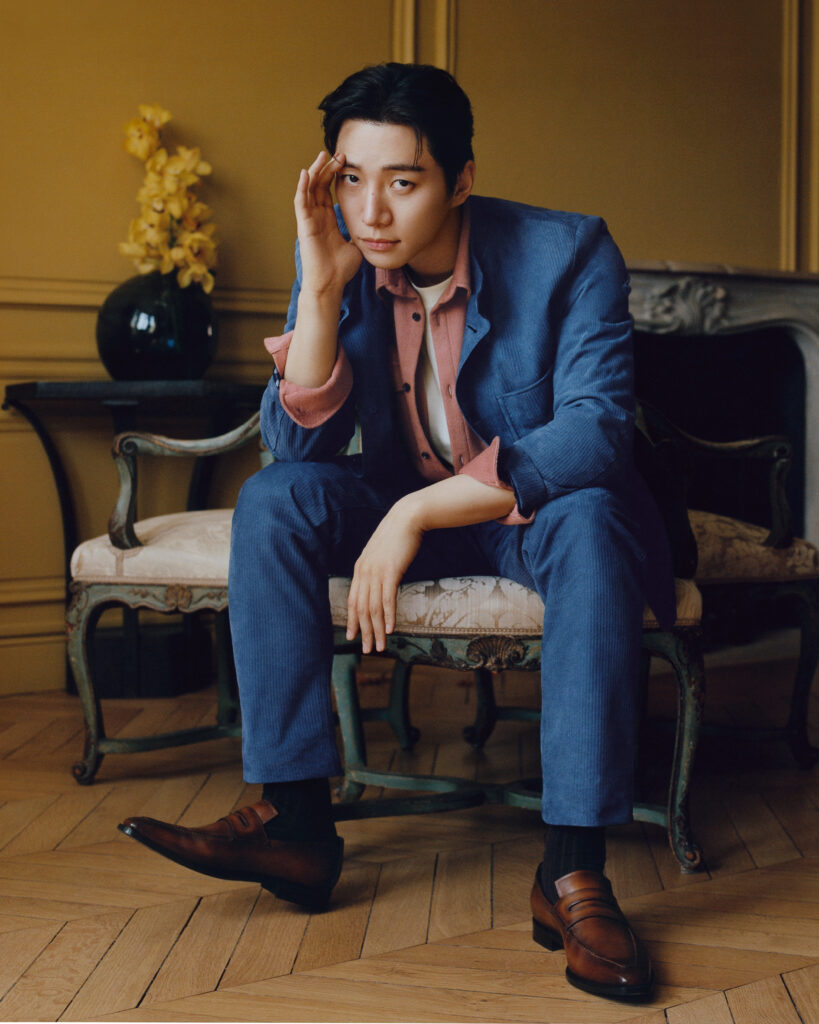
Lee Jun-ho’s arrival shifts the tempo. Shod in Andy loafers that click against the honey-coloured parquet, he crosses the frame in a blue leather suit built around the Forestière jacket, lined with a second version, in powder pink, visible underneath. Settled into a vintage armchair, head resting in one hand, he seeks no particular pose: he occupies the space with an elegance free of stiffness or solemnity, as though he had always lived there.
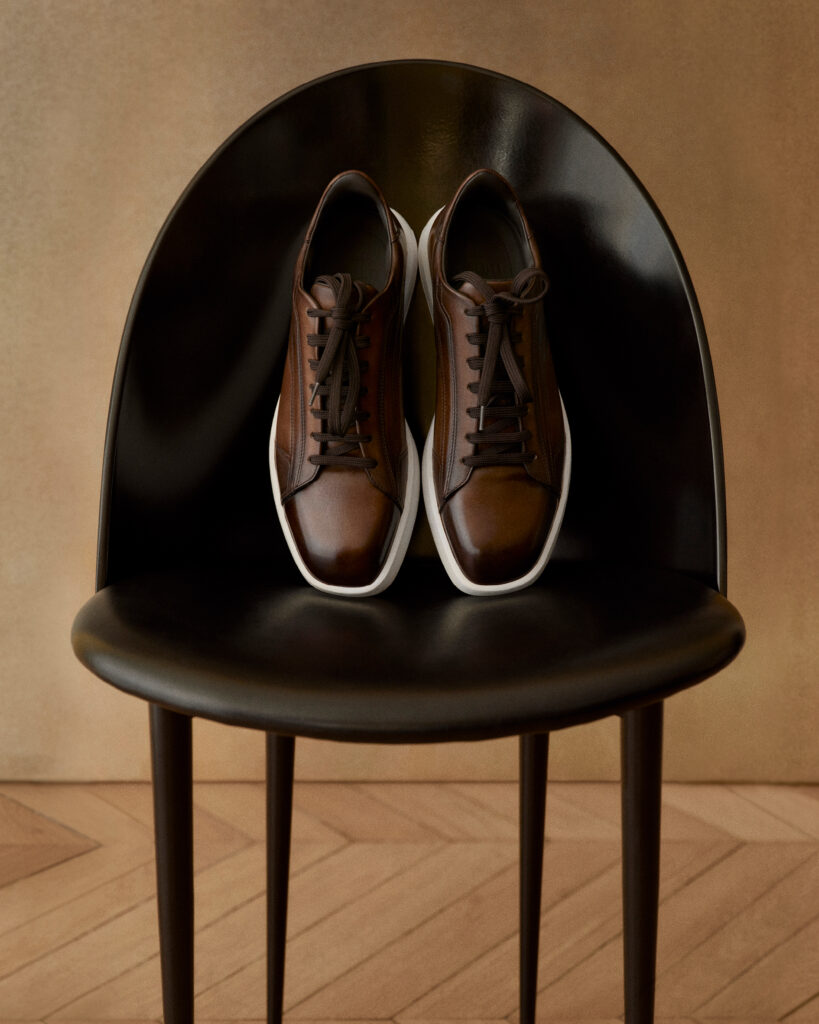
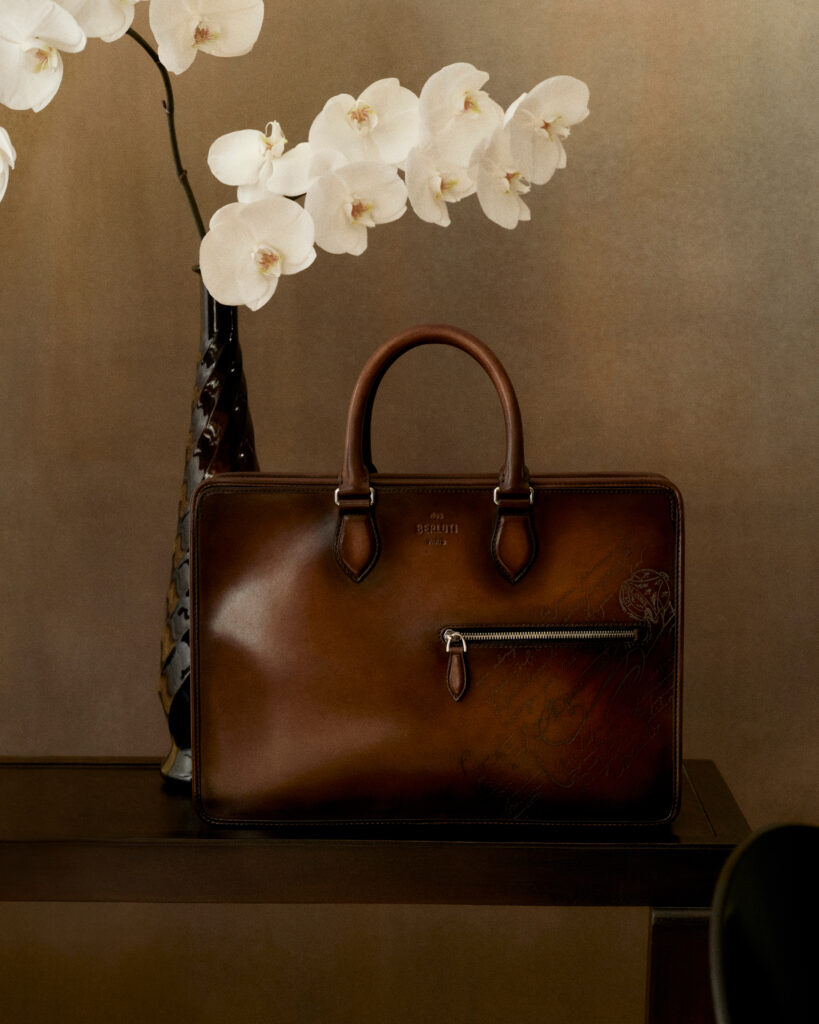
This intimacy of surface owes much to the light: the Parisian apartment is bathed in cream, honey and amber tones, a warm, almost painterly clarity that, in its grain, seems to hold a distant echo of the Italian Renaissance. This interplay between Paris and Italy is no accident of staging: it quietly replays Berluti’s dual origin, a house founded at the end of the nineteenth century by a line of bootmakers, rooted in both Italy and Paris. Around the two actors, several emblematic pieces of the house are lit like contemporary still lifes: a pair of Stellar sneakers in deep brown Venezia calfskin set on a dark chair, or an Un Jour bag placed on a console, crowned with a branch of white orchid, sculpted by an almost painterly play of light and shadow.
Bringing together a French actor, heir to a lineage of popular cinema, and a Korean star from the world of K-pop and drama, is likewise no neutral choice: it is a way for a centuries-old Parisian house to signal that its wardrobe now circulates between two capitals of taste rather than radiating from a single one. Photographer Estelle Hanania, known for her sensitivity to the zones of drift between pose and stolen moment, finds in this two-voice device a terrain that feels familiar to her: less the demonstration of a garment than the capture of a mood.
Since the end of the nineteenth century, four generations of bootmakers have succeeded one another at the head of Berluti, before the house extended its gesture to leather goods in 2005, then to a full clothing collection in 2011, never abandoning its made-to-measure service, still available in its workshops on rue Marbeuf and rue de Sèvres. The house now counts more than sixty boutiques worldwide. But what this campaign tells above all, through two faces that everything seemed to set apart, is a definition of chic that no longer rests on standing at attention: it now resides in the ability to remain oneself, down to the natural sight of a boxer short peeking out beneath a master tailor’s jacket.
Cette publication est également disponible en :


