
When execution becomes a matter of convenience, judgment becomes a luxury.
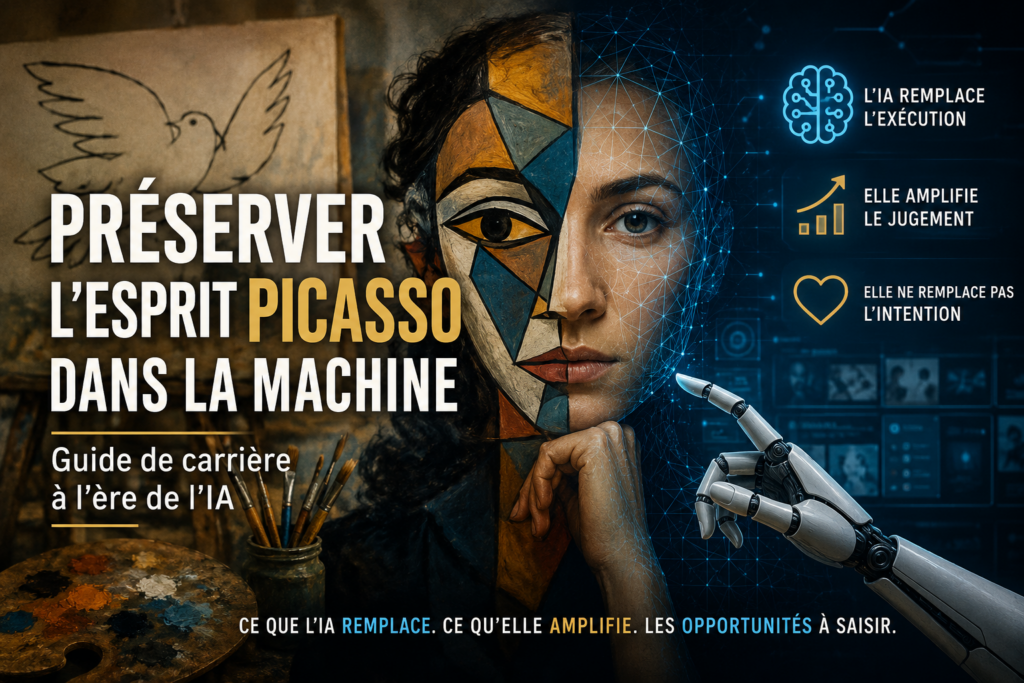
In a studio filmed in the mid-20th century, Pablo Picasso draws without a preliminary sketch. A few lines appear. A face seems to emerge. Then, without warning, the drawing takes a different turn. The face disappears, giving way to a dove. No algorithm had predicted this change of direction. Perhaps not even Picasso himself.
This scene, discussed during a masterclass on the future of work in the age of artificial intelligence, may hold part of the answer to the question that now concerns students and executives alike: What will be left for humans to do when machines can write, draw, program, and design?
The answer probably lies neither in fear nor in enthusiasm.
It lies in the very nature of what creates value.
The Abundance of Execution
For two centuries, the job market has heavily rewarded one ability: production.
Producing text. Producing code. Producing visuals. Producing presentations. Producing analyses.
Artificial intelligence is upending this balance because it is gradually transforming execution into an abundant resource.
This phenomenon is no longer theoretical.
In writing-related fields, object descriptions, advertising variations, document summaries, and large-scale content are now generated in a matter of seconds.
In creative fields, mood boards, initial visual concepts, and graphic variations are produced at a pace no human team can match.
In software development, documentation, project structures, and repetitive code sequences are increasingly being automated.
Economic history shows that a skill that is widely available rarely retains its value.
The question then becomes: what remains rare?
The Return of Judgment
As production becomes more widespread, another faculty regains its value.
Discernment.
Not the ability to generate a hundred ideas.
The ability to recognize the one that deserves to exist.
Artificial intelligence knows how to generate answers.
It still struggles to determine which one really matters.
In the world of luxury fashion, this distinction is well known.
Excellence has never been about churning out more and more creations.
It lies in selection.
A studio may produce hundreds of sketches.
Only one will become a finished piece.
Luxury has always been an economy of selection.
Artificial intelligence specifically accelerates this logic.
In the future, competitive advantage will no longer lie in the ability to produce more content, more concepts, or more images.
It will lie in the ability to choose better.
What the models struggle to understand
One of the demonstrations presented during this talk focused on the user experience.
A mobility platform was looking to improve interactions between passengers and drivers with hearing impairments.
Automated systems were able to accurately identify friction points along the journey.
Their natural instinct was to eliminate them.
However, some of these moments of interruption served an essential purpose: to create a human connection.
The machine optimizes.
Humans interpret.
The difference may seem slight.
Yet it is significant.
In the world of luxury, this logic is everywhere.
The anticipation before a fine jewelry presentation.
The ritual of a fitting.
The time spent recounting the creation of a piece.
The apparent slowness of certain experiences.
All of these frictions would likely be deemed inefficient by a system designed to maximize speed.
Yet they are at the heart of desirability.
The shortcut isn’t always the best path.
Creativity is not the same as generation
The other confusion of our time concerns creation itself.
Because artificial intelligence produces a novel image, many conclude that it is creative.
Yet novelty and creativity are not synonymous.
Generative models work by observing the past.
They identify patterns, styles, structures, and associations.
They recombine.
They extrapolate.
They extend.
They excel at this.
But they remain dependent on what already exists.
Radical creation works differently.
It often emerges when someone strays from the expected path.
When logic becomes intuition.
When the face becomes a dove.
When the question itself changes.
It is precisely this kind of break with convention that the great Houses seek when they launch a new silhouette, a new aesthetic language, or a new vision of luxury.
The Aristocracy of Attention
The true impact of artificial intelligence may ultimately be cultural rather than technological.
For decades, information was scarce.
Today, information is everywhere.
Tomorrow, what will be scarce is the attention needed to make sense of it.
In a world where machines instantly produce text, images, and analyses, value will shift toward those who know how to exercise judgment.
Observe for longer.
Compare multiple perspectives.
Recognize an error.
Detect a weak signal.
Reject a solution simply because it’s easy.
The future will likely not belong to those who work against artificial intelligence.
Nor to those who delegate everything to it.
It will belong to those who know how to harness its power without giving up their ability to think.
For models analyze the past with remarkable efficiency.
But the future remains uncharted territory.
And that is precisely where human work begins.
Cette publication est également disponible en :

