
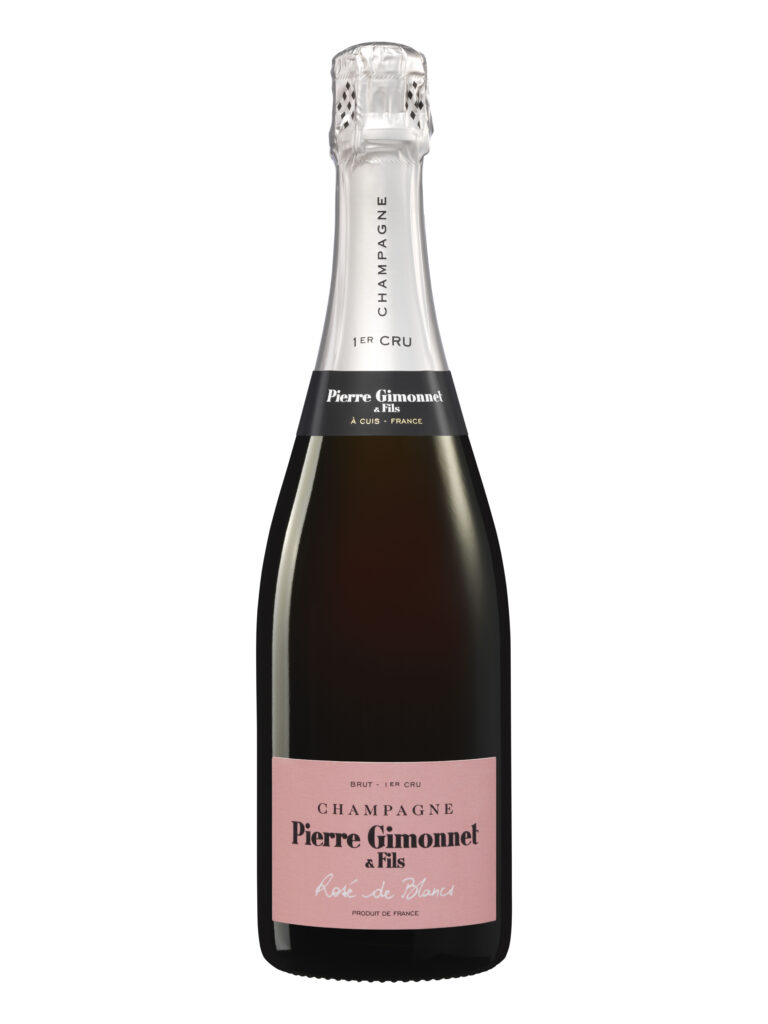
In champagne vocabulary, “Rosé de Blancs” is a delicious anomaly. A rosé champagne made exclusively from Chardonnay, a white grape variety, with no addition of red wine. The colour here comes from skin maceration, from that brief and controlled contact between the must and the golden skins of the grape. The house of Pierre Gimonnet & Fils has mastered this art from its vines in Cuis, and this summer it offers it as the secret weapon of the season of bubbles.
Gimonnet: the Chardonnay growers of Champagne
The house of Pierre Gimonnet & Fils is one of those addresses that serious champagne lovers know and that the general public discovers too slowly. Based in Cuis, in the heart of the Côte des Blancs, the house has cultivated its own vines since 1935 and has always distinguished itself by one obsession: Chardonnay. Not Chardonnay as a pretext for freshness and lightness (the easy cliché), but Chardonnay as a complex register, capable of depth, tension and length.
The house’s philosophy rests on respect for terroirs, the lieux-dits of the Côte des Blancs, their chalk, their exposures, and on cellar work that seeks to reveal rather than to correct. Not manufactured champagne: cultivated champagne.
What the “Rosé de Blancs” says about champagne
A rosé de Blancs is first of all a courageous technical decision. Most houses obtain the pink colour of their champagnes by blending with still red wine, often pinot noir. Skin maceration on Chardonnay is a more delicate, more uncertain route, which yields different results: a paler, often salmon colour, and aromas that owe as much to white fruit as to strawberry or light raspberry.
Choosing this method for a Rosé de Blancs is a wager on subtlety in a rosé champagne market dominated by generous expressions and vivid colours. Gimonnet plays intelligence against spectacle, and it wins.
The perfect summer pairing
Pierre Gimonnet & Fils’ “Rosé de Blancs” presents itself as a gastronomic champagne before being a terrace champagne. Its mineral structure, a direct legacy of the chalky terroirs of Cuis, allows it to accompany dishes that other rosés could not hold: a sea bass tartare, a lobster salad, grilled summer vegetables with a touch of olive oil. Lightness here is not synonymous with blandness.
Served at 8-9°C, this champagne reveals a rare aromatic progression: the fresh, almost taut attack softens into a touch of white peach and dried flowers, before a mineral finish that invites another glass. Summer, decidedly, goes very well with a rosé Blanc de Blancs.
The house that has no need of noise
In a sector where communication is often more worked on than the wine itself, Pierre Gimonnet & Fils represents a model in reverse: a house that trusts the intrinsic quality of its cuvées to make its place. The “Rosé de Blancs” is, in that respect, a fine introduction for those who do not yet know Gimonnet, and a confirmation for those who have long ranked it among their references.
Cette publication est également disponible en :


