
Maison CAMUS presents its new expression: Caribbean Expedition
A unique cognac thanks to its dual oceanic and tropical maturation.
After a perilous 45-day journey, the Cognac casks landed in Bridgetown to be entrusted to Mr. Richard Seale, Foursquare’s Master Distiller, for a further year of maturation in a tropical climate.
Caribbean Expedition is the fruit of the experimental vision so characteristic of the Maison CAMUS.
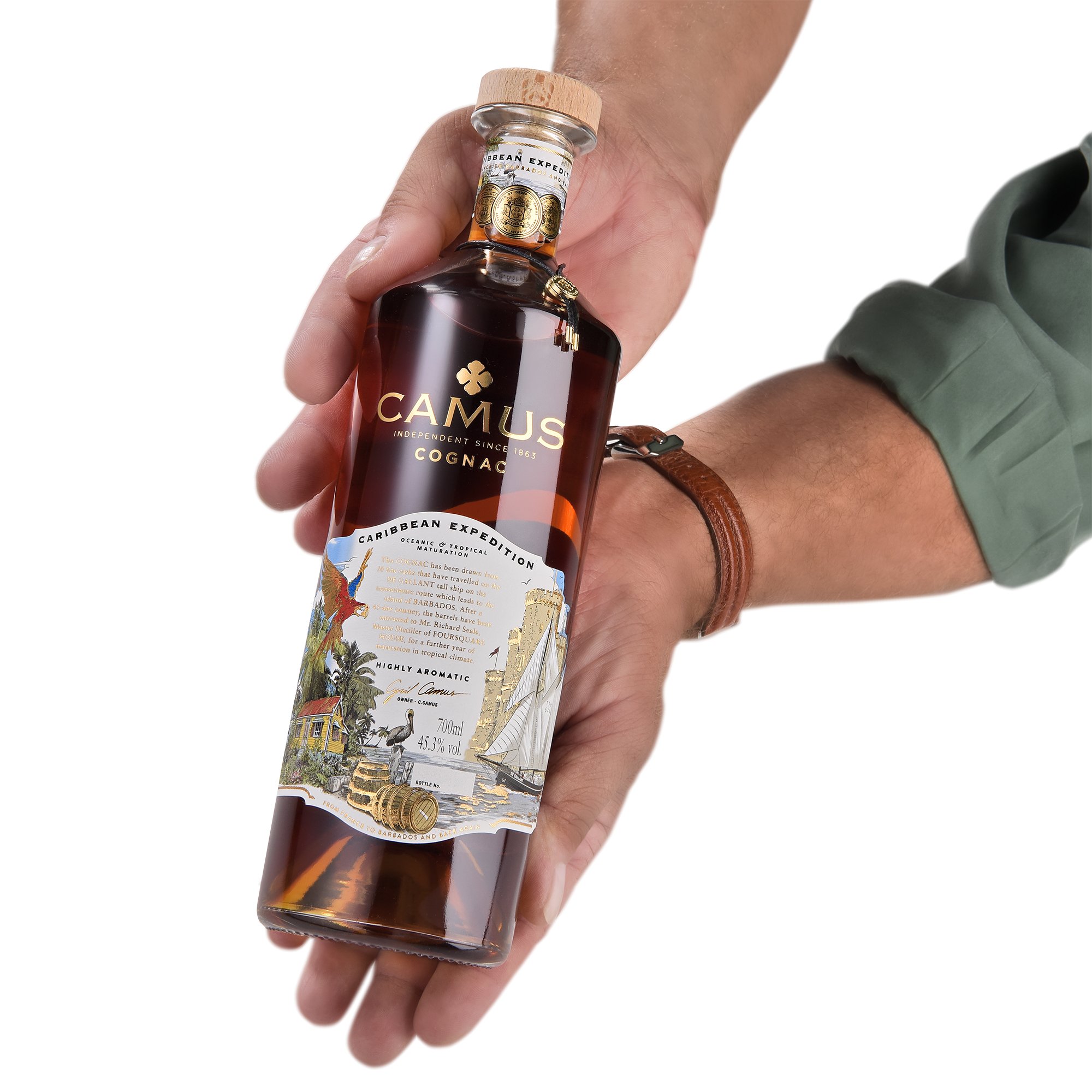
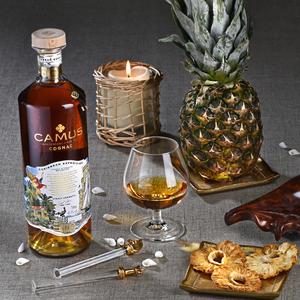
CAMUS Caribbean Expedition is a unique Cognac, with its dual oceanic and tropical maturation. This unprecedented concept of finishing under very specific environmental conditions is the fruit of CAMUS’s experimental vision, seeking to explore the frontiers of Cognac making in order to intensify its aromas. Throughout the 18th century and well into the 19th , the international Cognac trade was conducted by ship, with oak casks leaving their cellars in France for months of sailing to their destinations. At the end of the century, the introduction of glass bottles and the specific rules of the AOC gave rise to an entirely new trade for the Cognac houses. Indeed, this change put an end to the period of “maturation at sea” to which each Cognac had previously been exposed, and which undeniably influenced the evolution of the beverage after the voyage. To explore the opportunities offered by this oceanic maturation, CAMUS decided to load 10 sealed casks of Cognac onto a classic tall ship sailing the transatlantic route to the island of Barbados, in the Lesser Antilles of the Caribbean. The voyage was ensured by a partnership with TOWT, a French company still practicing traditional wind-powered shipping. After a perilous 45-day voyage, the casks landed in Bridgetown to be entrusted to Mr. Richard Seale, master distiller of the historic Foursquare rum house, for a further year of maturation in a tropical climate.
The tall ship De Gallant left the port of La Rochelle, France, on November 23, 2018, under trade winds. After only a few days at sea, weather conditions slowed the boat to the point of preventing it from crossing the Bay of Biscay. In the days that followed, the crew was unable to reach the north-westerly direction that would have given them a certain advantage over the strong winds. The schooner was unable to reach La Coruña, forcing the captain to opt for a south-southeast route. While waiting for more favorable winds, the yacht stopped in Gijón, where one of the crew was disembarked. In view of the time remaining to make up the entire voyage, the planned stopover in Madeira had to be cancelled, and the boat continued on its way at a speed of 5 knots. The descent along the Portuguese coast was slow, and the winds only began to push the schooner off the Moroccan coast, making it easy to dock in Tenerife for an intermediate stop on December 19. After just one day, the De Gallant left the Canaries, cruising at a speed of 7 knots along the Mauritanian coast. It was a smooth descent to Cape Verde, where the boat finally headed west towards Barbados. The crew celebrated New Year’s Eve 2019 on the Atlantic Ocean, 2,272 kilometers from Barbados. Eleven days later, the yacht arrived in Bridgetown harbor, welcomed by the Maison CAMUS team.
CAMUS Caribbean Expedition is a Cognac matured in both oceanic and tropical climates. At the time of departure from La Rochelle, the 10 sealed casks originating from this Cognac contained liquids already in their fourth year of ageing, with an ABV of 48%, subject to natural reduction during oceanic and tropical maturation. Barrel capacity was 350 liters, before variations due to evaporation. The unique series resulting from this project is limited to 4500 individually numbered bottles.
To encapsulate all the key elements of this experimental project, CAMUS has created a highly distinctive pack for Caribbean Expedition Cognac. Presented in a cylindrical bottle, Caribbean Expedition features a label with visual accents inspired by the two emblematic sites to which this Cognac is linked: France, via the port of La Rochelle, and Barbados, via the port of Bridgetown. The texts and drawings are underlined by an elegant gold thread, which adds sparkle to the entire label. The premium cardboard box features an illustration of the voyage to Barbados of the 10 Cognac casks behind this experimental series.
The unique maturation of CAMUS Caribbean Expedition Cognac is the result of two characteristic stages that strongly influence its aromatic profile, taking place over a year and a half between the Atlantic Ocean and the island of Barbados.
Ocean ripening
During the 45-day voyage to the Caribbean, the 10 barrels of CAMUS Cognac were exposed to a number of environmental factors, influencing the maturation process of the liquid. These particular conditions enriched its intensely aromatic profile thanks to very specific reactions that would have occurred much more slowly under continental weather conditions. The continuous shaking and vibration of the Cognac inside the casks, caused by the movement of the boat during navigation, amplifies the contact between each molecule of the liquid and the staves, accelerating the extraction of aromatic components from the casks. The influence of ocean climate All the chemical reactions involved in the maturation process are accelerated by heat. As the boat passed through several climatic zones, including some very hot ones, certain crucial maturation processes, such as oxidation with the formation of aldehydes, were able to take place more rapidly. Variation in atmospheric pressure The permanent change in atmospheric pressure increases the mechanical effect of contraction and expansion of the oak staves, accelerating the process of oxygen consumption. Most of the 10 casks were loaded in the boat’s hold, but two (no. 5 and no. 8) were deliberately tied to the bow, in the open air, to accelerate the effects of this phenomenon.
TROPICAL Maturation
Tropical maturation of this Cognac lasted a total of 1 year. The casks were stored in traditional Barbados cellars, stacked vertically on top of each other. To objectively measure the changes in the liquid during this period and compare them with normal maturation in a continental climate, we kept a barrel of the same Cognac in our cellars for the same period and then compared the two liquids using a chromatograph. Esters The results of the analysis show a significant contribution from wood tannins, which give greater structure and complexity compared with equal maturation in a continental climate. The aromatic components represented by esters also underwent a much greater increase compared to the liquid matured in Europe, with fruity and spicy notes having a higher impact on the palate. This experiment clearly shows a greater aromatic evolution of the liquid left for a year in Barbados, due to the higher temperature and humidity of the tropical climate responsible for accelerating the normal esterification processes. The range of flavors obtained by this process represents an exclusive primacy in the history of Cognac.
Cette publication est également disponible en :

