
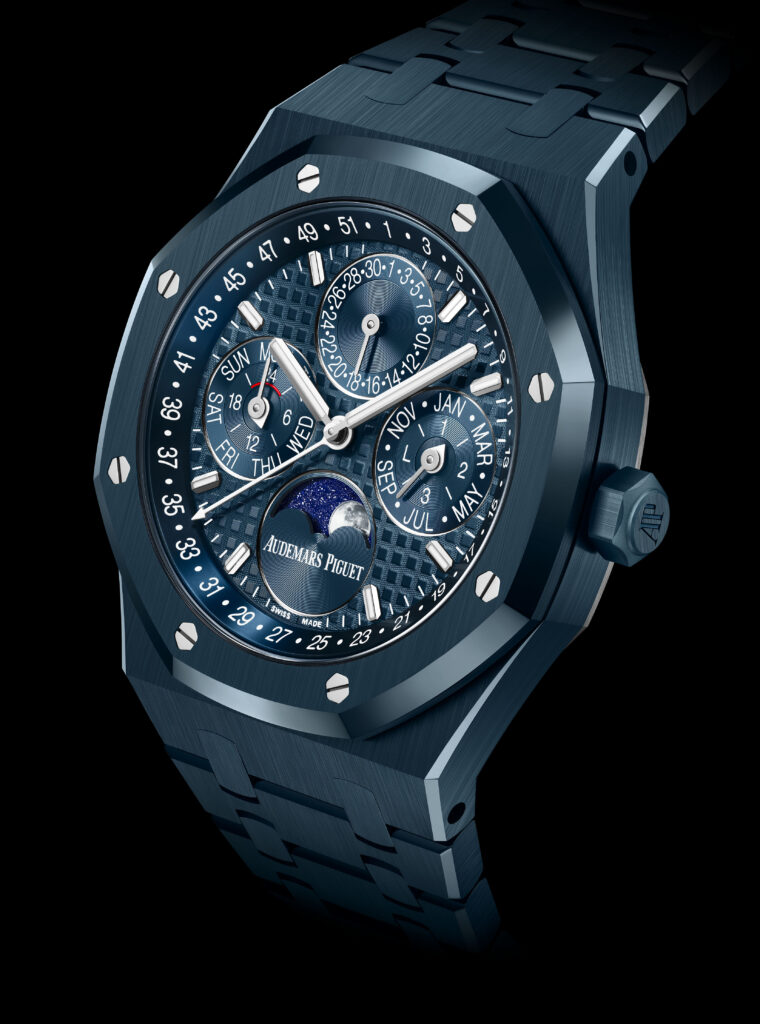
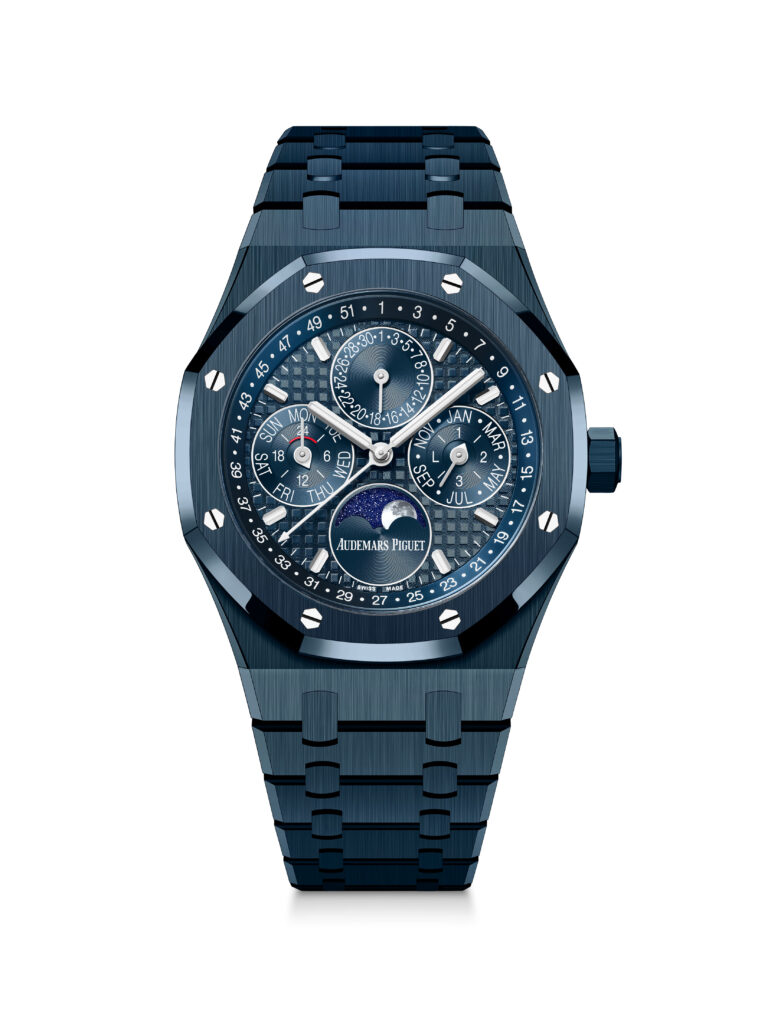
Fifty years after Gérald Genta designed a case that would redefine the relationship between the sports watch and haute complication, Audemars Piguet crosses a new threshold. In February 2026, the Manufacture in Le Brassus presents a 41 mm Royal Oak Quantième Perpétuel Automatique entirely clothed in “Bleu Nuit, Nuage 50” ceramic and powered by Calibre 7138 – a movement that, for the first time in the company’s history, makes the perpetual calendar setting accessible to the crown alone.
A material forged over time
High-performance ceramics are not part of the natural vocabulary of classic watchmaking. Mastering it requires an industrial apparatus that few manufactures can afford to integrate vertically. Audemars Piguet has done so, and the “Bleu Nuit, Nuage 50” color is its most recent achievement. The name itself is worth noting: “Nuage 50” refers to a degree of saturation in the Manufacture’s internal chromatic range – a technical nomenclature that indicates that this is not a fashion blue, but a blue of reference, rooted in the history of watch cases.
This material has qualities that steel and gold do not share. Its hardness – measured at around 1,500 on the Vickers scale, almost ten times that of stainless steel – makes it impervious to everyday scratches. Its lightness, around 40% less than that of steel, alters the way it sits on the wrist. But it’s the alternation of polished and satin-finished surfaces on the same piece of ceramic that reveals the real tour de force: where steel easily tolerates this contrast, ceramic makes it exceptionally difficult to achieve without cracking or tearing. The depth of the blue appears to vary according to the angle – an optical illusion produced by the difference in reflection between the two surfaces.
Calibre 7138: complication reconciled with use
The perpetual calendar has long suffered from a fundamental contradiction: it claims to free its wearer from calendar worries, while at the same time imposing a complex correction procedure, often risky for the mechanisms, at the slightest prolonged stoppage of the watch, which only the initiated can master. Pushing the correctors with a pin, respecting hourly blackout zones to avoid false jumps – this experience chilled more than one aesthete who was convinced by the complication.
Calibre 7138 breaks with this paradigm. The movement’s 423 components – 29.6 mm in diameter and 4.1 mm thick – incorporate an “all-in-crown” adjustment mechanism protected by two patents. Whatever the point in the calendar cycle, the correction is made by simply turning the crown, without tools and without risk to the gears. This is not a luxury of accessory comfort: it’s a redefinition of the relationship between the complication and its wearer. A minimum power reserve of 55 hours and a frequency of 28,800 vibrations per hour complete a caliber designed for real autonomy rather than performance on paper.
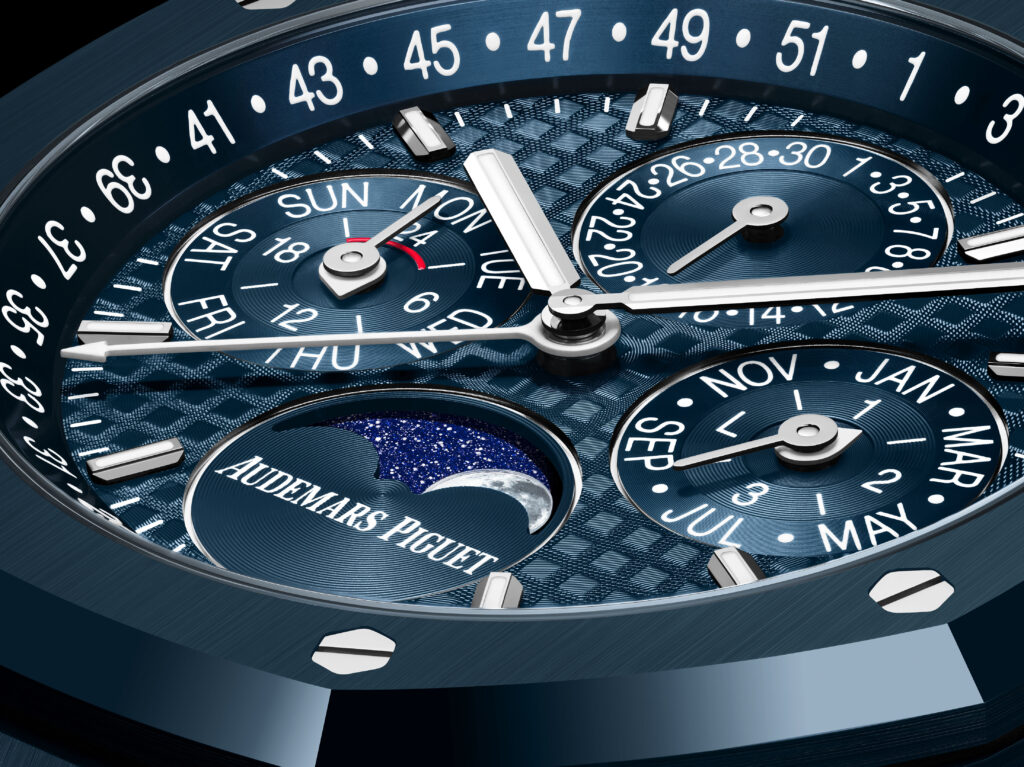
The Grande Tapisserie dial – Royal Oak’s historic guilloché – houses the calendar counters in a matching blue. The 18-carat white gold hour-markers and hands bear a luminescent coating. The legibility of information – weeks, day, date, astronomical moon, month, leap year – has been designed as a cartography rather than an accumulation of data.
Why now? Ceramics as a strategy
The timing is not insignificant. In 2026, the watch industry is going through a phase of readjustment after several years of sustained growth driven by first-time buyers. Manufacturers who have chosen to respond to this economic situation with technical innovation rather than a proliferation of limited editions are signalling a fundamental strategy. By combining two innovations launched separately in 2025 – the ceramic color and the patented caliber – in a single reference, Audemars Piguet is building a synthesis rather than a catalog novelty.
Bleu Nuit, Nuage 50″ ceramic covers the entire watch: case, bracelet, AP folding clasp. This material consistency is not just aesthetic – it’s a sign that the Manufacture has mastered the material sufficiently to impose it on every surface of a piece without compromise. As for the caseback, it remains in titanium and sapphire: a rational decision that preserves visual access to the movement without weighing down the 9.5 mm thick profile.
What this Royal Oak says is that haute complication can at last appeal to those who actually wear their watch – not just those who keep it in a safe. It remains to be seen whether the industry as a whole will learn the lesson from this patented movement: the value of a complication is measured not by its difficulty of use, but by its relevance over time.



Cette publication est également disponible en :

