
L’Artisan Parfumeur opens the year with an eau de parfum that sums up fifty years of niche positioning in a single gesture: entrusting a creation to a classically trained perfumer, with a deliberately reduced palette and materials whose antagonism is the real subject.
Nathalie Lorson’s signature doesn’t begin with a flower. It begins with a gentle aggression: pimento leaf, a top note chosen not for its immediate warmth, but for its vegetal vivacity, slightly chlorophyllated before becoming burning. It’s a risky technical choice – the leaf, distinct from the fruit, releases an accord more green than spicy at the opening, then gives way to what the dossier soberly calls “ink”.
The ink accord, a synthetic material based on iris and musky-aldehyde notes, is one of the few olfactory devices to mimic a tactile sensation rather than a plant or resin. Lorson makes it the linchpin of L’Amant: it links the volatility of pimento with the density of patchouli – a stable, earthy heart note, whose “dark chocolate” facet in modern versions provides this link between mineral aridity and organic warmth.
Technical details The complete pyramid: chili leaf (top); ink, patchouli (heart); cypriol, sandalwood, vetiver (base). Cypriol – extracted from the Indian rhizome Cyperus scariosus – adds a smoky, earthy character that sets this base apart from conventional orientals. Sandalwood and vetiver provide fixity and projection on the skin.
What deserves attention here is not so much the list of ingredients as the logic of construction. Lorson has avoided the oud accord, the dominant reflex in the orientalizing niche eaux de parfum of 2015-2023. Instead, she substitutes the less immediately identifiable cypriol, whose extraction by steam distillation of the rhizome produces a material both smoky and earthy, halfway between oakmoss and Haitian vetiver.
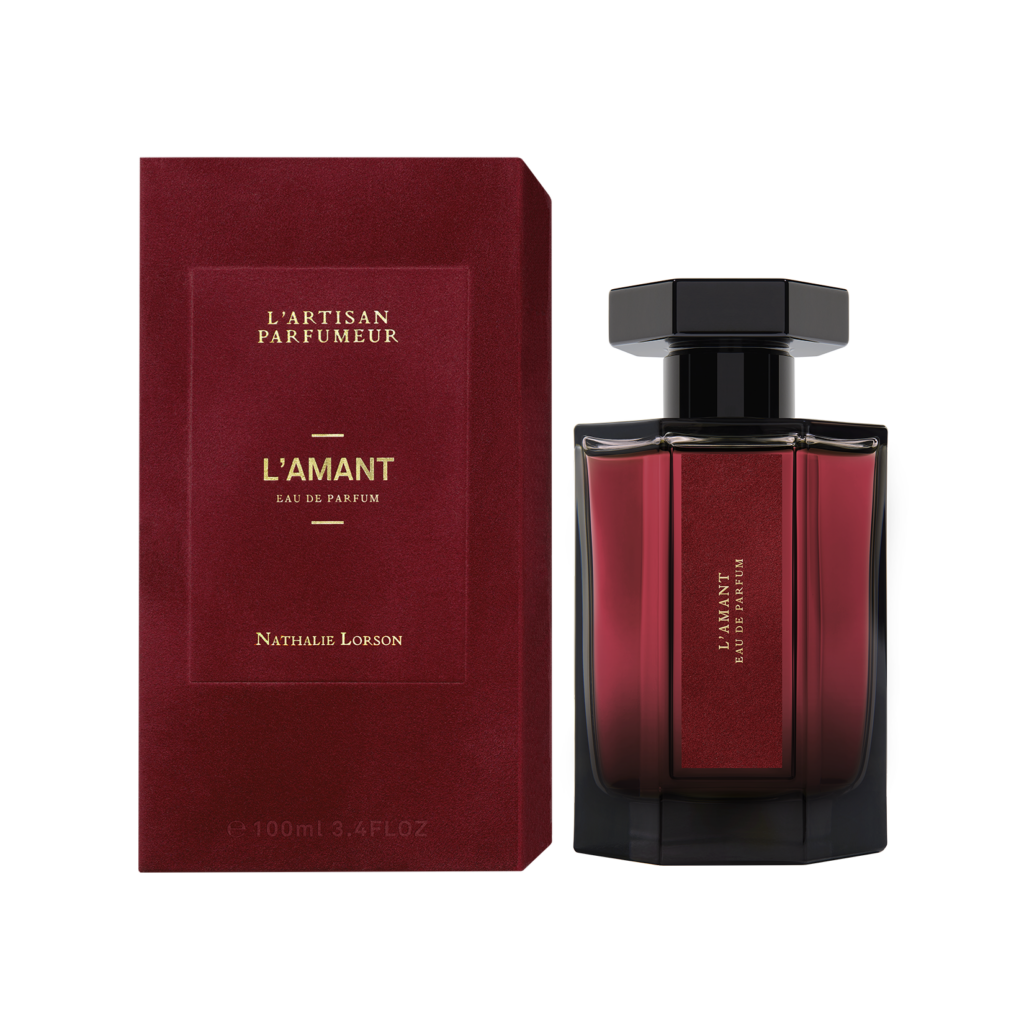
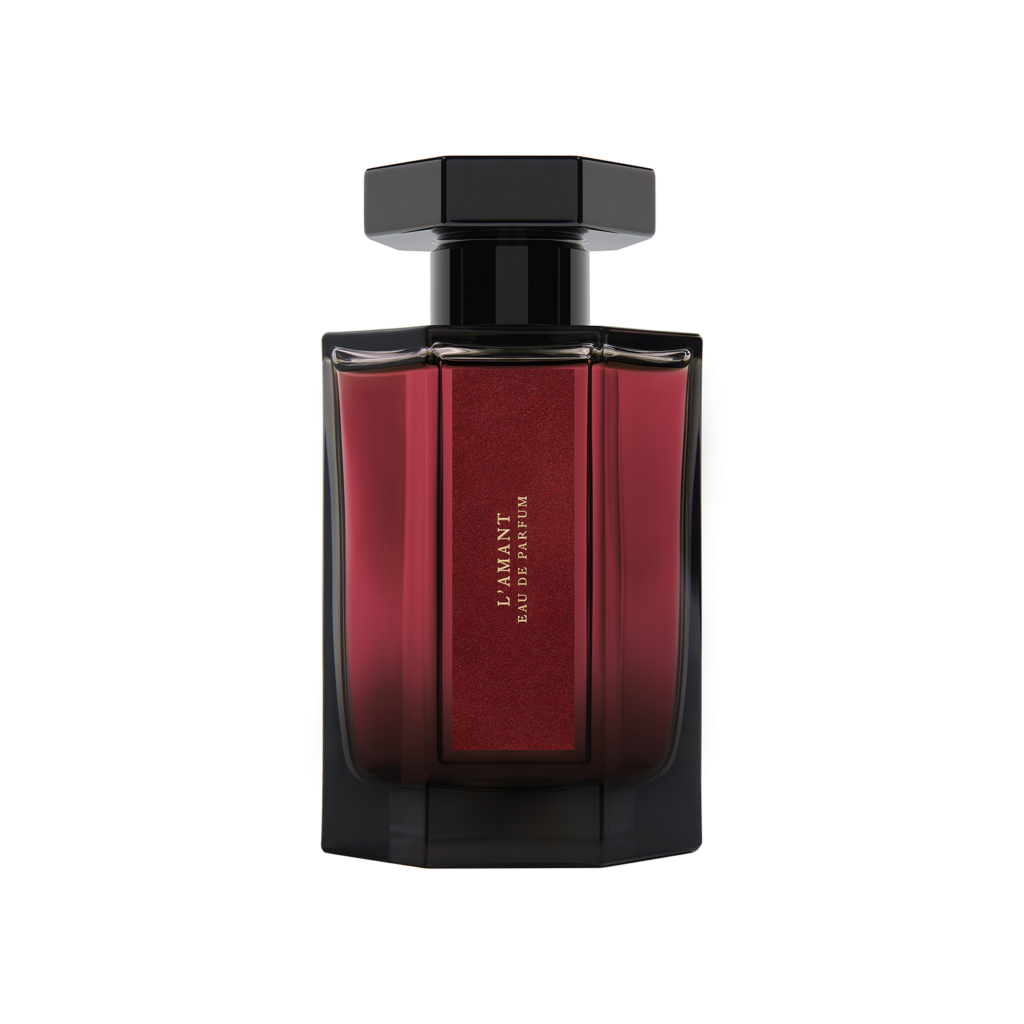
The bottle, in geometrically faceted red glass with a matte black cap, follows the chromatic range of the L’Artisan Parfumeur collection without any formal break – a choice of line consistency rather than singularity.
The real question posed by L’Amant is that of a return to constraint. Where contemporary niche perfumery sometimes multiplies ingredients to signal complexity, Lorson works with five-six materials and relies on their friction rather than their accumulation. It’s a school of thought – that of Jean-Claude Ellena or Olivier Polge – that considers restraint to be as much a technical skill as chemical precision.
L’Artisan Parfumeur, founded in 1976 by Jean Laporte as an artisan perfumery workshop against the tide of industrial production at the time, then acquired by the Puig Group in 2011, has been undergoing a decade-long reconfiguration of its identity between niche heritage and luxury distribution ambitions. L’Amant seems to confirm an editorial line: designers in the public eye, formulas reduced to their essentials, a literary narrative assumed as a pretext rather than an argument.
While the trend towards inky harmony continues to structure the House’s creations, we’ll be watching to see whether this choice of material tension – between vivid botanicals and a woody-earthy background – becomes a real thread, or simply the signature of a season.
Cette publication est également disponible en :

