
Since 2000, BAO BAO ISSEY MIYAKE has been building on the same principle – PVC triangles on polyester mesh, manufactured in Japan – a formal vocabulary that reinvents itself through color and pattern. The SIGN series, available from March 1, extends this vocabulary to urban signage. The object raises a question that goes beyond leather goods: at what distance does a surface become a sign?
There’s a paradox in the genesis of BAO BAO. In 1997, Issey Miyake was inspired by the Guggenheim Museum in Bilbao – a building conceived by Frank Gehry around the notion of “forms born of chance” – to design a radically controlled piece: isosceles triangles of flexible PVC, glued to an underlay of polyester mesh, whose repetitive assembly produces volumes not anticipated by the initial design. The final shape depends on content, movement and positioning. The architect as a pretext for anti-architecture.
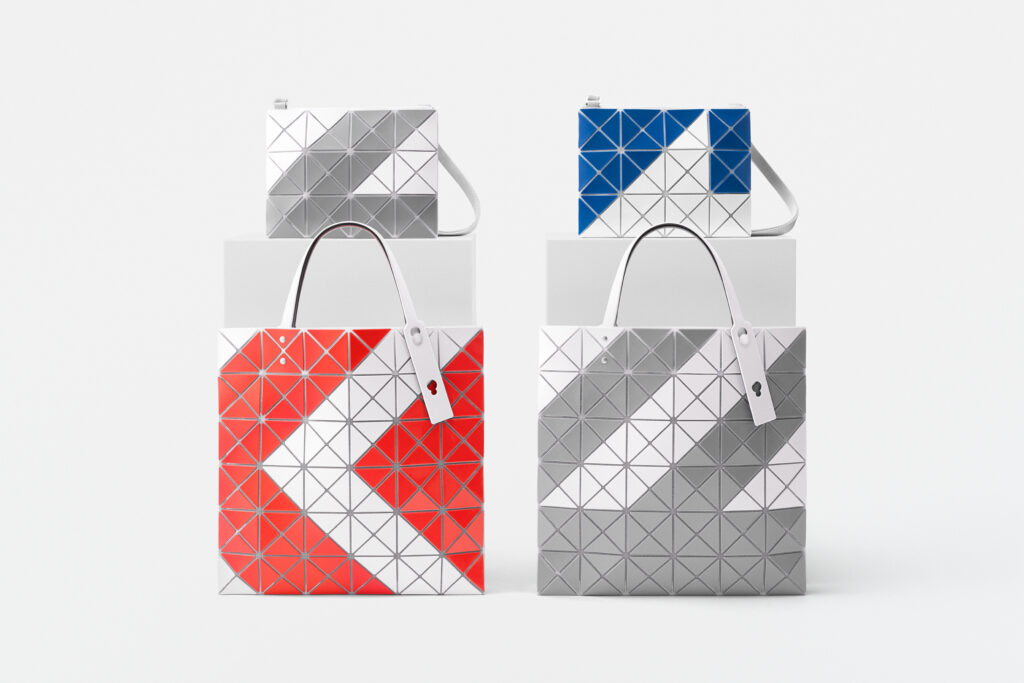
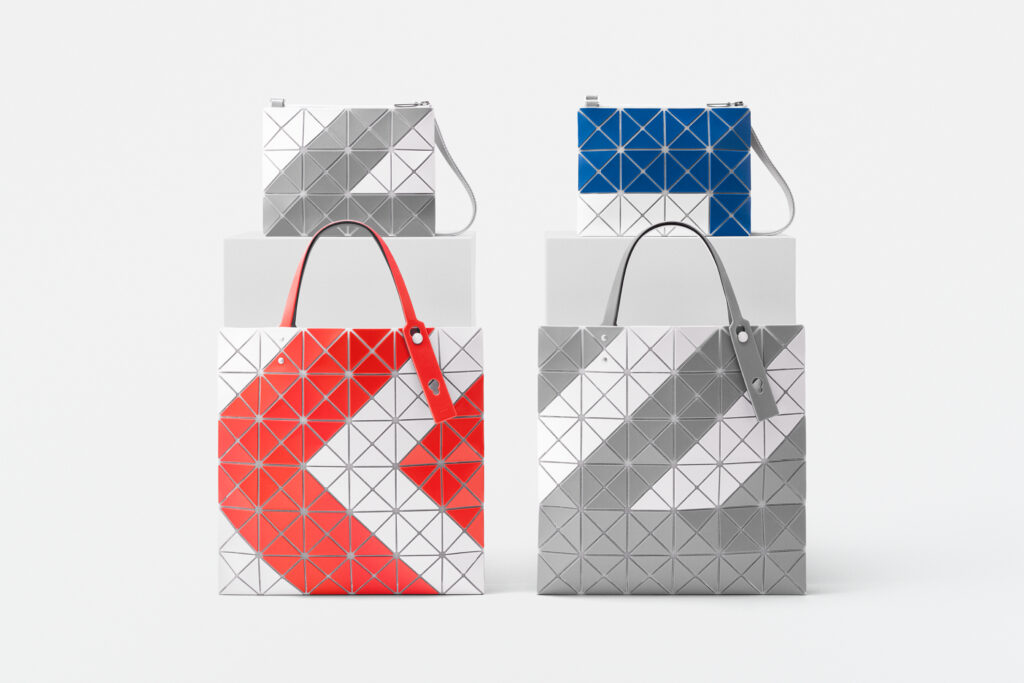
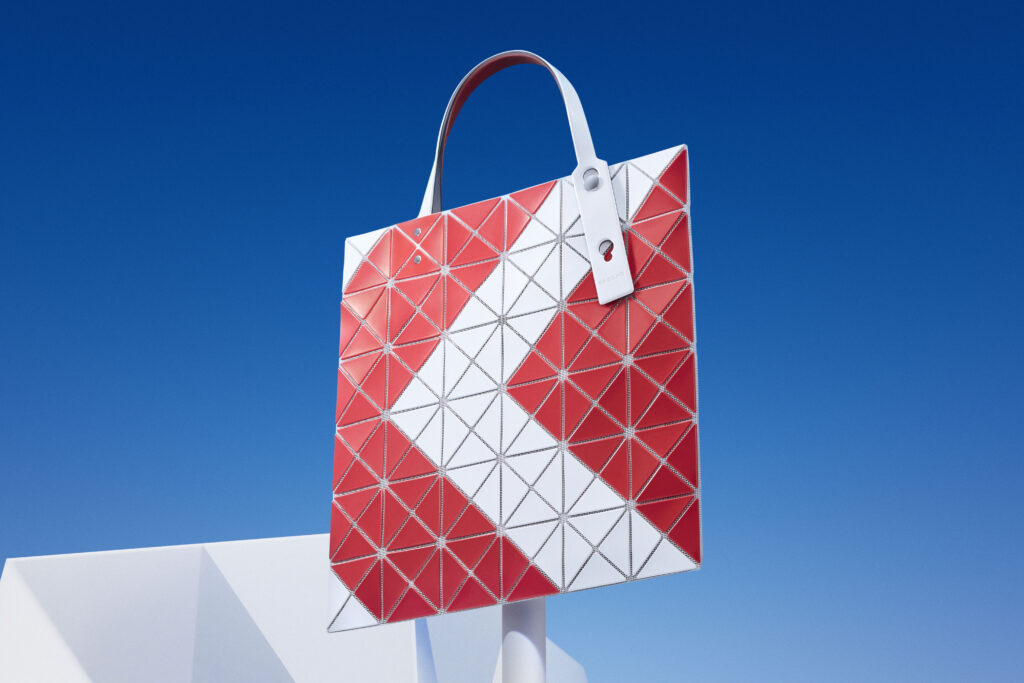
Twenty-five years after this first gesture, the SIGN series extends the logic of the legible surface. The three colors chosen – red, blue and gray – are not gratuitous chromatic choices. They reflect the international codification of road signs: red for the bend sign, blue for the one-way arrow, grey for the crosswalk. Seen from a distance, the triangular modules merge into an identifiable sign-form. Close up, they reveal their construction: independent facets, visible joints, play of reflections depending on the angle of incidence of the light.
This is where SIGN’s formal interest lies. BAO BAO has always worked on variable perception – the same bag read differently according to distance, light and movement. This series adds a semantic layer: the shape perceived at a distance is a quotation of urban reality, a shape that the user knows without having learned it, because it belongs to the common space of the city. The 34 x 34 cm tote bag thus becomes a hand-held billboard – not out of provocation, but out of consistency with an approach that has always treated the object as a surface of projection.
The manufacturing process remains the same: flexible PVC triangles assembled on polyester mesh, produced in Japan. Two formats on offer – the 17 x 23 cm shoulder bag at 530 euros, the 34 x 34 cm shopping bag at 690 euros. The short film accompanying the launch extends the idea: road signs that “turn out to be bags” and move “towards a new destination”. The narration is perhaps too explicit, but it confirms that the formal intention is assumed, not accidental.
The SIGN series reminds us that BAO BAO occupies a singular position in the landscape of contemporary Japanese accessories: neither traditional leather goods, nor a fashion object in the seasonal sense, but a continuous exploration of the same constructive principle from which each series draws a new angle. The modular surface as method. The city, this time, as vocabulary.


Cette publication est également disponible en :

