
By adding a gem-set bezel to its Royale Paris, the Manufacture franc-comtoise is not changing its register. It confirms a trajectory – that of an independent watchmaker who really does make watches in France.
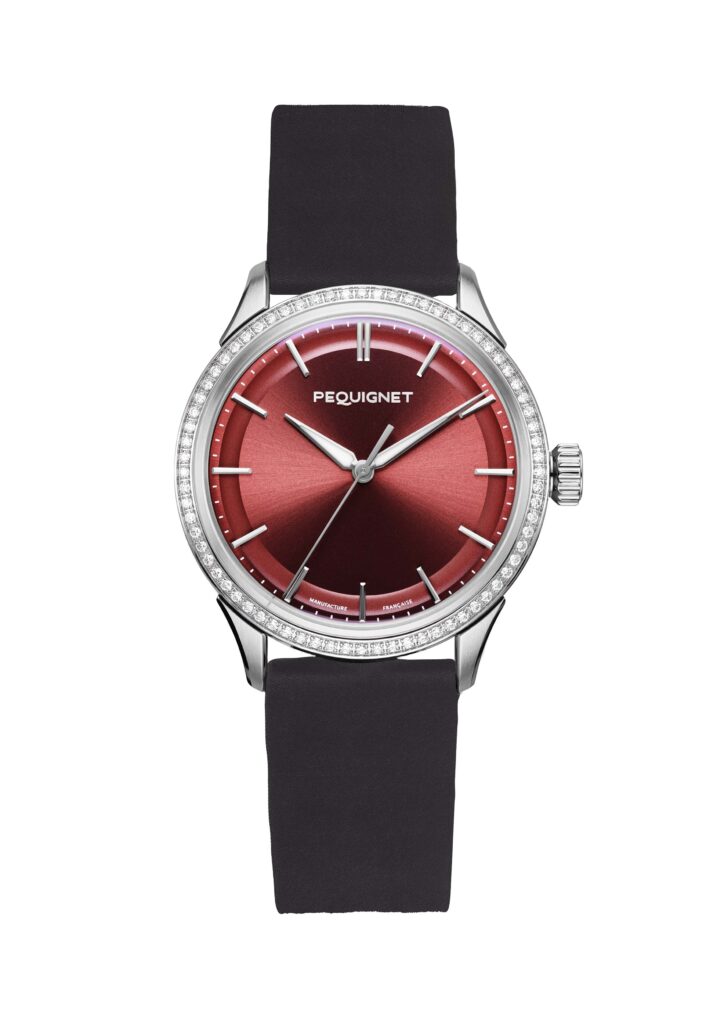
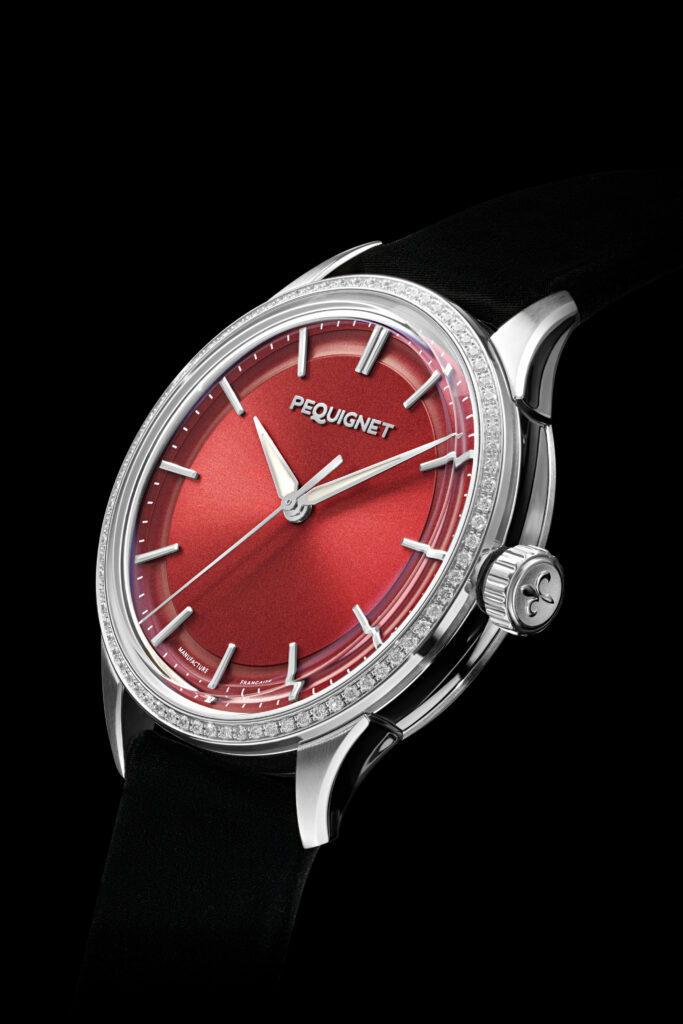
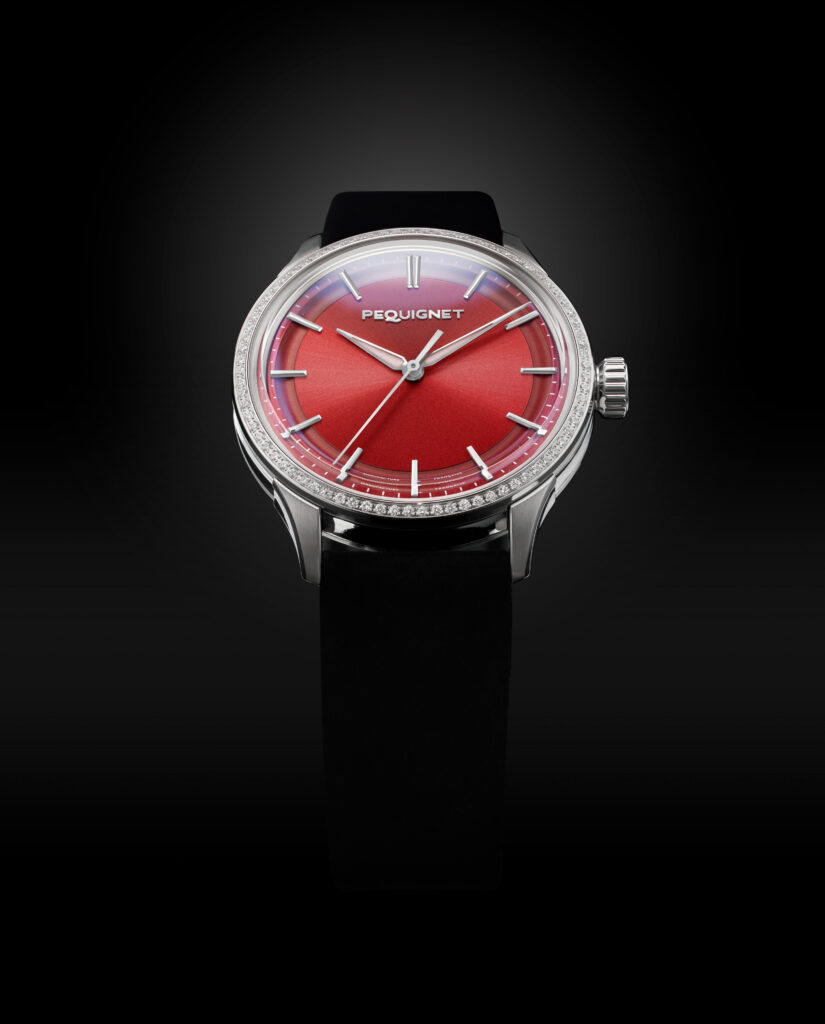
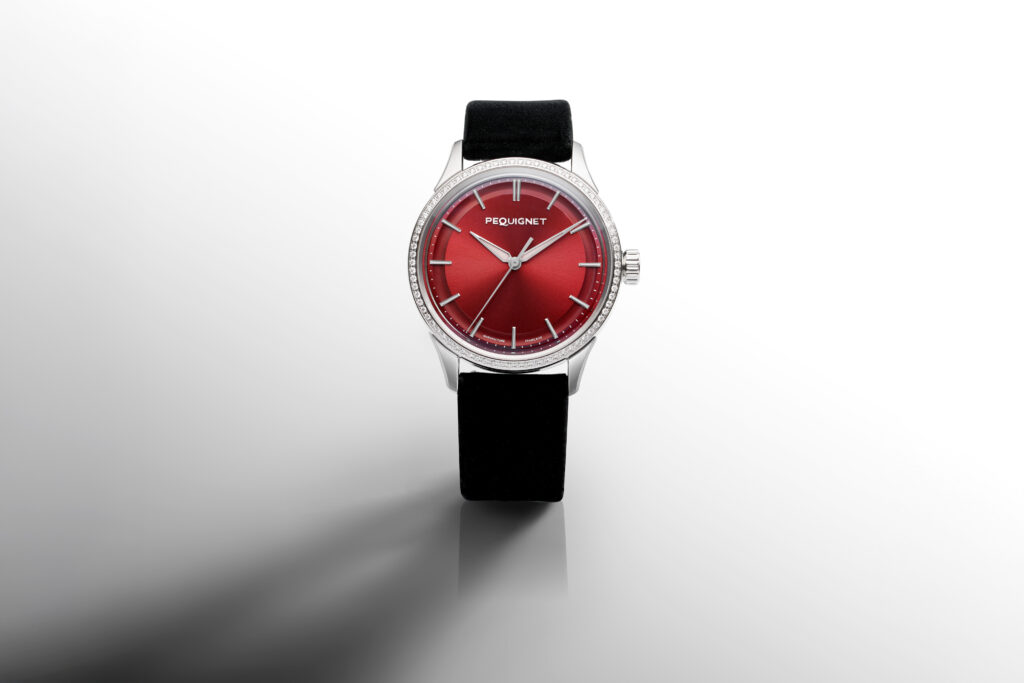
It’s easier to talk about the 78 diamonds. They occupy the bezel, weigh a total of 0.312 carats and constitute the only visible variation on a watch whose morphology has now been stabilized since the 2025 redesign. The burgundy sunray dial – the only one offered with this variation – accentuates the contrast between the sobriety of the 316L steel case and the discreet sparkle of the perimeter. Each stone is small. The effect is restrained. This is not haute joaillerie: it’s setting in the service of a line.
But the real subject of Manufacture Pequignet has never been the bezel.
The geography of a movement
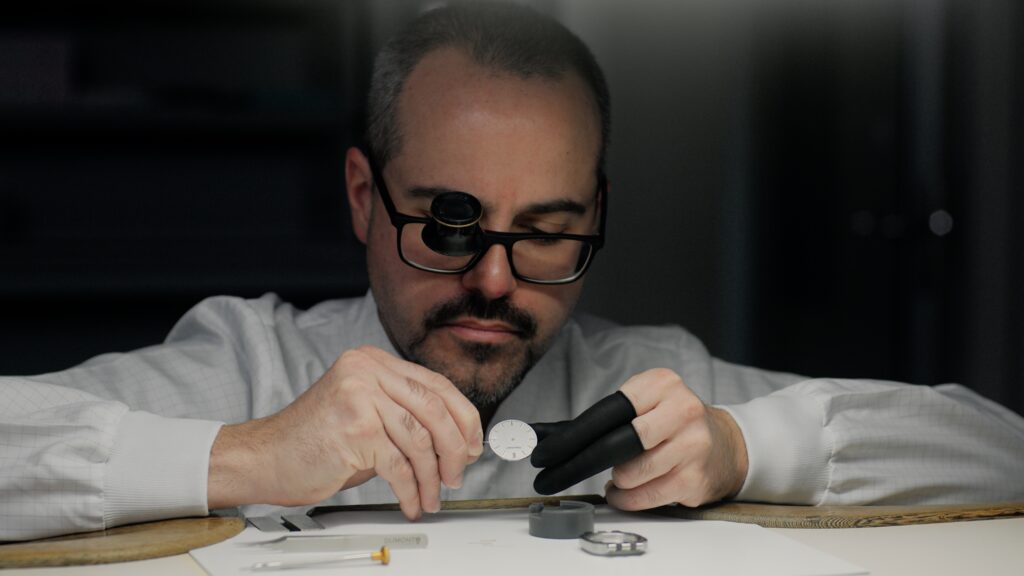
The Initial® Calibre, which powers this Royale Paris 36 mm Sertie, is designed, developed and hand-assembled in the workshops of Morteau, in the heart of the Jura mountains. The town is sixty kilometers from Besançon, the historic capital of French watchmaking – an industry decimated by the quartz shock of the 1970s and 80s, and which a handful of companies are trying, with unequal means, to rebuild. Pequignet is one of them. Its components are sourced within an 80 km radius; 72% come from France. This figure is worth noting: in a sector where the notion of “manufacture” can cover widely disparate realities, it indicates real, not rhetorical, vertical integration.
The movement itself is set to six positions, with a tolerance of -4 to +6 seconds per day – a demanding standard for a caliber in this price range. Wearing accuracy is around +/-2 seconds daily. Power reserve reaches 65 hours at 4 Hz (28,600 vibrations/hour). The oscillating weight is openworked, decorated with a colimaçonnage and a lily in relief – visible through the sapphire caseback held in place by six screws.
Inset Detail – The glass box
The domed anti-reflective sapphire crystal, known as the “glass box”, is a convex-cut construction that optically amplifies the depth of the dial. The slight curvature creates a magnifying glass effect on the center of the sunray dial, whose rays converge towards the axis of the hands. The anti-reflective coating on both sides reduces light interference, which would otherwise be multiplied on a curved surface. This type of crystal requires greater precision of shape than flat glass, and a suitable frame to avoid mechanical stress during assembly.
Building independence
Founded in 1973 by Émile Péquignet, the company only became a Manufacture in 2010 – thirty-seven years after its creation, by which time it had mastered the design and production of its own calibers. In 2021, it will join Maisons & Manufactures, a structure founded by industrialist Hugues Souparis to support French know-how. In 2024, the Calibre Royal® Tourbillon extended the range to the upper echelons of mechanical complication.
The Royale Paris Sertie, available as a permanent edition from €4,900, is not aimed at the high jewelry market. It’s for those for whom the watch case is first and foremost an envelope – and what’s inside, the essential.
Cette publication est également disponible en :

