
The movements of 23 clocks at the Château de Fontainebleau are the subject of a major restoration campaign, made possible by Rolex’s sponsorship, which is bringing these historic sites back to life.
Since 2008, the Swiss watch manufacturer Rolex has been maintaining and restoring the château’s exceptional clock collection, which includes some sixty clocks made between 1680 and 1880. Both scientific instruments and objets d’art, these clocks set the pace for Fontainebleau’s heyday, and continue to enliven the tour today.
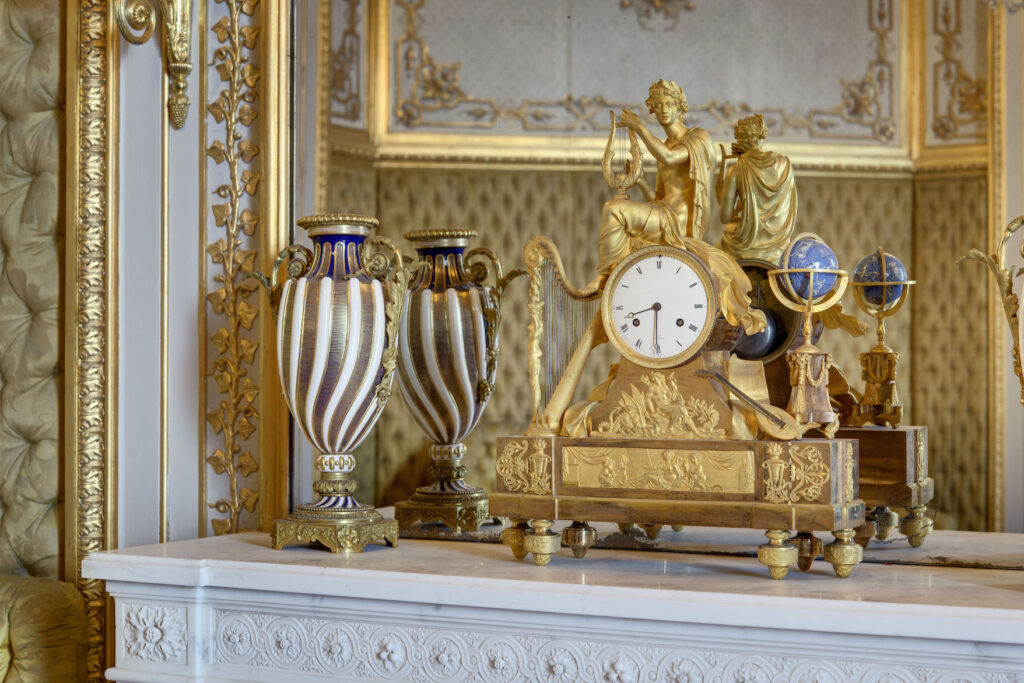
RMN-Grand Palais (Château de Fontainebleau) / Adrien Didierjean
Octagonal salon clock in the Emperor’s salon, First Empire, Lepaute movement
Clock restoration and maintenance
The daily operation of the clocks and the climatic hazards of the rooms in which they are deployed call for particularly careful upkeep and maintenance. Indeed, the relative humidity of the premises can affect the clocks’ sometimes capricious mechanisms. With two visits per month, restorer Ryma Hatahet, assisted by two watchmakers, ensures that the mechanisms are in good working order and carries out regular repairs. The main challenge is to get long-damaged movements working again. This mainly involves cleaning and replacing missing parts. Thanks to Rolex’s renewed sponsorship in 2021, the heart of 23 clocks has been revived and is now serviced twice a month.
In addition to these 23 clocks, the famous bell tower clock in the Cour d’Honneur is being studied with a view to its forthcoming restoration, which will be a major undertaking.
Fontainebleau’s formidable watchmaking heritage still has a long way to go. 
From left to right: detail of the clock with Apollo’s chariot, cabinetmaker André-Charles Boulle, Mynuel movement in Paris © RMN-Grand Palais (Château de Fontainebleau) / Thierry Ollivier; clock with the figure of the Study, early 19th century, Lepaute movement; clock with the sleeping beauty and Love, late 17th or early 18th century, Debay movement in Paris © Sophie Lloyd, Château de Fontainebleau
The ten-dial clock: an exemplary restoration of a rare object
The exceptional ten-dial clock dates from the 19th century and is attributed to the great Swiss watchmaker Samuel Roy (1746-1822). In 2020, a preliminary study was initiated to assess its condition. Deformations, cracks, corrosion and missing parts were preventing it from functioning. It took six months to complete the restoration of this exceptional work.
Last September, the clock was reinstalled in Napoleon I’s interior apartment, where it had stood since 1840, and thanks to the support of Rolex, visitors can now hear it strike for the first time in many decades.

Astronomical clock with ten dials, in the antechamber of the interior apartment of the Château de Fontainebleau,
late 18th or early 19th century © Serge Reby, Château de Fontainebleau
Rolex, perpetuating culture and knowledge
Rolex is an independent, integrated Swiss watch manufacturer. Based in Geneva, the brand is renowned the world over for its expertise and the quality of its products, symbols of excellence, elegance and prestige.
This philosophy is reflected in its long-standing commitment to the arts and culture through partnerships with artists, cultural institutions and exceptional performances.
It is driven by this desire to contribute to the preservation and transmission of a unique cultural heritage steeped in history that Rolex France undertakes sponsorship initiatives.
More information on rolex.org
Cette publication est également disponible en :

