
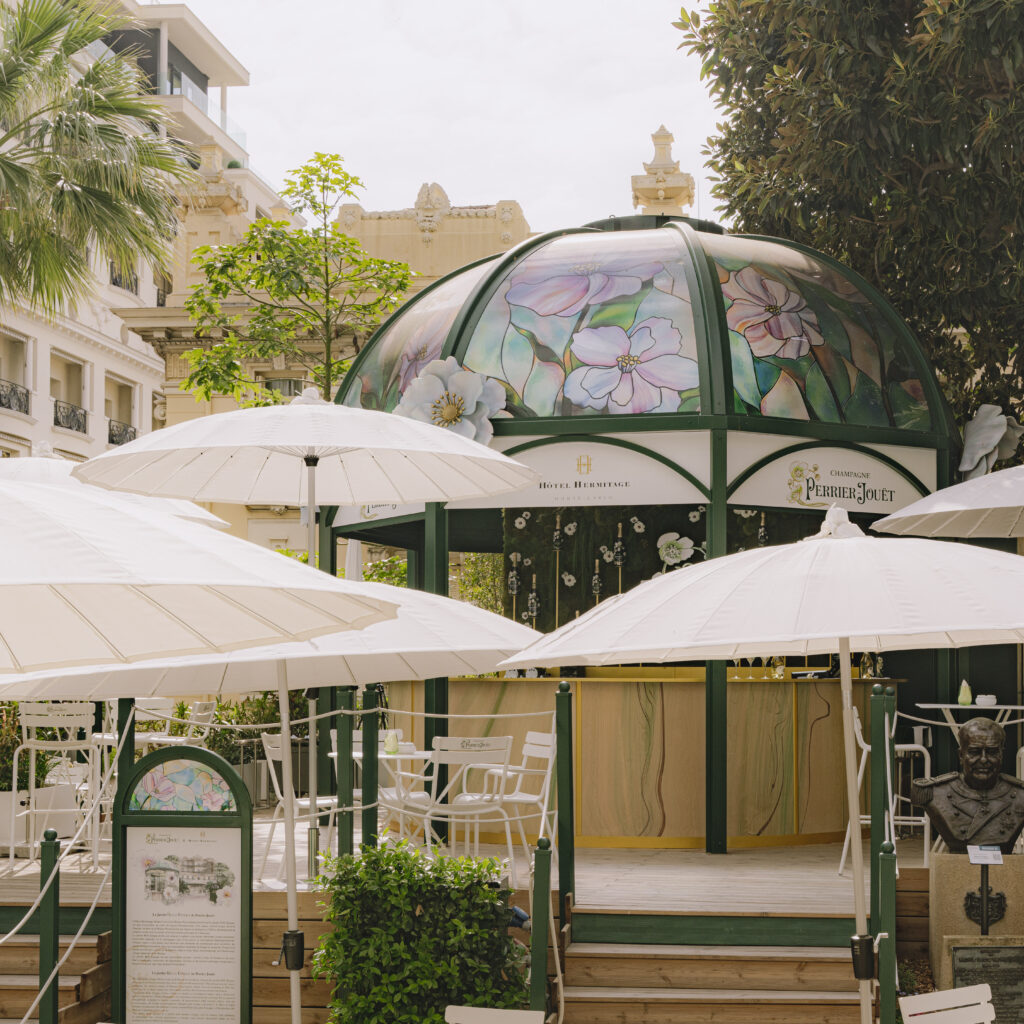
In Monaco, Square Beaumarchais is hosting the Jardin Belle Époque for a second season—an installation conceived by Perrier-Jouët in collaboration with the Hôtel Hermitage Monte-Carlo. More than just a tasting space, the project offers a sensory exploration of the biodiversity that shapes the Champagne vineyards.
In the spring, Monaco fosters a special relationship with temporary gardens. Set between the Belle Époque facades of the Hermitage and the hustle and bustle of the harbor, Square Beaumarchais once again hosts a structure inspired by Art Nouveau. Beneath its green dome, Maison Perrier-Jouët has created an experience that goes beyond a simple champagne bar.
This initiative might seem predictable. Yet the project reveals a deeper trend in contemporary luxury: the need for luxury brands to highlight the ecosystems that support their production. For several years now, Perrier-Jouët has placed biodiversity at the center of its agricultural narrative. Here, this approach moves beyond the vineyard and into the urban landscape.
The tour is organized like a stroll. Visitors first discover the Flute Tree, created by Dutch designer Tord Boontje. Usually on display at the Maison Belle Époque in Champagne, this hybrid object draws as much from sculpture as it does from the ritual of wine tasting. Its branches hold suspended flutes that visitors take before tasting the vintages under the guidance of a sommelier.
Further on, the sound installation *Oecanthus*, created by David Monacchi, introduces another dimension of the vineyard landscape: that of sound. The work is the result of several months of sound recording in the estate’s vineyards. It captures the subtle presence of the species that make up this agricultural environment. In a sector that often focuses on “terroir” as a geological concept, this installation serves as a reminder that the vineyard is also a living habitat.
This exploration continues with the recreation of the “Biodiversity Island” conceived by the FormaFantasma studio. The installation brings to life the experiments conducted on the coexistence of grapevines, pollinating insects, and local flora. It is a way of translating an agronomic program into an accessible experience.
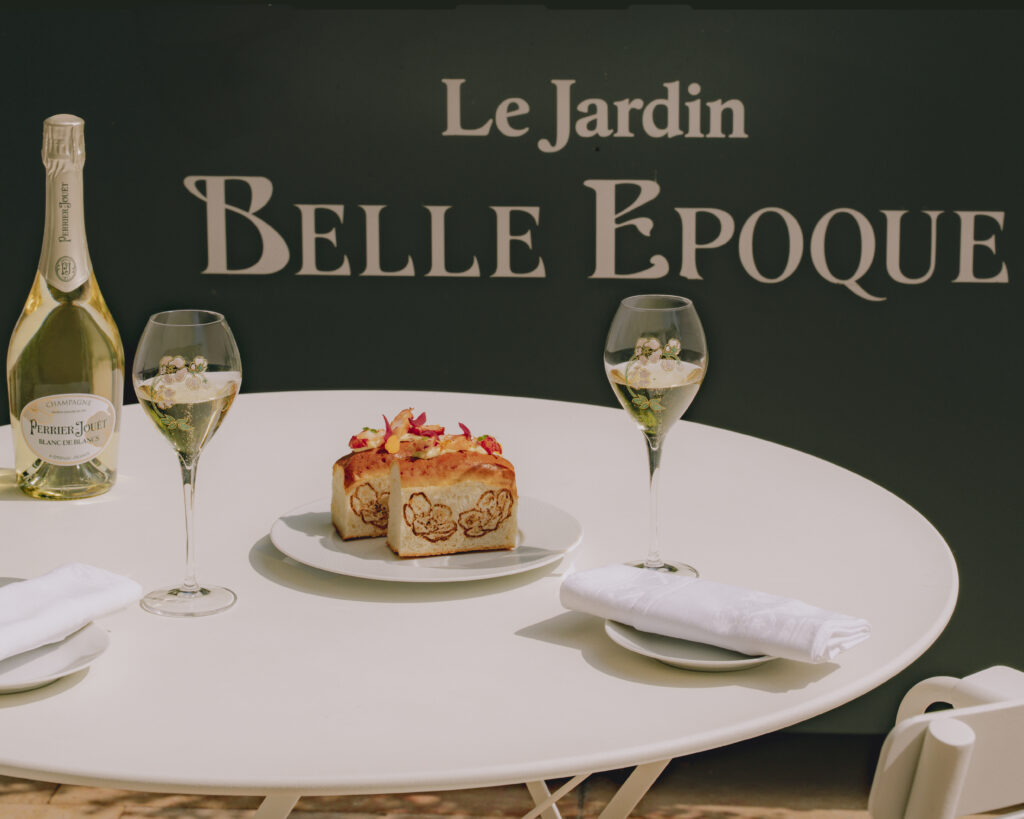
The culinary aspect also plays a role in this presentation. Laurent Piolti, Executive Chef at the Hôtel Hermitage Monte-Carlo, and Sébastien Morellon, Executive Chef at Maison Belle Époque, have created a series of pairings centered on Chardonnay, a grape variety that Perrier-Jouët has used as its signature since 1811. A lemon-caviar lobster brioche served with a citrus mayonnaise pairs beautifully with the House’s Blanc de Blancs. “The minerality of the Chardonnay complements the briny notes and elegance of the lobster, as well as the toasty notes of the brioche,” explain Sébastien Morellon and Séverine Frerson, Cellar Master.
Detail
Chardonnay as the common thread
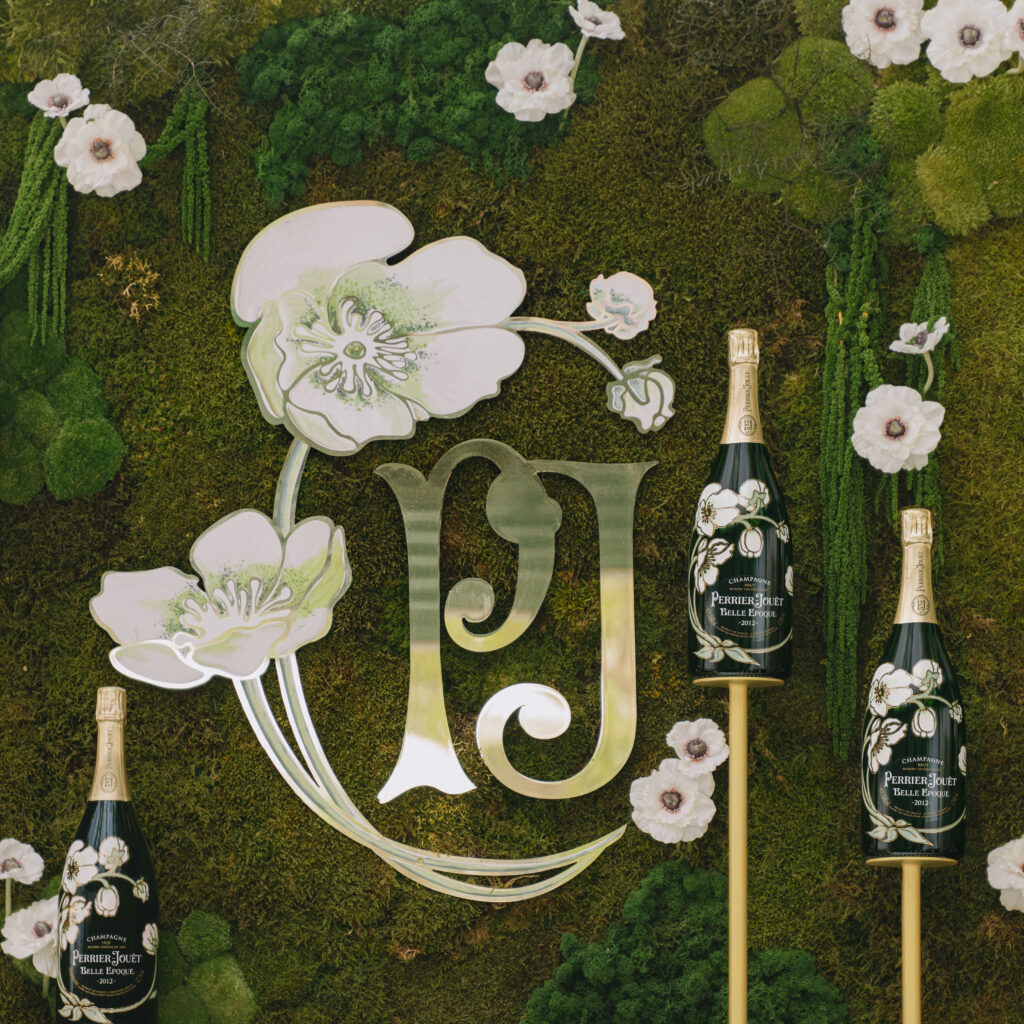
Founded in 1811, Perrier-Jouët has built its identity around Chardonnay, a grape variety that has historically been less dominant in Champagne than Pinot Noir or Meunier. Le Jardin Belle Époque uses this uniqueness as a narrative thread, linking wine tasting, biodiversity, and artistic creation through a shared floral vocabulary.
Perhaps that is the true appeal of the Jardin Belle Époque. In an industry where the experience often boils down to spectacular staging, this installation seeks to reintroduce a more subtle concept: that of interdependence. Combining temporary architecture, soundscapes, and the observation of living things, Monaco becomes, for the duration of a season, a cultural extension of the Champagne vineyards.
Cette publication est également disponible en :

