
Nuclear fusion promises massive, carbon-free, and virtually inexhaustible electricity. But between the initial scientific breakthrough and a power plant connected to the grid, there remains a vast chasm in terms of engineering, production scale, and cost.
We now know how to ignite, for a few billionths of a second, a miniature version of the Sun on Earth. In a chamber ten meters in diameter, 192 laser beams converge on a tiny target containing deuterium and tritium, two isotopes of hydrogen. The process takes less than the blink of an eye: in ten billionths of a second, the matter transitions from its normal state to temperatures on the order of 100 million degrees. On this scale, physics is no longer an abstraction. It becomes a choreography of extreme intensity, precise to the micron.
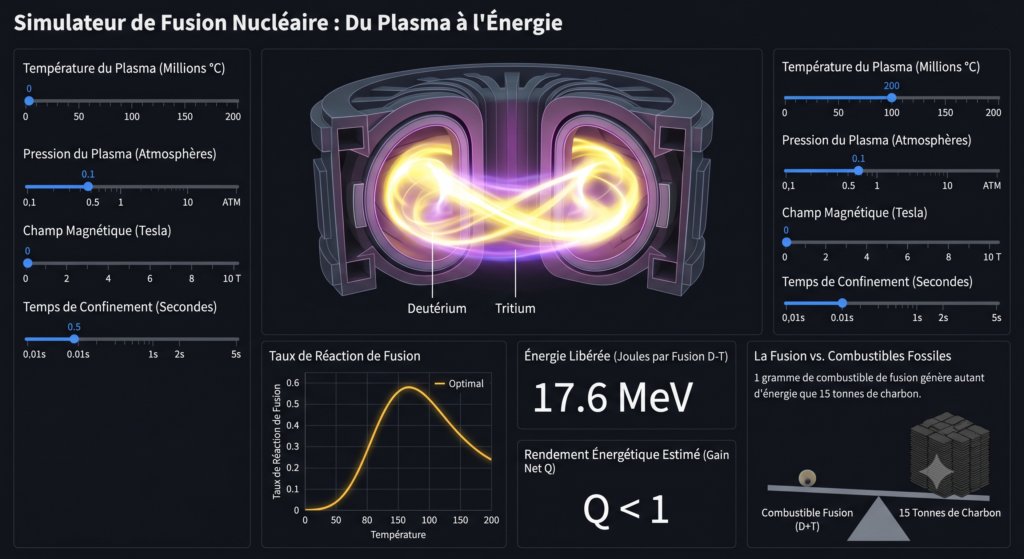
The promise lies in an age-old equation: a tiny fraction of mass is converted into energy. When deuterium and tritium fuse, they produce helium, a fast neutron, and a considerable amount of energy that can be recovered as heat. This heat, just as in a conventional power plant, must then be used to produce steam, drive a turbine, and feed electricity into the grid. The breakthrough, therefore, is not in the turbine. It lies in the heat source.
Energy without a chain reaction
Fusion is not fission. In a modern nuclear power plant, a heavy uranium nucleus splits upon being struck by a neutron, releases energy, and triggers a chain reaction. It is precisely this chain reaction that must be controlled. Fusion, on the other hand, presents the opposite challenge: it is so demanding that the reaction stops as soon as the system that sustains it is shut down. No more laser, no more tokamak, no more fusion.
This is one of its strongest arguments: no uncontrolled chain reaction, no need to import large quantities of fissile fuel, and no very long-lived radioactive waste comparable to the actinides produced by fission. Deuterium is found in water. Tritium, which is rarer and radioactive, will need to be produced on-site, likely from lithium, and then reintroduced into the system.
On paper, the appeal is almost brazen: an abundant fuel source, continuous production, carbon-free baseload electricity, and no major geopolitical dependence. But what works on paper still falls short in practice.
The obstacle is no longer just scientific
Two major approaches dominate today. Magnetic confinement, embodied by tokamaks, seeks to contain a superheated plasma within a ring using powerful magnetic fields. Inertial confinement, on the other hand, uses lasers to compress a fuel capsule until fusion conditions are created.
The first path is that of ITER, a massive international project based in Cadarache. Its goal is clear: to demonstrate that a plasma can produce ten times more fusion energy than the energy injected to heat it. The second path reached a historic milestone in 2022, when the National Ignition Facility in California achieved energy gain at the target for the first time. Since then, records have been set one after another, but it’s important to understand what these records mean: they prove that the physics works. They do not yet prove that a fusion power plant is within reach.
The Details
Today, a large fusion laser can fire once a day. A power plant would need to aim for about ten shots per second—or more than 800,000 shots per day. An experimental target can cost several hundred thousand dollars; the economics of a power plant would require reducing the cost to a negligible industrial level, on the order of a few tenths of a cent. The challenge, therefore, is no longer just to ignite the star. It is to reignite it continuously, at an industrial rate, without breaking the energy balance.
This is where the fusion takes on a different character. It moves away from the narrative of scientific miracles and into the much harsher reality of the supply chain, materials, high-repetition lasers, superconducting magnets, mass-produced targets, maintenance under neutron flux, construction costs, and financial feasibility.
Industry enters the chamber
For a long time, fusion research was confined to large-scale government programs, national laboratories, and massive infrastructure projects. That landscape is changing. Private companies—primarily American but also European—are raising significant capital. Commonwealth Fusion Systems, a spin-off from MIT, is relying on high-temperature superconducting magnets to design more compact tokamaks. Others are exploring alternative geometries, such as inertial or hybrid systems.
This shift says something about the times. Fusion is no longer just an academic pursuit; it is becoming an industrial venture. The rise in electricity demand—accelerated by the electrification of everyday uses, data centers, and AI—makes the issue more pressing. The world isn’t just looking for cleaner energy. It’s looking for massive, controllable, and sovereign energy.
France has a unique advantage in this area. Its history in nuclear energy, its laser expertise, its research laboratories—the CEA, the CNRS, and the École Polytechnique—and its industrial players, such as Thales, form a rare foundation. But scientific leadership alone is not enough. An industry is built over time, with factories, standards, engineers, long-term financing, and a clear industrial strategy.
Not for the immediate future, but for what comes next.
The most honest question isn’t: “Will fusion save the climate?” The answer is probably no—at least not within the timeframe of this critical decade. The industry’s projected timeline suggests that the first grid-connected reactors will come online sometime between 2040 and 2050. This does not make fusion a secondary option. It puts it in its proper place: not as a short-term stopgap solution, but as a potential infrastructure for a world that will still need a considerable amount of electricity after the climate crisis that is already underway.
Fusion is perhaps one of the few technologies where humility and ambition can coexist. Humility, because no commercial power plant is yet generating electricity from fusion. Ambition, because physics has crossed thresholds that were long thought to be far off. The rest falls into a more challenging category: turning an exceptional experiment into a repeatable process.
Humanity now knows how to create the spark. It must still learn how to build the furnace.
Cette publication est également disponible en :

