
For a long time, the Corbières was a wine region people simply passed through without stopping. With ten million hectoliters produced regionally, it is an appellation known for its robustness but lacking in subtlety, structured around cooperatives whose focus on volume has long overshadowed the work done on individual plots. What Domaine de La Lause has been doing since 2019—on 10.5 hectares nestled in the foothills of the Montagne d’Alaric in Monze—is the opposite approach: treating Languedoc with the care usually reserved for Burgundy.
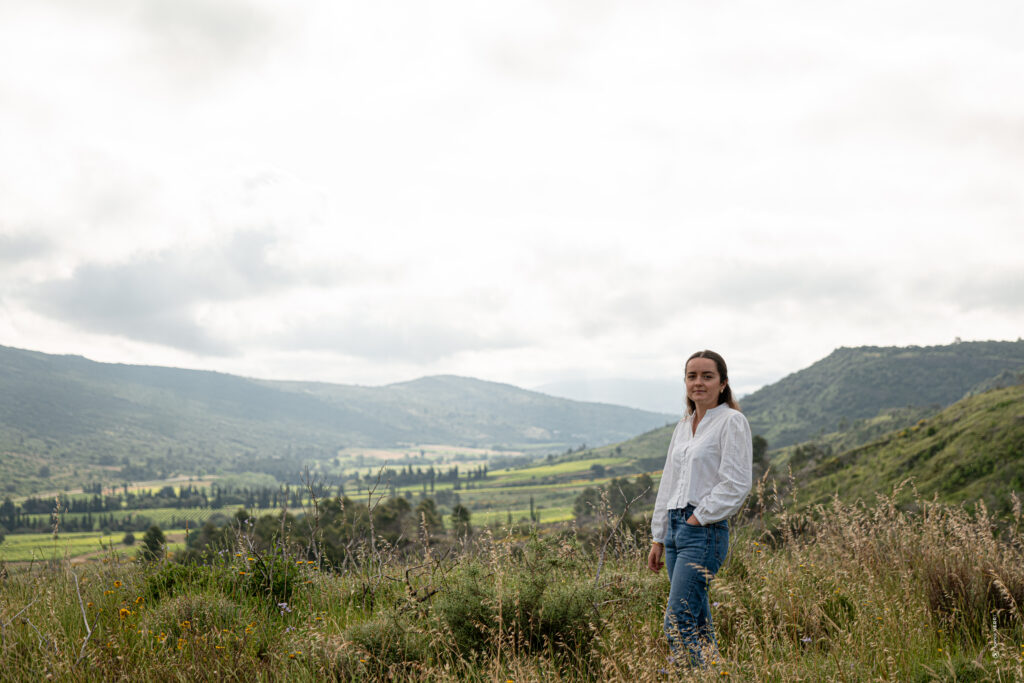
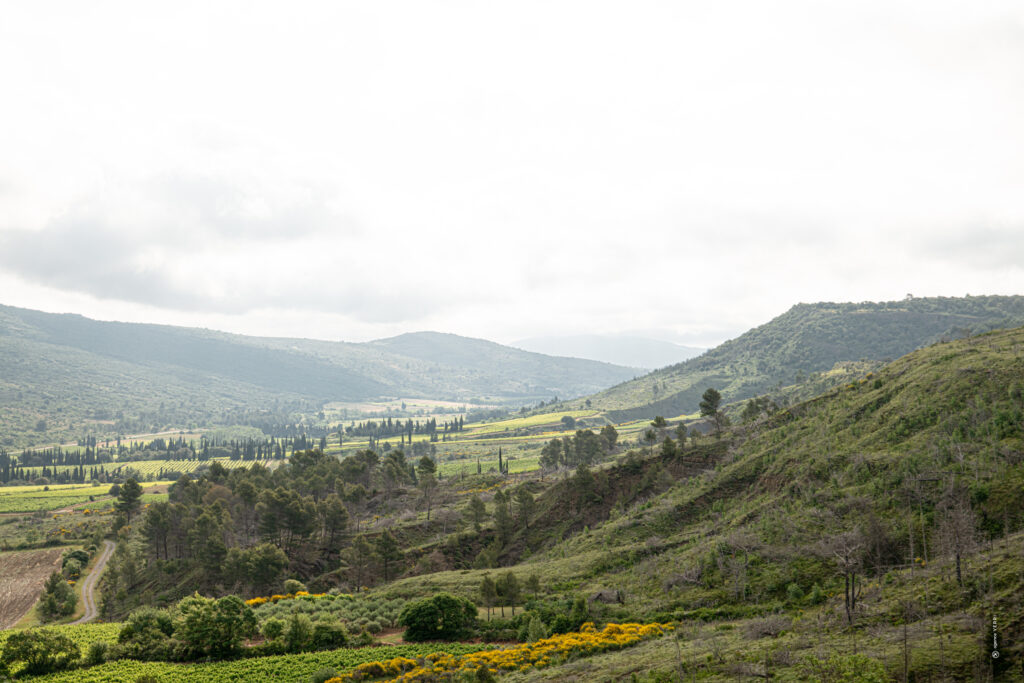
The reasoning starts with geography, not marketing. The Montagne d’Alaric is not just a backdrop—it is infrastructure. This limestone massif, which rises to 600 meters, acts as a thermal regulator: it absorbs the most intense Mediterranean winds, moderates summer heat waves, and creates nighttime temperature fluctuations that slow the ripening of the grapes. On the estate’s clay-limestone slopes, composed of ancient alluvial deposits, gravel, and small stones, this temperature differential produces what winemakers call “coolness in a warm terroir” — a productive contradiction that few Languedoc vineyards can claim with such precision.
The Path and the Trail
Two plots exemplify this approach in their most thoroughly documented forms. The first is named La Lause — an Occitan term referring to the flat limestone used in southern French construction, which makes up part of the plot’s soil. Facing northeast along the Bretonne stream, it yields a Syrah vinified without crushing, 100% destemmed, with a two-day cold maceration at 15°C before fermentation is allowed to proceed naturally. The wine is aged for nine months in Burgundian oak barrels. The second plot, Sainte-Colombe Road, takes its name from the trail that climbs toward Montagne d’Alaric. It is planted with Grenache Gris, whose vines—trained in the goblet style—are nearly eighty years old. These old vines naturally produce low yields, which fall below the profitability thresholds required for a commercial wine business but are in harmony with a philosophy where concentration comes from the soil rather than from technology.
The winemaking process for the Grenache Gris “Chemin Sainte-Colombe” This exemplifies a level of winemaking rigor rarely highlighted in descriptions of southern wines: the grapes are pressed as whole clusters without prior crushing—to limit color extraction from the variety’s pink skins—using only low pressure, with the first and last juices systematically discarded. Cold settling lasts twenty-four hours without the addition of sulfur. Fermentation begins in stainless steel tanks at 14°C and is completed in barrels and demi-muids that have been used for four and five vintages. No malolactic fermentation: aromatic freshness takes precedence over richness. This wine received 94 points in Decanter.
Winter 2024 as a Litmus Test
The 2024 vintage of Corbières Blanc reveals more about the estate’s identity than any statement of intent ever could. On the night of May 17–18, a hailstorm struck the higher-elevation plots—Marsanne and Vermentino—while partially sparing the Roussanne, planted at a lower elevation. This year’s cuvée is composed of 90% Roussanne, with 7% Vermentino and 3% Marsanne. Only 818 bottles were produced. This is not a limited edition in the commercial sense of the term: it is a record of a May night, captured in a blend shaped by the weather rather than by a set of specifications.
Technical Details: The 2023 Grenache Gris “Chemin Sainte-Colombe” is aged for 9 months on fine lees in barrels and demi-muids that have held 4 and 5 vintages, without malolactic fermentation, and bottled in July 2024. Décanter awards it 94/100. The 2023 “La Lause” Syrah, 100% destemmed and aged for 9 months in Burgundian oak barrels, receives 90/100. The 2023 Corbières Rouge AOP—a blend of Syrah, Grenache, and Mourvèdre incorporating Lledoner Pelut, a now-rare Catalan grape variety—received a score of 91/100 at the 2025 International Wine Challenge.
Since its takeover in 2019—and under the leadership of Jeanne Delaunay since 2023—Abbotts & Delaunay has put forward a simple premise: that the Corbières region is capable of expressing the distinct character of individual plots comparable to that of Burgundy’s vineyards, provided that each hectare is treated with the same analytical rigor. The Domaine de La Lause is living proof of this.
The question that remains open—and one that only the next decade of vintages will be able to answer—is whether this emphasis on terroir can, over the long term, forge an identity as distinct as that of the appellations that, before Corbières, succeeded in making geology a cultural selling point.
Cette publication est également disponible en :

