
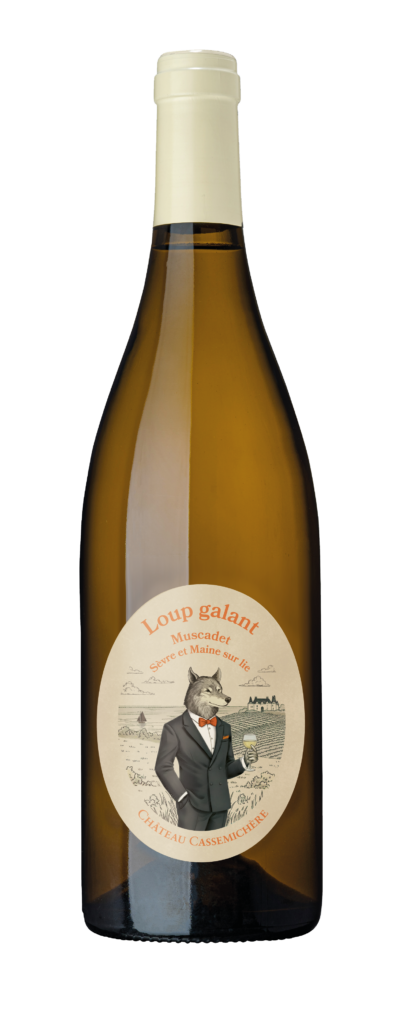
A few kilometers southeast of Nantes, the Château de Cassemichère vineyard carries on a low-key tradition of Muscadet. It is a story less about spectacle and more about terroir, shaped by the schist soils of the Nantes region and by a grape variety long underestimated: Melon de Bourgogne. With Loup Galant, this Loire Valley estate offers a straightforward interpretation of this tradition, without attempting to mask it with contemporary winemaking techniques.
The name evokes Henry IV—the “Vert-Galant”—during whose reign the château was rebuilt in 1601. This nod to history could have remained merely anecdotal. Here, however, it becomes a coherent narrative anchor: that of an estate whose sense of time extends far beyond the effects of a particular vintage or the fads surrounding so-called “thirst-quenching” white wines. In the Nantes wine region, Muscadet remains, first and foremost, a wine defined by its geography. The Melon de Bourgogne grape, planted after the frosts of the 17th century, has found here a natural expression of its climate and mineral character.
This cuvée is made from vines that are about thirty-five years old, grown on loamy soils resting on schist. This fact carries more weight than the usual promises of freshness or tension. Here, the schist acts as a thermal and hydrological regulator; it often gives Muscadets a more straightforward, sometimes briny structure, which sets the wine apart from overtly varietal profiles. The estate employs a classic yet demanding plot-by-plot cultivation method: Guyot pruning, three-wire trellising, manual debudding, and selective harvesting. Nothing spectacular, but a series of precise steps that determine the final balance far more reliably than the marketing rhetoric that often accompanies summer whites.
The winemaking process remains faithful to the fundamentals of the Muscadet Sèvre-et-Maine sur Lie appellation. Temperature-controlled stainless steel tanks, regular stirring of the lees, followed by six months on fine lees. This final stage remains one of Muscadet’s historic hallmarks: the dead yeasts slowly enrich the wine with texture and depth, while preserving its fresh character. This process, widely practiced in the Nantes wine region since the 20th century, explains that distinctive sensation of subtle body that many sommeliers now seek after years dominated by excessively aromatic whites.
The wine’s profile, as described by the estate, emphasizes light citrus notes, white flowers, and ripe fruit rather than sharp acidity. This is an interesting direction at a time when Muscadet is trying to move beyond its strictly maritime image. Of course, Loup Galant pairs naturally with shellfish and fish. But this rounder profile also lends itself to more unexpected pairings: creamy poultry dishes, lightly smoked vegetarian dishes, or soft cheeses.
Today, there is a quiet reappraisal of Loire Valley wines in European city restaurants. Paris, Copenhagen, and Brussels are rediscovering Muscadet not as a second-rate white wine, but as a table wine in the noblest sense: versatile, approachable, and never overwhelming on the nose. In this context, Loup Galant comes across less as a one-off release and more as a timely reminder: that even a popular wine can regain a sense of precision when it stops trying to seduce the palate immediately.
Château de Cassemichère isn’t revolutionizing Muscadet with this cuvée. And that’s probably its greatest strength. At a time when so many wines seek to showcase technical prowess or an oenological signature, Loup Galant seems to favor a different approach: letting the grape variety, the time on lees, and the schist-rich terroir from which it comes speak for themselves. It’s a form of restraint that has become rare in the contemporary wine world.
Cette publication est également disponible en :

