
Champagne has long been told through its houses. Today, it can be read differently: through its soils. With Mapping Champagne, a new cartography of the Champagne vineyards emerges – not as an educational tool, but as a precision instrument.
It’s not about redesigning a region.
It’s about making it readable.
From territory to plot
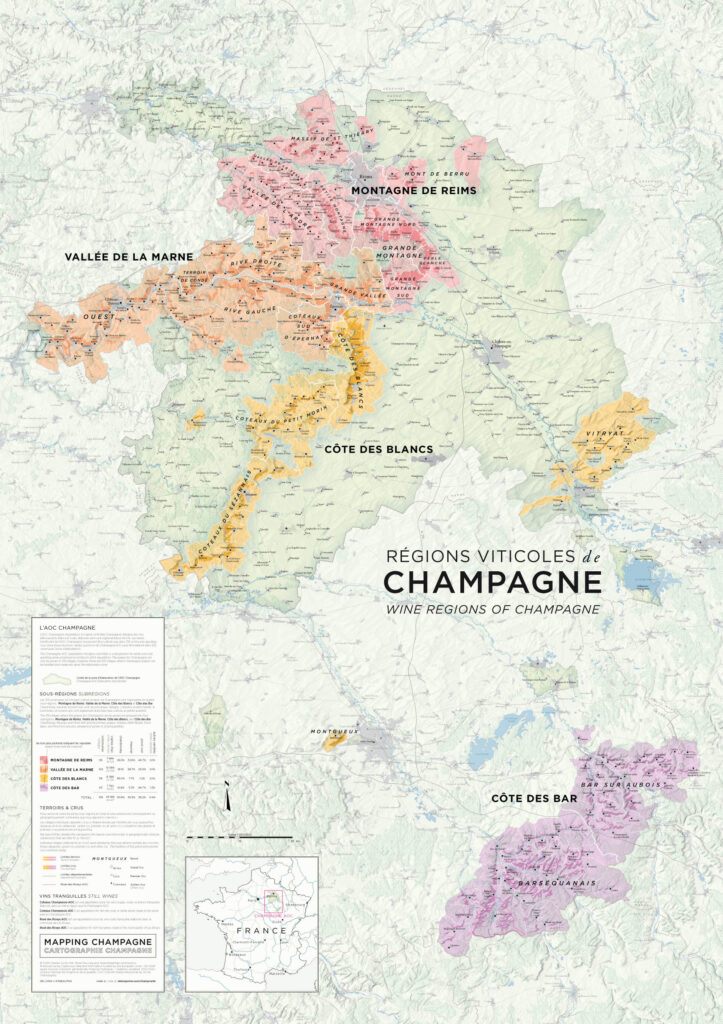
Historically, Champagne has been organized into large zones – Montagne de Reims, Vallée de la Marne, Côte des Blancs. These are effective benchmarks, but insufficient to grasp the real complexity of the vineyard.
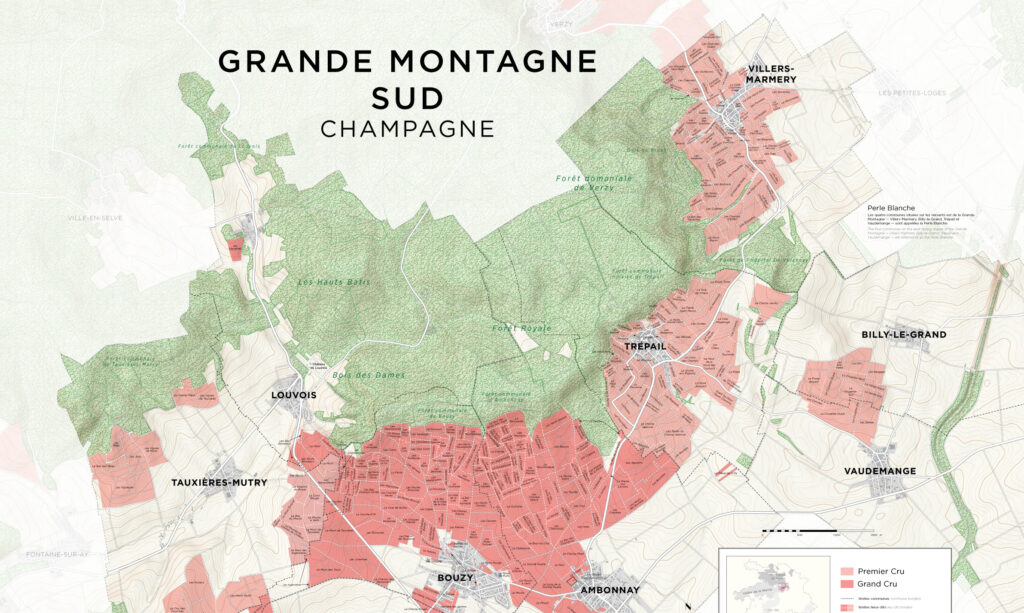
The new cartography makes a change of scale. It goes down to the level of the plot, or even the locality. Each unit becomes identifiable by its own characteristics: soil composition, exposure, altitude.
Vineyards are no longer homogeneous.
It becomes a mosaic.
Soil as the main variable
At the heart of this reading is one constant: geology. Chalk, marl, clay – each type of soil influences water retention, temperature and grape ripening.
Chalk, for example, acts like a sponge. It stores water and releases it gradually, regulating the vine’s water stress. This phenomenon translates into a particular tension in the wine, often associated with Côte des Blancs chardonnays.
The cartography not only describes these soils. It relates them to viticultural practices.
A tool for winemakers
This precision is not just for amateurs. It primarily meets an internal need: to enable winemakers to adjust their decisions.
Choice of grape varieties, harvest dates, winemaking methods – these are all variables that can be fine-tuned thanks to a better knowledge of the terrain.
The map becomes a working tool.
It turns intuition into data.
Blending and understanding terroir
In champagne, blending remains central. But its logic is evolving. Where once it was primarily aimed at maintaining a consistent style, today it tends to express differences.
Base wines are no longer just interchangeable components. They become identified elements, from specific parcels.
The assembly is similar to a composition.
Every origin counts.
Soft power and transparency
This development is part of a broader context. Consumers are no longer just looking for a brand, but an origin. Traceability, legibility, understanding.
By making the complexity of its vineyards visible, Champagne strengthens its positioning. It doesn’t simplify its message – it enriches it.
The map becomes a tool of soft power.
It asserts control over the territory.
A new way of reading wine
In the end, Mapping Champagne doesn’t change wine. It changes the way we understand it.
Drinking champagne is no longer just about identifying a house or a style. It involves locating a place, a soil, an exhibition.
Wine becomes geographical.
And the map, indispensable.
Cette publication est également disponible en :

