
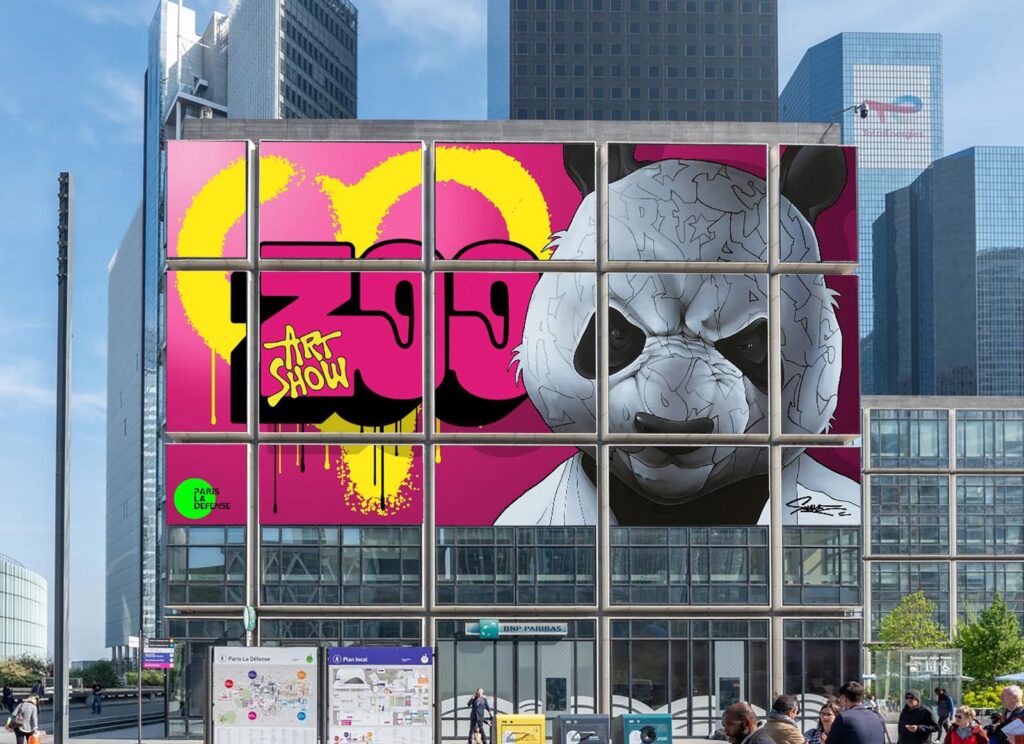
Since the summer of 2025, a line has been intriguing busy executives in the business district, though no one really knows where it leads. Since July 29, the answer has been clearly displayed on the building’s facade: a 375-square-meter panda, the signature of a venue that has quietly transformed La Défense into a hub for urban art.
There’s something incongruous about this scene: at the foot of the glass towers where the biggest CAC 40 deals are negotiated, a line has been forming every day since June 2025—without any flashy poster campaign or immediate explanation for passersby. Those who eventually stepped through the doors at 4 Place de la Défense in Paris-Puteaux discovered the Zoo Art Show: 4,000 square meters spread across five levels, where more than 500 international and local artists chronicle forty years of street art through immersive works. In just one year, the venue has recorded more than 150,000 visits and strolls—a figure that borders on a statistical anomaly for a space dedicated to a culture long relegated to the margins.
From July 29 through the end of December 2026—the announced closing date following several successive extensions—Zoo Art Show is no longer confined to its own walls. An XXL sticker measuring 375 m², depicting a panda, now covers the glass facade of the building that houses it. The artwork is by Snake, a French artist and the venue’s artistic director, in partnership with the Paris La Défense institution. It is no longer just a matter of displaying urban art inside a building; it is about turning the building itself into a work of art, visible to employees in the business district as well as to tourists who sometimes come from far away.
This shift from the interior to the exterior says something about Snake’s artistic journey. Since 1990, the artist has used the urban landscape as a medium for expression, drawing inspiration from hip-hop culture. After years of working on the streets—sometimes illegally—he became a professional urban artist in 2000 and developed his own unique style, the “Typogractère,” a fusion of figurative symbolism and urban typography. Now internationally recognized, he shares his experience through participatory workshops and lectures, where he advocates a simple idea: art must remain accessible to everyone, and learning comes as much from perseverance as from failure.
The choice of a panda is undoubtedly significant for a venue that has built its legitimacy on a paradox: bringing to light, in the heart of Europe’s leading business district, a culture that has historically developed in secrecy and underground. Other projects and venues are already being considered to extend this enthusiasm beyond the December 2026 closure—a sign that the experience, however fleeting it may be within its current walls, is already looking for its next home.
Cette publication est également disponible en :

