
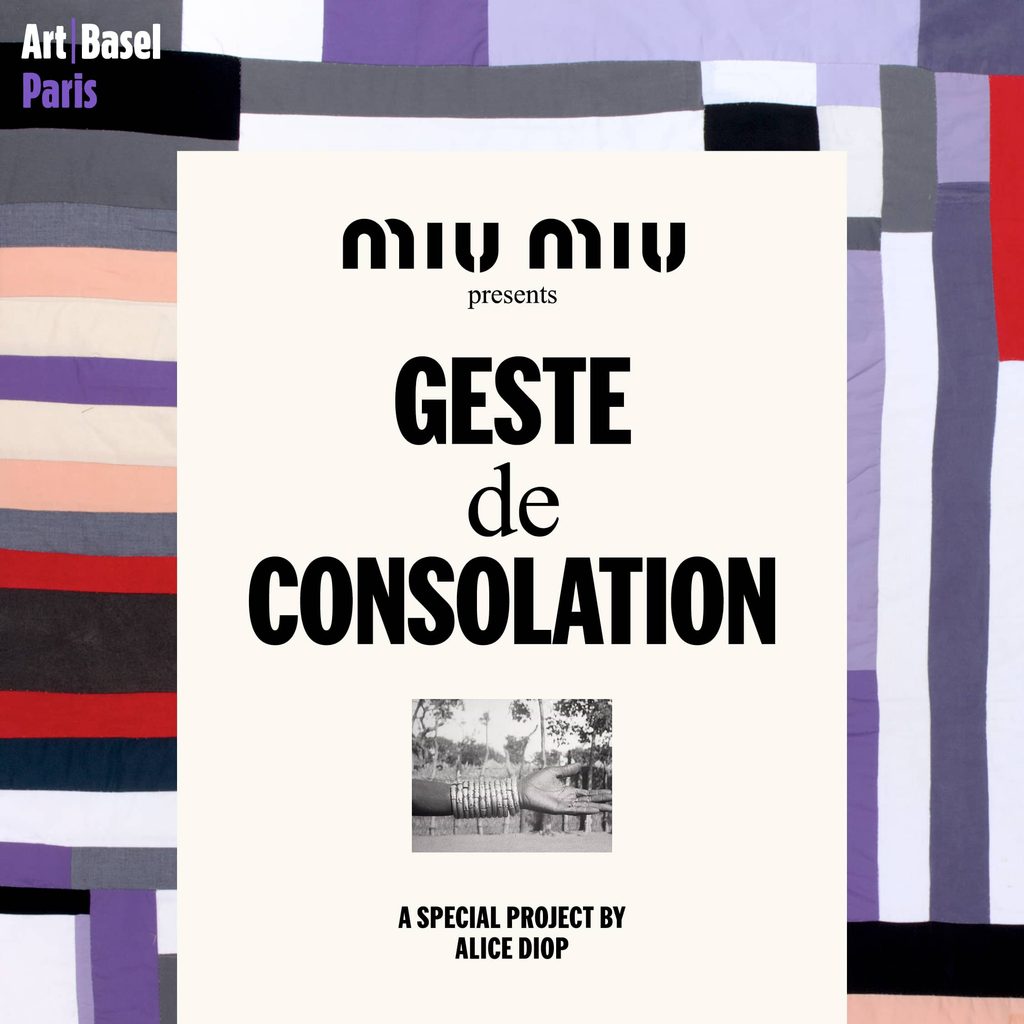
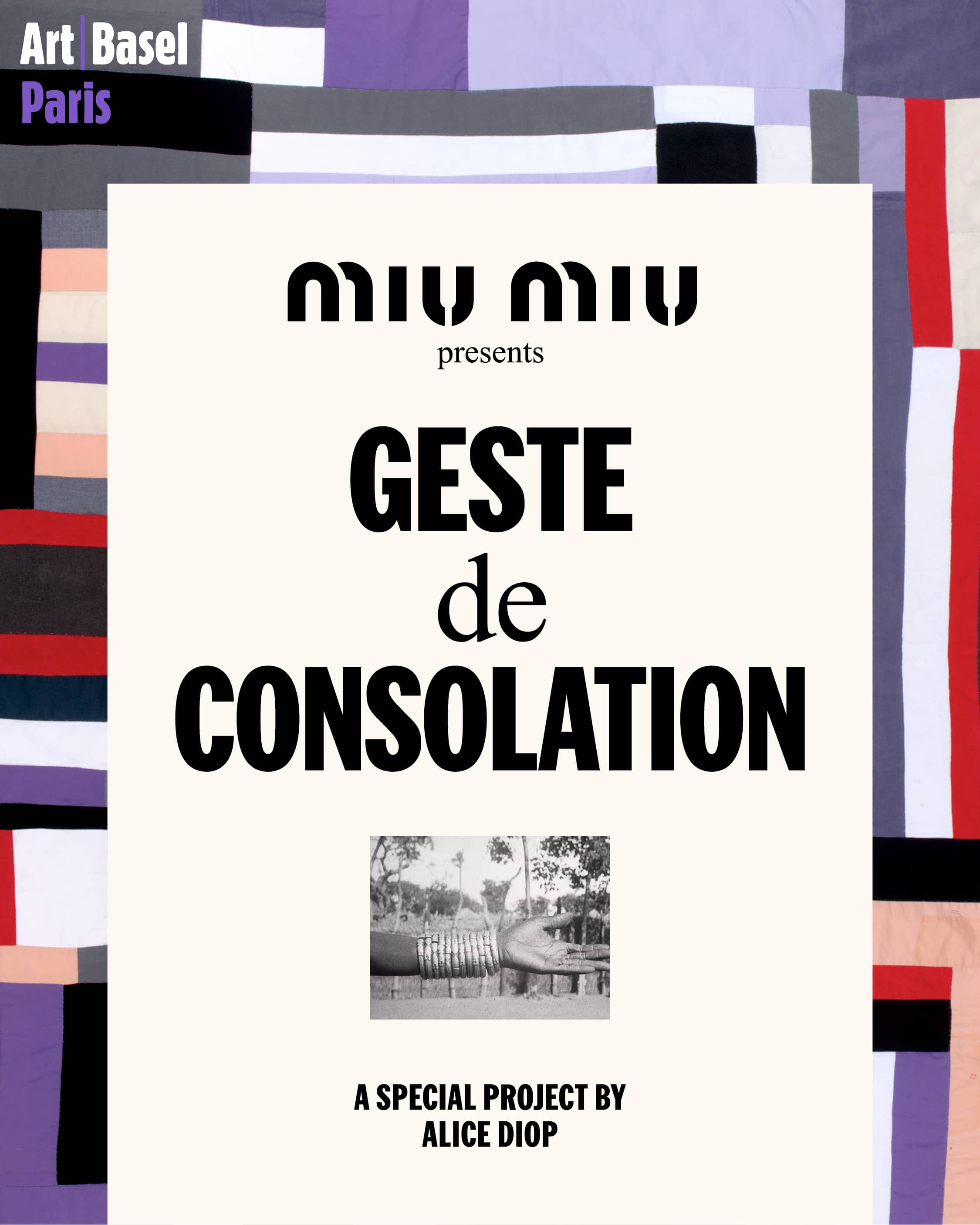
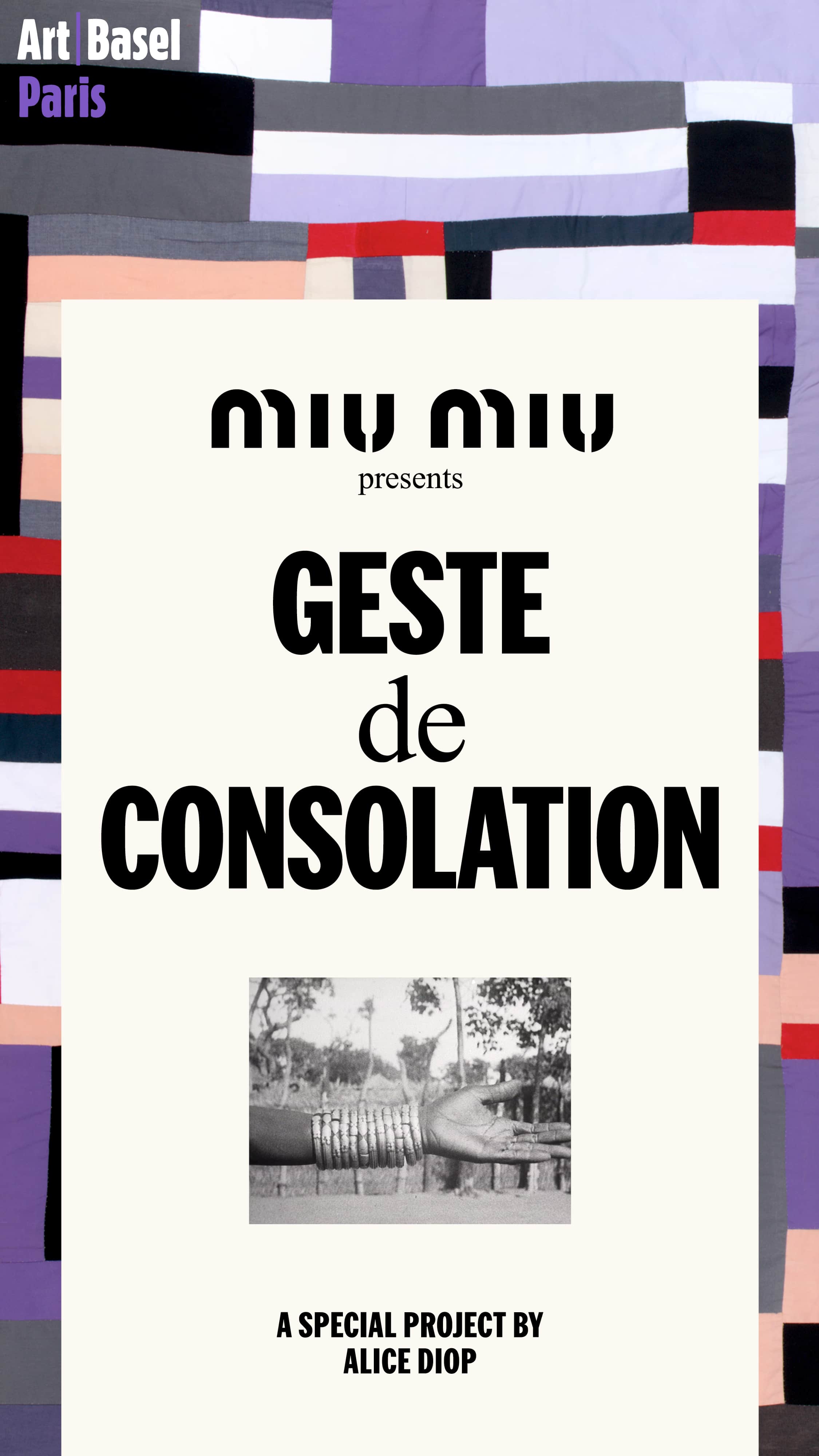
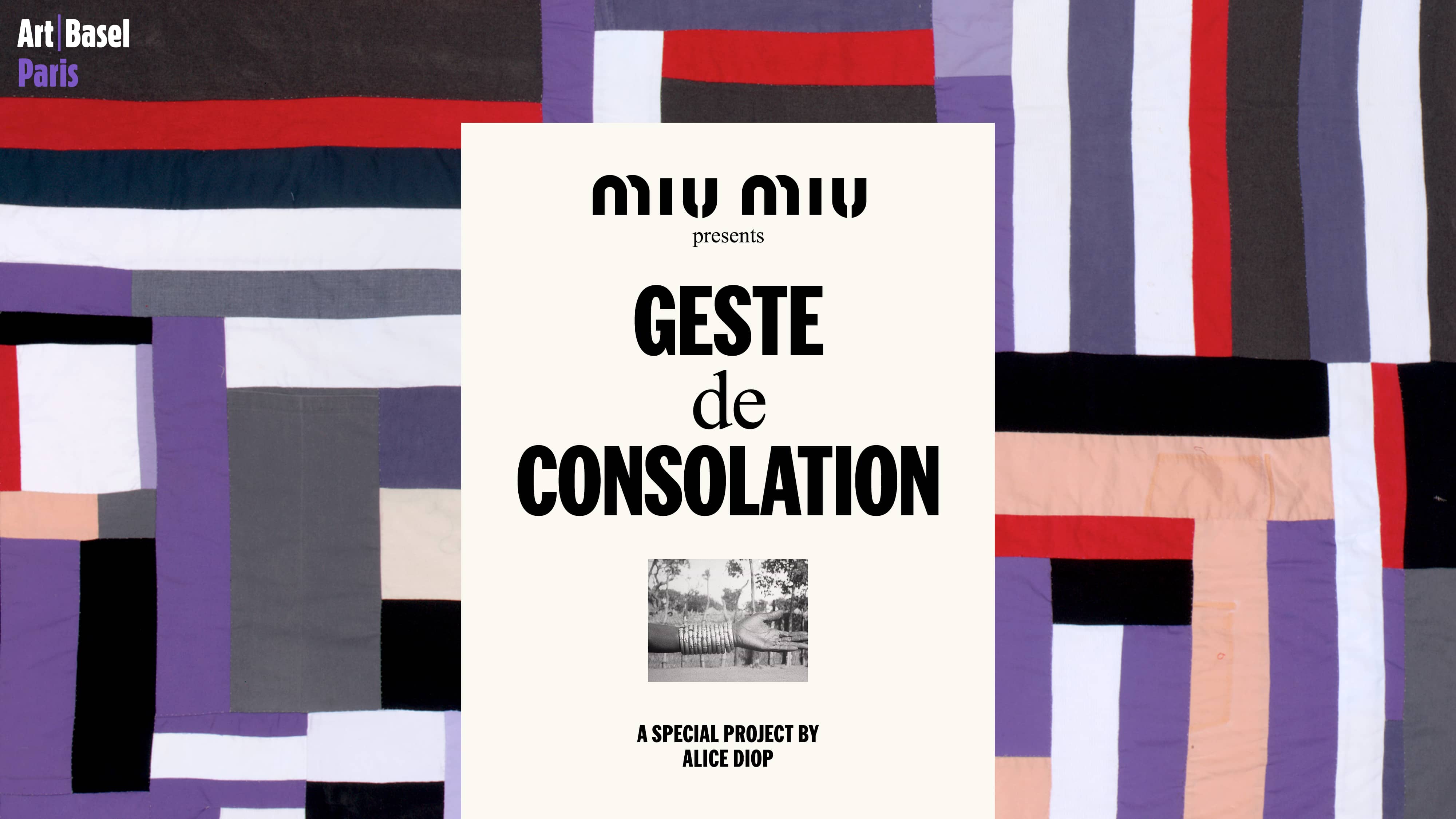
For the third consecutive year, Miu Miu is official partner of Art Basel Paris’s public programme. But this 2026 edition marks a turning point: Miuccia Prada’s house entrusts, for the first time, the design of an entire exhibition project to a filmmaker. Alice Diop, whose name remains associated with the most demanding French documentary cinema, signs with Geste de Consolation her very first foray into the field of exhibitions — and the result resembles no usual brand commission format.
The project extends a dialogue begun in 2025 with Fragments for Venus, the film Alice Diop made for the Miu Miu Women’s Tales series. In it she was already pursuing a question that runs through all her work: how have Black women been represented throughout history, and in what ways do these representations remain fully contemporary issues. Geste de Consolation takes up this question and deploys it, this time, as a multimedia scenography designed at the invitation of Miuccia Prada herself.
“I want my curatorial work to focus on gestures of consolation designed by Black women artists, each active in her own discipline, to repair the fetishising gaze to which centuries of art history have confined us,” explains Alice Diop. The exhibition takes the form of a route through four interconnected spaces, each organised around a distinct discipline, voice and architectural atmosphere — a way, for the filmmaker, of extending her gesture of editing beyond the screen.
The route opens with a photograph by the South African artist Zanele Muholi. It continues with a two-screen video installation designed by Diop herself, an edit of archive images and film excerpts that have shaped her gaze as a filmmaker — violent images alongside those that consoled her. Next comes Chambre à soi, a salon-library laid out on a patchwork of brightly coloured rugs, adorned with a motif by the artist Mary Lee Bendolph: a domestic space nestled in the monumental concrete structure of the Palais d’Iéna, open to all, where the books that have nourished Diop’s intellectual life are gathered.
At the centre of the exhibition, this library gives way to a performance space where texts by Penda Diouf, Zora Neale Hurston, June Jordan, Audre Lorde, Marie NDiaye and Zadie Smith are read live by a rotating cast of women performers, among them Alice Da Luz Gomes, Latifa Laabissi, Séphora Pondi, Davide-Christelle Sanvee and Betty Tchomanga. The stage also hosts an adapted version of Prophétique, a choreographic piece by the Ivorian artist Nadia Beugré performed by six dancers, followed by performances by the Chicago composer and musician Angel Bat Dawid, accompanied by her ensemble Sistazz of the Nitty-Gritty.
The route ends before Sentinel (Mami Wata), a monumental bronze sculpture by the artist Simone Leigh. Nearly five metres high, its elongated female silhouette, encircled by a serpent, reinterprets a powerful West African water deity whose image has travelled and been transformed across Africa and its diasporas — an ambiguous figure, at once destructive and creative, which closes the scenography like a silent sentinel watching over the whole space.
Diop conceives Geste de Consolation as an edit in its own right: moving from one space to the next works like a film cut, where meaning accumulates by proximity and by sequence rather than by direct explanation. The exhibition will be open to the public from 21 to 25 October, with a preview on the 20th, at the Palais d’Iéna — seat of the Economic, Social and Environmental Council, and also the venue for Miu Miu’s shows. Registrations for guided tours will open on 8 October on miumiu.com. One question remains, deliberately left open by the filmmaker herself: what does consolation look like when it is conceived not as an individual repair, but as a collective edit?
Cette publication est également disponible en :


