
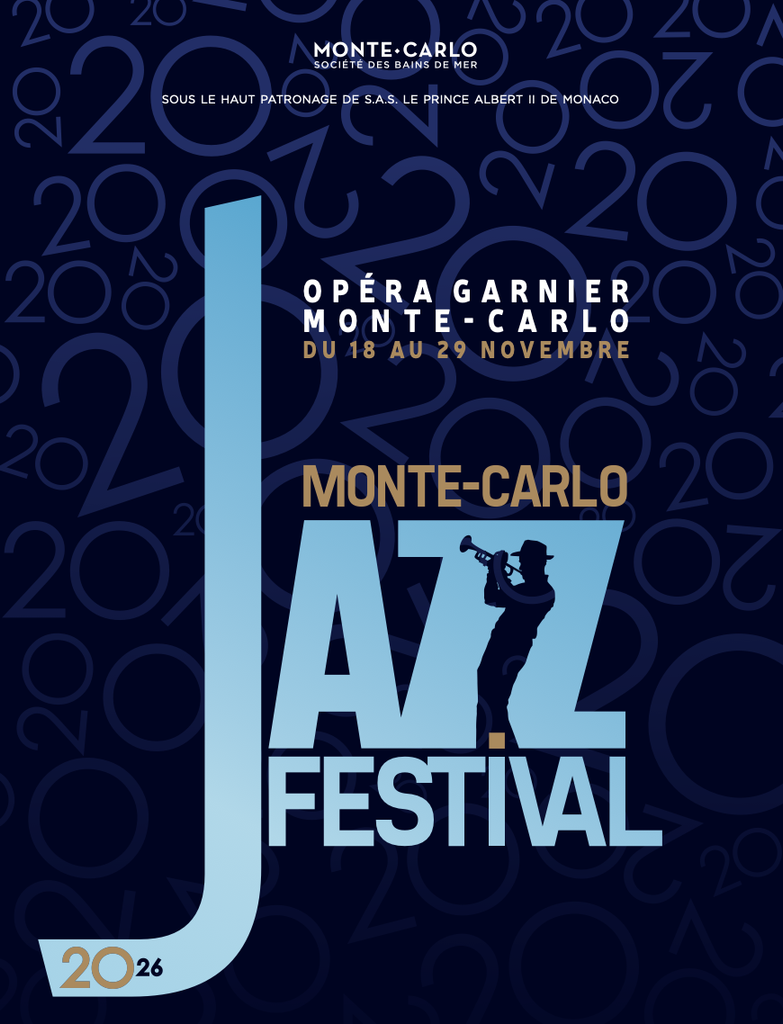
Twenty years after its creation, the Monte-Carlo Jazz Festival is no longer merely a musical gathering. Its longevity says something else: the Principality’s ability to establish a recurring programme in a heritage venue and turn it into an instrument of cultural influence. The 2026 edition, from 18 to 29 November, allows this strategy to be read over time.
The festival was born in 2006 on the initiative of Jean-René Palacio. Two decades later, its artistic direction is led by Alfonso Ciulla, Artistic Director of Monte-Carlo Société des Bains de Mer. The stage remains the Salle Garnier of the Opéra de Monte-Carlo, a setting that places jazz from the outset in a particular relationship with heritage: neither club nor large arena, but a historic theatre associated with Monaco’s cultural imagination.
The anniversary programme seeks less genre purity than a controlled widening. The opening on 18 November is entrusted to the young musicians of the Académie Rainier III, with free admission. Two days later, Youn Sun Nah and Gregory Porter take the stage, followed by Melody Gardot, GoGo Penguin, The Brand New Heavies, Marillion, Thomas Dutronc and the Soweto Gospel Choir, among others. Announced ticket prices generally range from sixty to eighty euros depending on the evening.
The most revealing choice, however, is not necessarily musical. On 22 November, the festival screens Otto Preminger’s The Man with the Golden Arm, a 1955 film starring Frank Sinatra, in partnership with the Institut audiovisuel de Monaco. This inclusion of cinema in the programme is a reminder that the event now seeks to build a cultural environment around jazz rather than a mere succession of concerts.
The presence of the Thanda Choir, the Soweto Gospel Choir, Tyreek McDole and Youn Sun Nah also widens the festival’s map well beyond a Franco-American narrative of the genre. The programme moves between South Africa, South Korea, the Caribbean, the United Kingdom, Belgium and the United States. This openness is not neutral in a territory whose international visibility has historically rested on hospitality, sport, spectacle and a high concentration of events of global reach.
The festival thus produces a form of soft power that is small in scale but repeated. It gives Monaco an identifiable cultural season in November, away from the summer peaks and the major motor-racing events. The Salle Garnier then becomes less a backdrop than an institutional continuity: a single venue able to connect architectural heritage, established artists, young musicians and international audiences.
Data is nonetheless missing to fully measure this cultural policy. No cumulative attendance figure over twenty years, no proportion of foreign visitors, no budget, no economic impact and no occupancy rate has been released. Without these elements, success can be read through duration and the quality of the programme, but not yet through its measurable impact.
The next stage for the Monte-Carlo Jazz Festival could be precisely there: documenting what twenty years of programming have actually built for the Principality. Because beyond the posters, the cultural value of a festival is also measured by what it durably installs in the habits, audiences and image of a territory.
Cette publication est également disponible en :


