
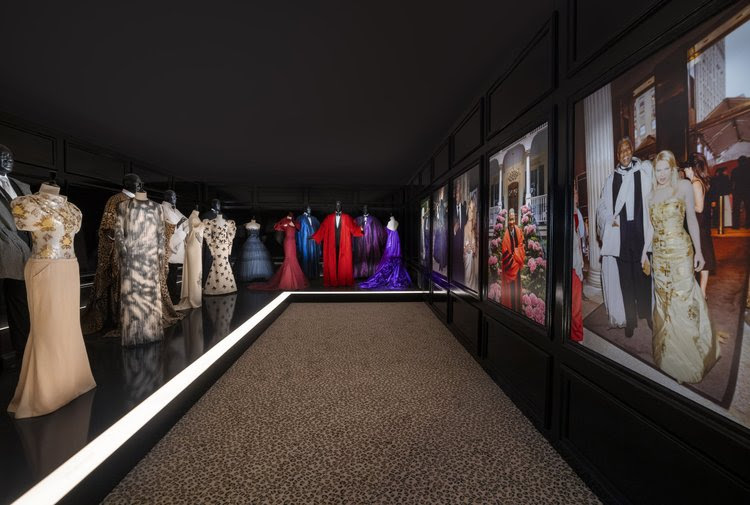
Until October 31, SCAD FASH Lacoste is presenting, for the first time in France, the clothes André Leon Talley bequeathed to the university he advised for many years. One detail of the exhibition design changes the way we look at them.
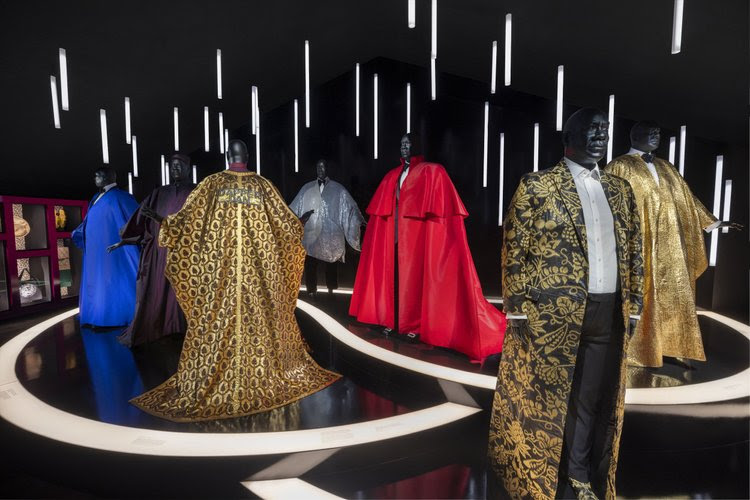
The silhouettes in the exhibition are not displayed on standard mannequins. SCAD says they are presented on custom-made mannequins based on a sculpture of Talley by Stephen Hayes, a former student of the university (master’s degree in sculpture, 2010). In a fashion museum, the support is usually something one tries to make viewers forget. Here, it embodies the body of the person who chose the clothes. Each piece can thus be read as a decision by Talley before being read as a record of an era.
Those decisions span a wide range. The exhibition brings together haute couture, ready-to-wear and bespoke outfits by Karl Lagerfeld for Chanel, Nicolas Ghesquière for Balenciaga and John Galliano for Dior, as well as Chado Ralph Rucci, Roger Vivier, Yves Saint Laurent, Charvet and Hermès. Two pieces are documented in the exhibition images: a Chanel cape by Lagerfeld in scarlet silk taffeta, and a Ralph Rucci caftan worn with an Accessocraft NYC chain, both photographed by Allen Cooley, also a former SCAD student. There are also dresses worn by people close to Talley, including Anna Wintour, Renée Zellweger and Lauren Santo Domingo, alongside artworks, photographs, letters and books from his archives.
The French context is far from incidental. Talley grew up in Durham, North Carolina, raised by his grandmother. He studied French literature at the University of North Carolina, then at Brown. He worked in New York with Diana Vreeland at the Metropolitan Museum of Art’s Costume Institute before heading the Paris bureau of Women’s Wear Daily. According to SCAD, he subsequently became the first Black art director of American Vogue. Showing his wardrobe in France brings it back to a language and a couture tradition he had studied before working there.
The bequest also has a destination. The pieces are joining SCAD’s permanent collection, where they will serve students and researchers. In the accompanying text, president Paula Wallace recounts that Talley called this collection ‘his armour’ and his ‘tabernacle’, and that he wanted it to remain at SCAD. This is the university’s position, and it explains why the mannequin’s shape matters: a collection intended for teaching is better studied when it retains the imprint of the person who assembled it.
Cette publication est également disponible en :


