
In 1926, René Lalique was the leading figure in French Art Deco glass. It was his daughter, Suzanne Lalique-Haviland, who designed the Tourbillons.
This fact deserves to be made clear: the vase that Lalique is celebrating this year to mark its centennial is not a creation by the founder. It is the work of Suzanne Lalique-Haviland—René’s daughter, heir to a vision, not a style. In 1926, while her father was making his frozen female figures in opalescent glass ubiquitous, Suzanne chose the fern. A sprouting frond, its spirals opening as they twist—the logic of a living form that does not obey the symmetrical axes of the great designer.
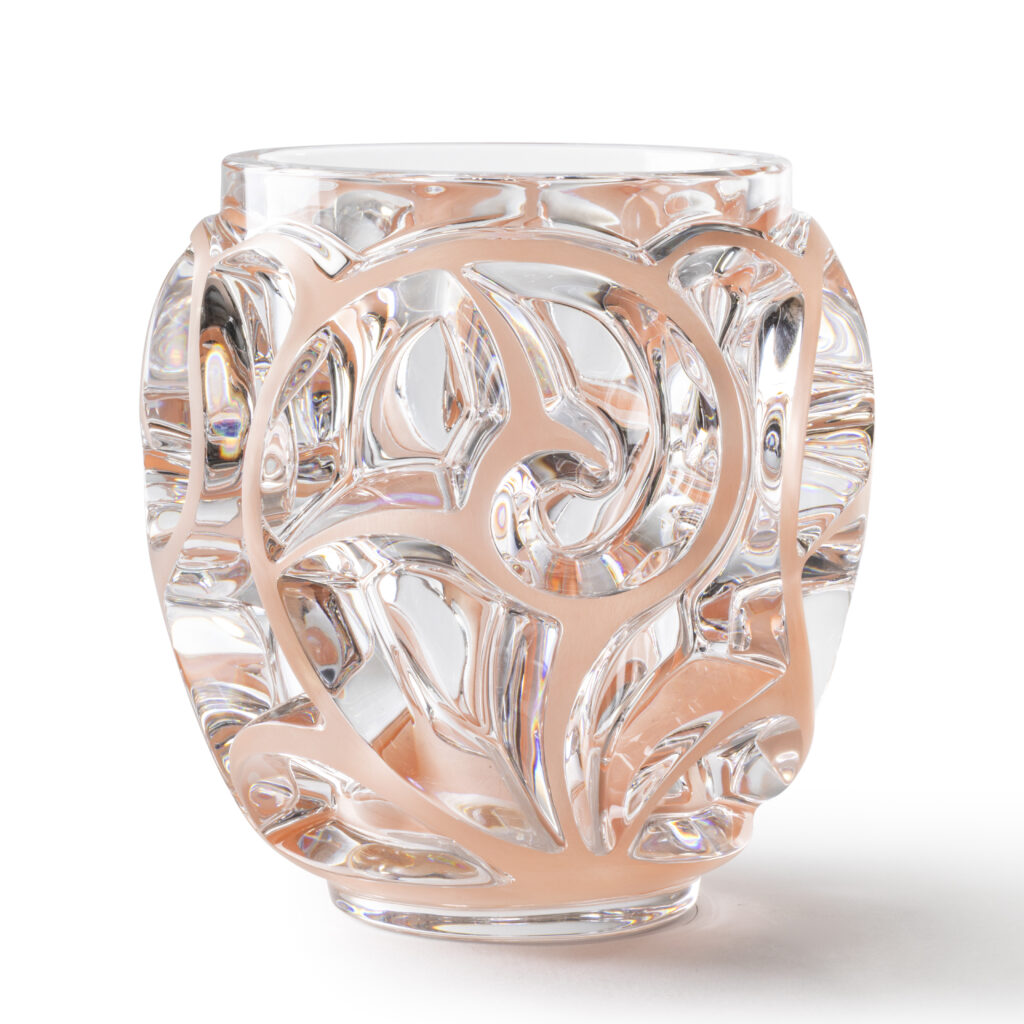
This choice is by no means trivial. The fern is a capricious botanical subject, difficult to stabilize in a stained-glass composition: its veins run wild, its frond curls in on itself in a centrifugal motion that Art Deco sculpture specifically seeks to restrain. Suzanne allows the movement to take its course. The result—sculped scrolls in relief, with crystal featuring two distinct surface textures—works because it does not seek to freeze the form, but rather to capture it in its momentum.
Technical Detail: The contrast between satin-finished crystal and re-polished crystal is not a decorative effect added afterward; it is a direct result of the relief carving process. The recessed areas, which are less exposed to the final polishing, retain their frosted finish; the protruding edges, which are reworked, remain transparent. Light is not reflected but distributed according to the depth of the scroll. The weight of the average model—6.74 kg with a diameter of 200 mm—attests to the thickness of crystal required for this relief to deliver on its optical promise.
To mark its centennial, the Alsatian manufacturer—in operation since 1922 and still crafting its pieces by hand—is reintroducing the colored patina that René Lalique created using enamel. The 1926 version was made of white glass with black enamel; the 2026 version features a coral-colored patina applied to the scrollwork. The process is not a revival of an identical technique: the black enameling of 1926 sought graphic contrast, while the coral patina of 2026 plays on a softer diffusion of light, consistent with contemporary crystal and its refractive properties.
The limited edition of twenty-six pieces—a number that recalls the year of its creation—featuring gold leaf application pushes the color scheme to its limit: the precious metal on the re-polished crystal evokes the gilding of Art Deco, yet is applied to a form that Suzanne had specifically designed to depart from that style.
What the centennial of the Tourbillons actually raises is a question of genealogy: to what extent does a House inherit from its founders, and to what extent from those within the family itself who were able to see things differently? Suzanne’s fern has coexisted for a hundred years in the catalogs alongside René’s fish and mermaids. Both traditions endure.
Cette publication est également disponible en :

