
The Trident does not begin on a hood. It begins in the still water of a fountain, in that way Italian cities have of entrusting their pride to stone, to the ancient gods, to the squares crossed by passersby who barely look up. In Bologna, Neptune holds his weapon as one holds a simple idea: upright, clean, almost abstract. Mario Maserati took that line to heart. In 1925, he designed a symbol. The following year, that symbol appeared on a Tipo 26 competing in the Targa Florio. Alfieri Maserati drove it. He won his 1500 cm³ class and finished eighth overall. The symbol had just found its first sound: that of a car racing across Sicily.
A hundred years later, there is something about this Trident that resists the wear and tear of logos. Many automotive emblems have ended up becoming mere hood ornaments, embellishments polished by marketing. This one retains an older, edgier spirit. Three prongs, a central axis, an almost heraldic tension. It doesn’t just promise performance; it reminds us that performance, before it became a given, was a risk.
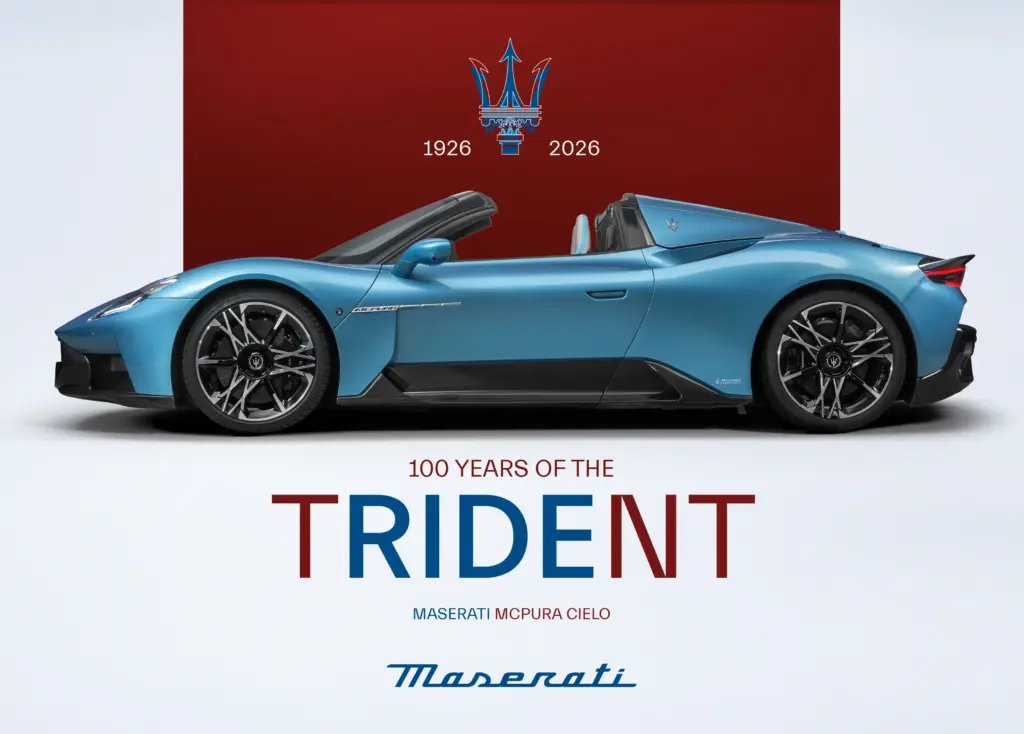
In 2026, Maserati will celebrate the centennial of its Trident and that of its first racing victory, bringing together the emblem and the race on the same date. Perhaps that, at its core, is what gives the story its substance. The logo wasn’t added later to embellish a reputation. It was there from the very beginning, when the brand entered the world of competition—amid the dust, the turns, the standings, and the tenths of a second. Santo Ficili, Maserati’s COO, speaks of a company that has learned to build its cars in pursuit of that very thing—that minuscule, almost invisible fraction of a second that separates a good car from a winning one.
The Trident changed its shape without changing its purpose. On the Tipo 26, it was set within a rectangular badge, dark against a light background. In the 1930s, it took on an oval shape and the red and blue colors of Bologna. In 1980, a gold background was introduced. In 1997, the proportions were readjusted. Then came the “New Era,” ushered in by the MC20 in 2020: the design became simpler, lighter, and more contemporary in its elegance, dominated by the deep blue of Blu Maserati. Icons that endure never stand still. They simply learn to modify their voice without losing their essence.
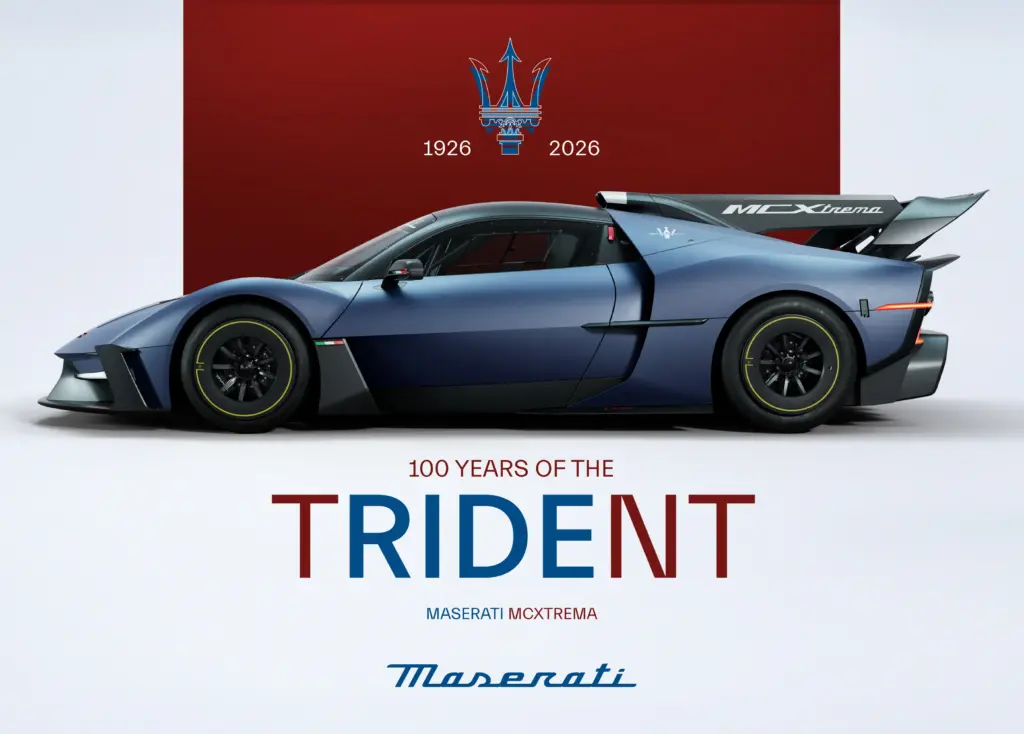
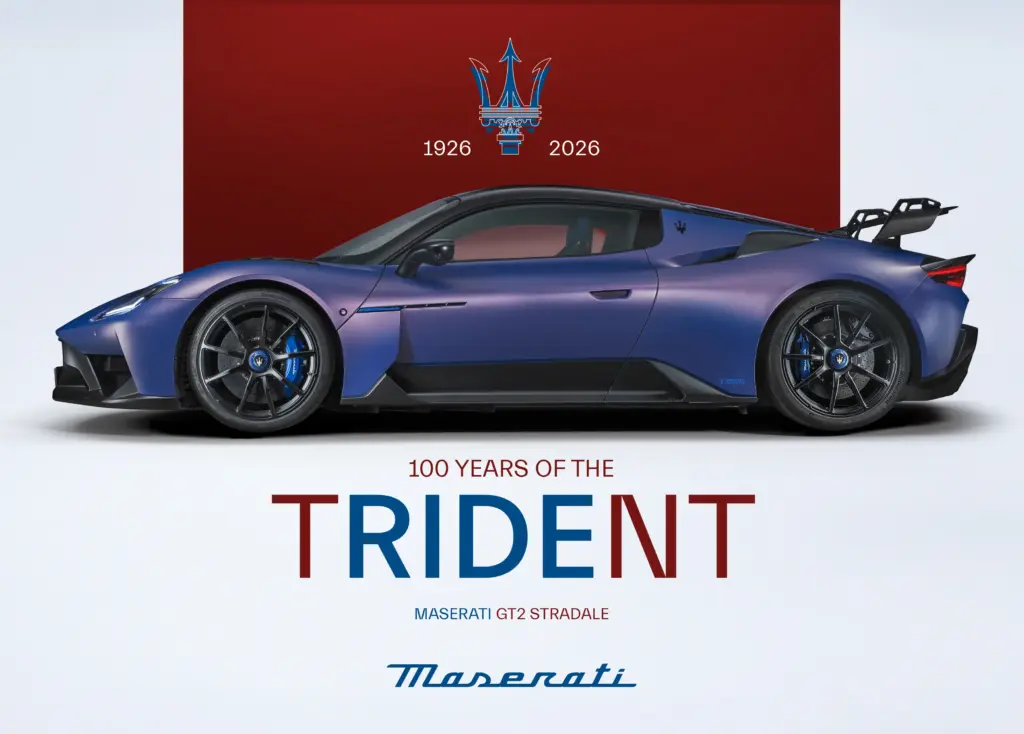
Sports history, for its part, has given the symbol a depth that design alone could not have achieved. Two consecutive victories at the Indianapolis 500, in 1939 and 1940. Four consecutive triumphs at the Targa Florio between 1937 and 1940. Nine Formula 1 victories. Juan Manuel Fangio’s world championship title in 1957. Later, the MC12, which dominated the FIA GT series between 2005 and 2010. Then Maserati’s return with the GT2 starting in 2023. These aren’t just entries in a list of achievements; they are layers. Each victory adds to the Trident a density of metal, hot oil, late-night tuning sessions, and engines laid bare under the harsh lights of the pits.
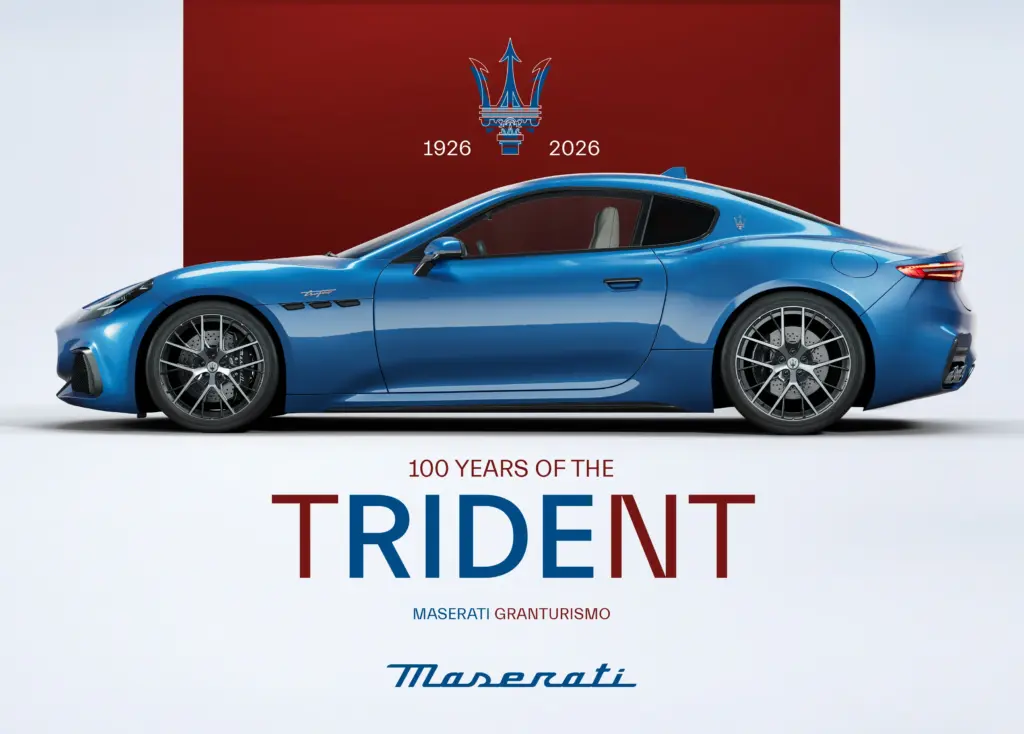
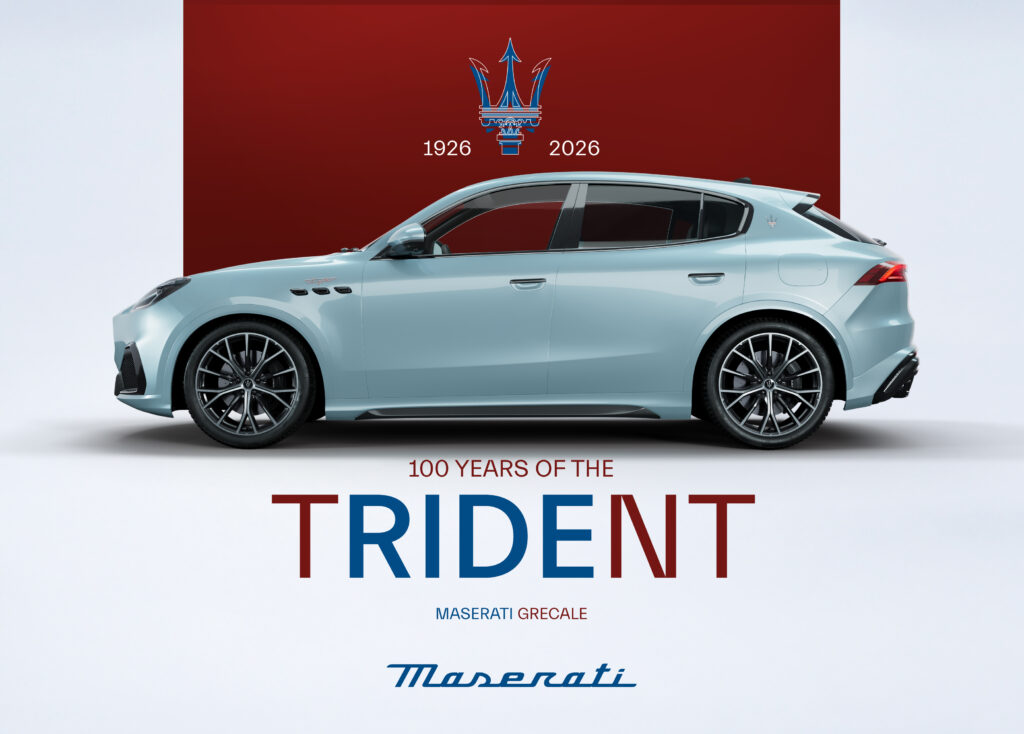
For this centennial, Maserati has chosen not to limit itself to its archives. All of the brand’s global events in 2026—from concours d’élégance to races, from launches to cultural initiatives—will feature the Trident as a unifying theme. A campaign accompanies this journey through the century, bringing together the Tipo 26, the Ghibli, the MC12, and contemporary models. It combines 3D animation and artificial intelligence, but its most striking element lies elsewhere: the recreated voice of Maria Teresa De Filippis, the first woman to compete in a Formula 1 Grand Prix in 1958 behind the wheel of a Maserati 250F. There is a certain sense of closure here. Technology is not merely used to produce a new image; it attempts to restore a tone to memory.
In fact, a stamp was unveiled on April 9 in Rome by the Italian Ministry of Enterprise and Made in Italy. Designed by the Centro Stile Maserati, it combines the contemporary Trident with motifs inspired by the first models from 1926. A postage stamp may seem modest compared to the roar of an engine. Yet it conveys something specific: when a logo enters the world of stamps, it ceases to be merely a commercial symbol. It becomes a small piece of state property, an image that is affixed, canceled, and sent. A form of miniature diplomacy.
That leaves the question of the future. Maserati is now talking about hybrids, V6 engines, Folgore, electric grand tourers, Fuoriserie customization, Classiche, and Corse. The lineup itself seems caught between two poles: preserving the mechanical sensuality of a brand born in Modena, and shaping a vision of luxury mobility that is less dependent on the old rituals of the engine. In this transition, the Trident becomes more than just a legacy. It must serve as a guiding principle—not as a nostalgic talisman, but as a reminder of discipline.
So we imagine the emblem in its quietest form: not on a country wall, nor even in the center of a hood, but in the shadows of a workshop, before installation, before hitting the road. Three tips, still motionless. All around, the blue glow of a car body. And the sense that, sometimes, a century can be contained within a few millimeters of metal.
Cette publication est également disponible en :

