
In a panel discussion focused on the creative economy, L’Oréal confirmed a simple rule: no photorealistic digital clones to sell skincare or makeup. At the same time, two anecdotes cited in that same forum showed that this boundary has already been tested elsewhere in the industry—and not always successfully. The question is no longer whether the sector will move toward digital twins, but who will determine their use, and according to what criteria.
An economy that’s calculated by the minute
The most compelling point made during the roundtable didn’t come from a discussion about creativity, but from a cost breakdown. One minute of average-quality YouTube content costs about ten thousand dollars. One minute of a Netflix show costs around two hundred thousand dollars. One minute of theatrical film costs over one million dollars. This hierarchy, presented by Hannah, vice president of Gen AI New Business Ventures at Adobe, isn’t meant to tout a particular technology: it explains why studios have long been able to finance only sequels and established franchises, and why independent creators can now give themselves the green light without waiting for approval from a committee.
This economic dynamic is also what is driving the Houses to rethink their approach to volume. Sandy Morrigan, global head of social, advocacy, and influence at L’Oréal, noted that creators participating in the L’Orealista program—the initiative that brings together the group’s approximately 40 fashion houses—are spontaneously producing four to eight times more content than expected. This figure is not merely anecdotal: it points to a production pressure that artificial intelligence is, in fact, absorbing elsewhere in the chain.
Details. Ten thousand dollars a minute on YouTube, two hundred thousand on Netflix, a million at the box office: the cost difference—not the difference in talent—explains why the green-lighting process has shifted from the studio to the creator.
The line that L’Oréal has chosen to draw
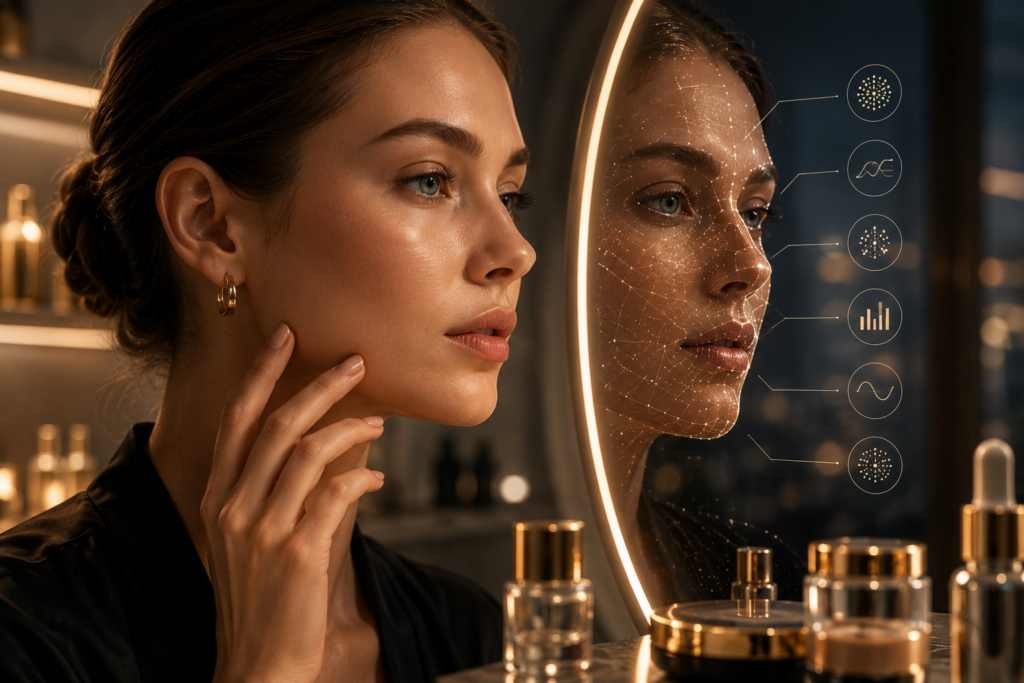
It is in the realm of digital doubles that L’Oréal’s stance has become most explicit. Sandy Morrigan has identified two very different uses of generative artificial intelligence. Virtual influencers created using computer-generated imagery—deliberately non-human and playing on a fantastical theme—are considered acceptable; according to her, some have garnered up to a million views in certain markets. But the photorealistic digital twin—the one that replicates the face and voice of an identifiable human being—is rejected for a reason tied to the very nature of the product being sold: a skincare product or makeup is purchased on the promise of a sensory experience felt on real skin and hair. A brand that sells a product for use on the body cannot, according to this logic, entrust its demonstration to a disembodied image.
This guideline is not an abstract communication principle: it is part of an internal policy that has already been formalized—what Sandy Morrigan has referred to as the group’s “principles of trust in artificial intelligence.” It also comes with an opportunity cost, as it deprives the company of a tool that other market players are already using without such restraint.
A boundary that has already been tested by others
The rest of the panel demonstrated just how fluid this boundary remains outside of L’Oréal. Ian Shepherd, CEO and co-founder of Electrify Video Partners—a company that has invested in eleven creators and built a team of more than two hundred people to support them—explained that his organization already uses digital twins for specific purposes: localization, foreign-language dubbing, or replacing a creator who is unavailable for a reshoot. Their use remains limited, but it exists, and it’s expanding.
Two examples cited on the sidelines of the debate illustrate the two possible outcomes of this experiment. The founder of one of the leading newsletters on artificial intelligence experimented with using his own digital double to produce content on his behalf; he abandoned the idea after realizing that the cloned version lacked the same authenticity as his actual presence, and he returned to live recording. Conversely, a creator known for never speaking on camera reportedly agreed to grant the rights to his image to a company wishing to use a digital double of him for multilingual live shopping, 24 hours a day—a project that, according to those involved, failed to live up to its promises and was abandoned.
These two opposing approaches—one assertive, the other reserved—convey the same message: the industry has yet to establish a common doctrine regarding what constitutes a human face when it becomes a reproducible asset. Everyone sets their own limits on a case-by-case basis, without a shared framework.
What the Limit Doesn’t Yet Reveal
L’Oréal has therefore chosen to address this lack of a guiding principle with a clear, publicly stated rule. But a rule established at a given moment is no guarantee for the coming decade. The pressure to produce content will not let up; meanwhile, content-generation tools are becoming more convincing from a sensory standpoint with each passing quarter—skin texture, hair movement, and vocal tone. The day the technical boundary between a computer-generated image and a real face becomes indistinguishable to the naked eye, the question will no longer be whether the tool can mimic reality, but whether the company still has a reason to prohibit it from doing so. Sandy Morrigan herself hasn’t ruled out a different future—she simply said, “You never know.” That cautious remark may have been the most honest of the entire roundtable discussion.
Cette publication est également disponible en :

