
In 1874, a woman who had taken over the business from her husband—who had died sixteen years earlier—asked her cellar master for something that no one had yet bottled: a dry champagne, without harshness, smooth without being heavy. The request, addressed to Damas Olivier, reads like a set of specifications as precise as an architect’s blueprint—which, in a way, Madame Pommery was.
One hundred and fifty years later, Clément Pierlot, the tenth Cellar Master at Maison Pommery, took up the project. Not to correct it, but to carry it forward.
The blending process in Champagne is unlike any other aspect of winemaking. It is neither winemaking nor aging—it is an architectural decision. From the 319 crus available in Pommery’s cellars, Pierlot selects 40 for the Brut Royal, seven for the vintage champagnes, and three for the Cuvée Louise. Forthe Apanage Brut 1874, he works with 17 crus, including the Clos Pompadour in Reims—plots that have been part of the House’s historic holdings for over a century.
The Perpetual Reserve plays a significant role in the blend. This system, which is standard practice for the Apanage cuvée, involves maintaining a stock of reserve wines that grows with each new vintage, serving as a foundation of depth for each new cuvée. It is a liquid memory: the 2012 wine still speaks through the 2024 bottle.
Apanage Brut 1874 is primarily based on the 2018 vintage, complemented by touches of 2015 and 2012. The core is made up of Chardonnay and Pinot Noir from prestigious vineyards, with added complexity from Meunier grapes sourced from the Montagne de Reims and the Grande Vallée de la Marne. The wine is aged for 48 months in the chalk cellars of the Butte Saint-Nicaise—cavities carved into the chalk beneath the 50-hectare estate, a space that Madame Pommery had built at the end of the 19th century in an Elizabethan Neo-Gothic style, featuring an H-shaped open floor plan, deliberately at odds with the insular traditions of Champagne.
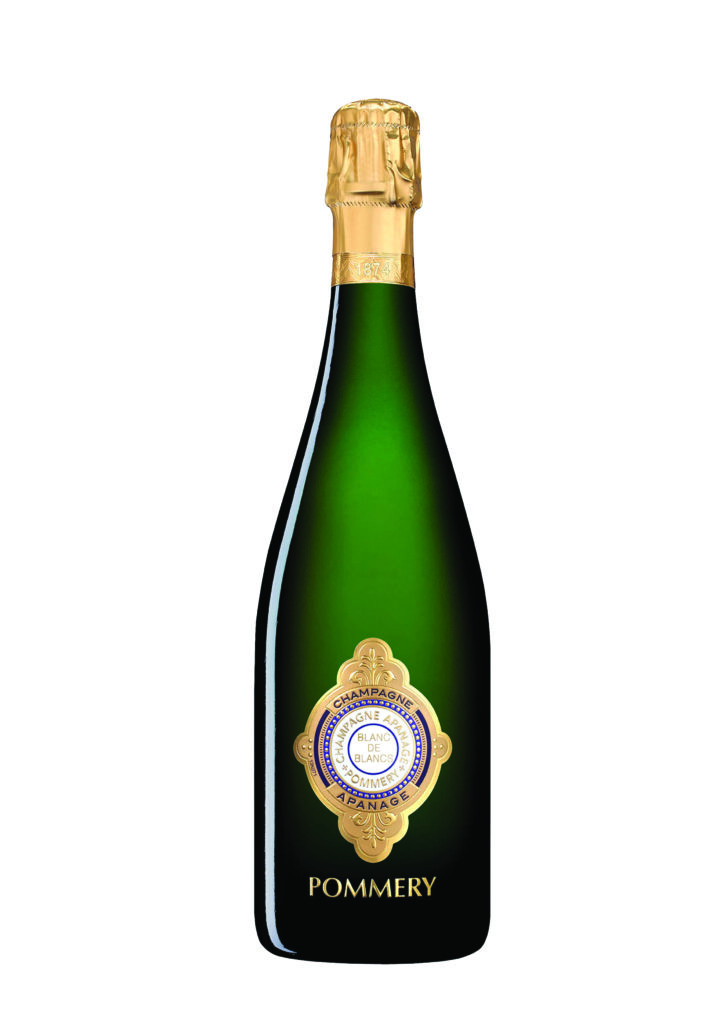
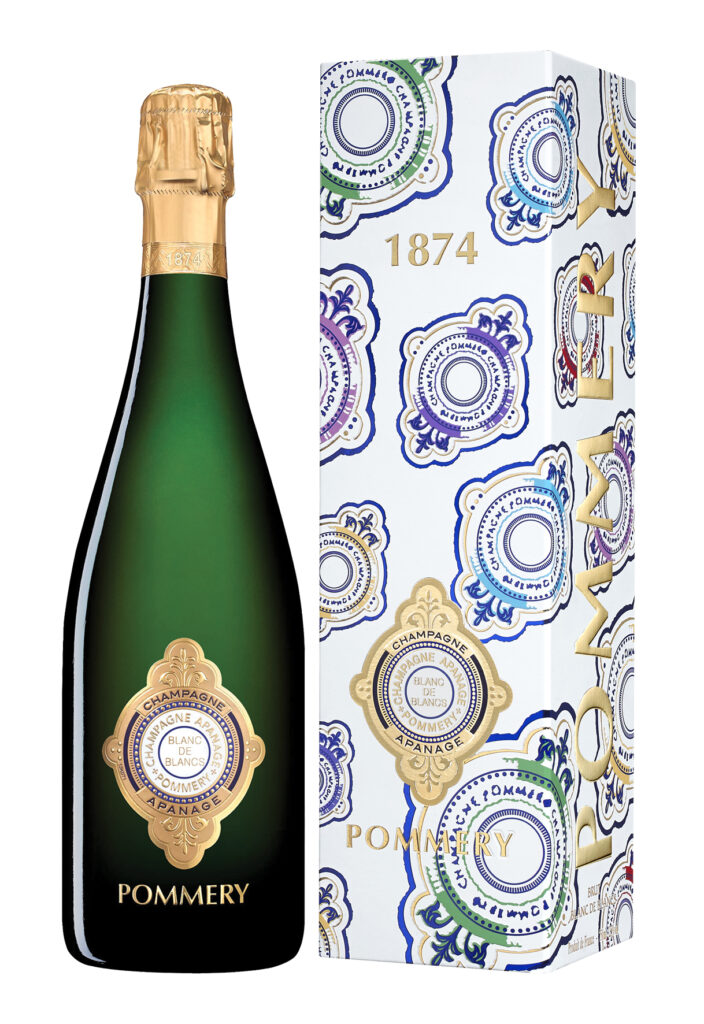
Technical Details — La Réserve Perpétuelle Blanc de Blancs
Forthe Apanage 1874 Blanc de Blancs, Pierlot focuses exclusively on Chardonnay. The base is a Perpetual Reserve composed of Grand Cru wines, which gains maturity with each new vintage added. The final blend incorporates crus from the Côte des Blancs (Avize and Cramant for 2014 and 2016), the Montagne de Reims, and the Monts de Berru-Nogent—terroirs that have been part of the House’s cellars for over a century—and a touch of Clos de Reims from massal selections, which adds density and length.
What the 2024 report does not mention, but what history documents, is the nature of the risk taken in 1874. The stocks required to produce a brut—delayed harvests, extended aging, and the accumulation of reserves—represented an unprecedented financial commitment for a small House. The tension between Adolphe Hubinet, the sales director, and Henry Vasnier, who was in charge of wine investments, was palpable. Madame Pommery settled the matter. In 1885, Pommery accounted for 2% of total Champagne production. In 1890–1891, that figure rose to 10%—or 2.5 million bottles.
Clément Pierlot isn’t taking that gamble again. He’s inherited the estate. But the question he asks himself, harvest after harvest, is the same: how will each vintage express itself in the blend—with opulent, exquisite, or subtle notes? That is exactly the question Madame Pommery asked Damas Olivier. The wording has changed. The challenge has not.
The Apanage cuvée takes its name from a legal term referring to what is rightfully due to an heir. There is a precision to this choice that is not merely rhetorical: what Pierlot receives is less a recipe than a requirement. A style defined in two words by Madame Pommery herself— “lightness with a smile” —and one that every Cellar Master for the past 150 years has been tasked with bringing to life in the glass, without betraying or stifling it.
The next step will be to see whether this style can withstand the shifting trends in contemporary taste—low dosage, mineral tension, umami—which Pierlot deliberately incorporates into his tasting profile. Madame Pommery, who had anticipated the shift from sweet to dry tastes by observing English high society in the 1860s, would likely have found this approach familiar.
Cette publication est également disponible en :

