
On June 11, 2026, as the 1000 Miglia passed through Modena, a one-of-a-kind car was handed over to its owner at the brand’s showroom. The MCPURA Cielo Tributo 1926 is not a limited edition: it is a one-of-a-kind model, conceived as a tribute. Its bodywork tells the story of the first century of a logo born from a fountain.
A date rather than a model
On April 25, 1926, Alfieri Maserati took the starting line at the Targa Florio behind the wheel of the Tipo 26, the first car to bear the Trident on its hood. One hundred years later, the Modena-based manufacturer has chosen to celebrate not a specific model, but this founding date. The MCPURA Cielo Tributo 1926, created through the Fuoriserie customization program, brings this historic event to life: a one-of-a-kind vehicle, delivered on the very day that the most historic race in Italian motorsports passed right beneath the brand’s windows.
The connection between the company and this race is not a coincidence staged for the occasion. As early as 1931, the Tipo 26 C—the first Maserati to compete in the Mille Miglia—secured a class victory there. Choosing this moment to unveil the car is a way of placing this contemporary object within a verifiable lineage rather than a vague legend.


The Car Body as an Archive
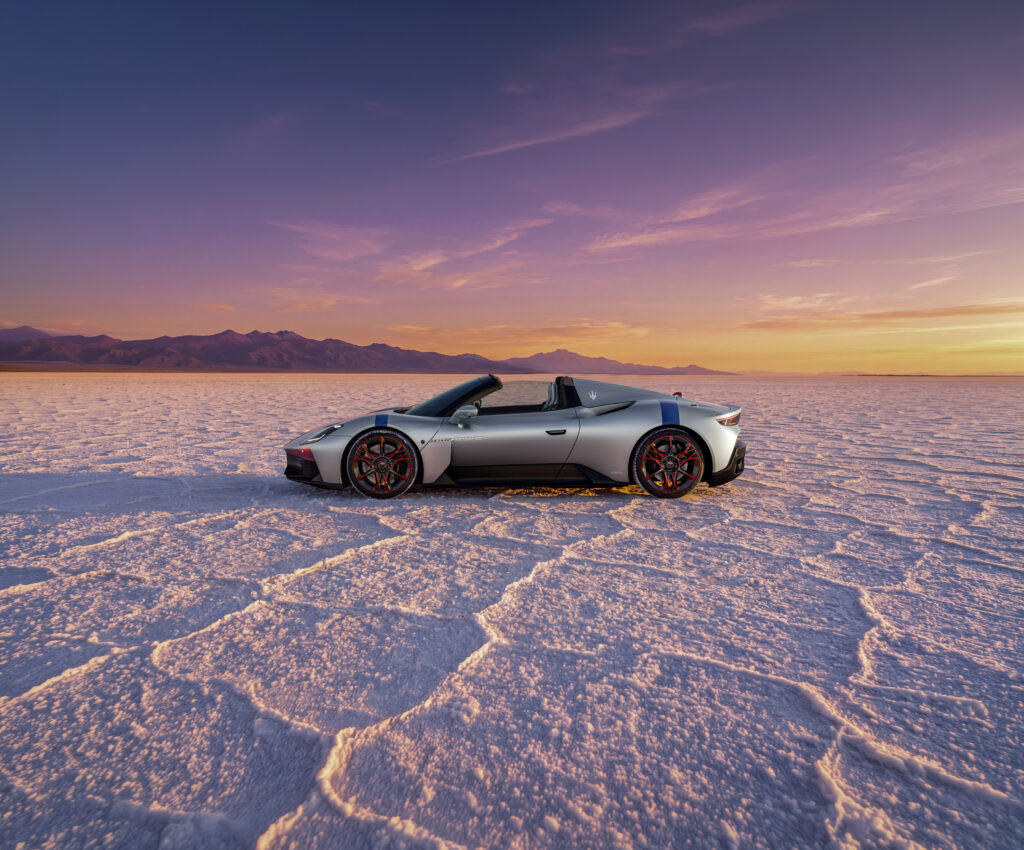
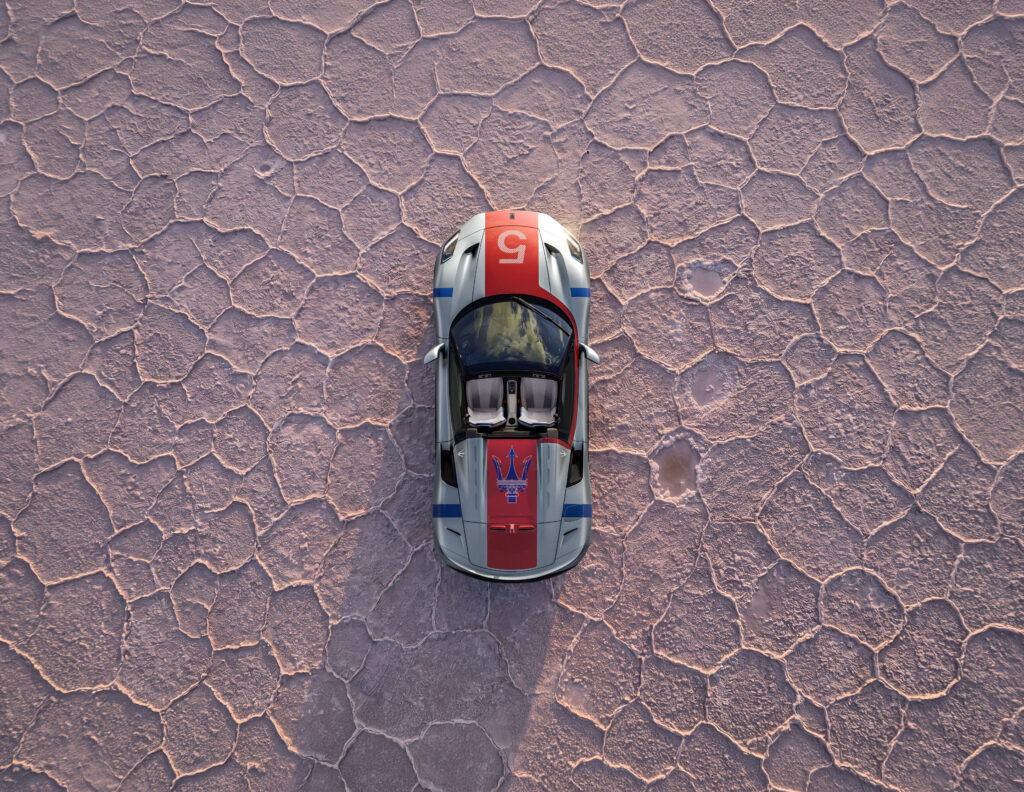
Everything about this convertible functions as a homage. The Grigio Lamiera Matte paint finish evokes the raw materiality of 1920s race cars; against this backdrop unfolds a color scheme combining Rosso Capannelle, Blu Infinito, and Bianco Pastello. In the center of the hood, a faithful reproduction of the original Tipo 26 badge establishes the most direct link between the 1926 car and the 2026 model.
The attention to detail extends even to the signature. On the soft-top cover, the Trident appears in two versions, juxtaposing the current logo with the first version designed by Mario Maserati in 1926. The door badges bear the names of the two protagonists of the inaugural race: Alfieri Maserati and his mechanic, Guerino Bertocchi. The 20-inch Cyclonic wheels, with a diamond-cut finish and red accents, echo the color scheme of the overall design, which is further enhanced by an exterior Carbon Pack.
| Under the bodywork, the 100% Maserati-built Nettuno V6 engine incorporates Formula 1-derived technologies into a production-spec engine block. The interior features an embroidered Trident on the headrests, a Carbon Interior Package, and a 695-watt Sonus faber audio system with twelve speakers. |
The Return of the One and Only
The MCPURA Cielo Tributo 1926 embodies a philosophy that mass-produced automobiles had long since abandoned: that of a vehicle designed for a single customer. Each Fuoriserie project arises from an extended dialogue between the buyer and the workshop, which designs the body, interior, and finishes to create a truly one-of-a-kind configuration. The division is part of a larger entity, BOTTEGAFUORISERIE, where the brand champions craftsmanship as a counterpoint to mass production.
This trend isn’t unique to Modena: all the major automakers are now reopening workshops dedicated to extreme customization, as if to remind us that before the assembly line, there was the workbench. But Maserati has an advantage that others lack—a logo whose origins can be traced back to an artist’s vision. For the Trident, before becoming a brand, was a sculpture. A great art lover, Mario Maserati borrowed it from the Fountain of Neptune in Bologna, the city where the Società Anonima Officine Alfieri Maserati was founded in 1914. One hundred years after its debut on a race car hood, the emblem returns to its origins: a unique, handcrafted object, where the history of a company is captured in the precision of a single brushstroke.
Cette publication est également disponible en :

