
France’s favorite clothing brands: Promise Consulting Inc. and Huffingtonpost.fr
unveil their aspirational rankings
Promise Consulting Inc, a marketing research and consulting firm specializing in brand value measurement, and one of its entities Panel On The Web present the 2nd
part of their monthly barometer of desirable brands* in partnership with Huffingtonpost.fr (*brands appreciated for their products or services, but also for their values, universe or cultural stances).
For this second edition, in addition to the desirability index of the 47 clothing brands preferred by the French, Promise Consulting Inc. and Huffingtonpost.fr also wanted to measure the awareness of these ready-to-wear franchises.
This study was carried out among a nationally representative sample of 1,000 people aged 18 and over between August 10 and 28, 2012.
Desirability Index: Low-cost brands take the podium… but without neglecting
their image
The Clothing Brand Desirability Index is calculated as the difference in scores, measured using a 10-point Likert scale (and converted into an index), between respondents who rate the “ideal clothing brand / close to their ideal clothing brand” and those who rate the brand “not at all / far from their ideal brand”.
“It is one of the 18 key indicators of the Monitoring Brand Assets model (a brand value measurement tool deployed both in France and internationally by Promise Consulting Inc.), and enables us to assess one of the key levers of brand growth, over and above immediate commercial performance”, emphasizes Valérie Jourdan, Chairman and CEO.
Calculated in this way, the Desirability Index enables a relevant and comprehensive analysis, since it takes into account both the highest and lowest ratings, and not just the highest or lowest. Ultimately, the Desirability Index proves to be predictive not only of French people’s current behavior and expectations, but also of their future behavior.
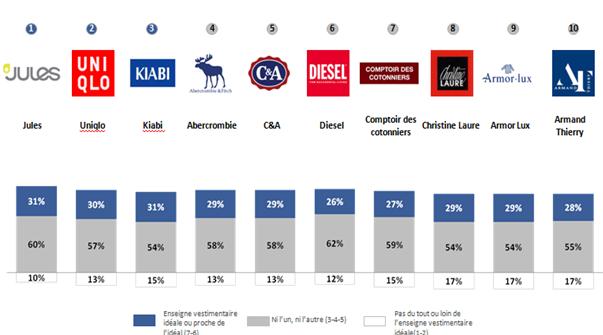
Brands are ranked in descending order of the difference between the positive modality (%7-6) and the negative modality (%1-2). Thus Jules’ desirability score is (31%-10%)=21%.
In the chart above, Jules (21%), Uniqlo (17%) and Kiabi (16%) make up the top three.
Low prices set the pace… but image is important
If low-cost brands have made their mark in the food retail sector (Liddl, Aldi…) or the automotive sector (Dacia), the same is true of the ready-to-wear market. As this study illustrates, the top three in this ranking are 100% low-cost brands. Jules (21%), the men’s counterpart to Camaïeu owned by the Mulliez family (Auchan Group), is now only present in outlying shopping centers, but also in
downtown. Japanese clothing retailer Uniqlo (17%) has rapidly established itself on the French market. A judicious choice of muses, including actress Ludivine Sagnier, tennis player Novak Djokovic and musician-producer Yulsek, and occasional collaborations with designers such as Jil Sander, have enabled the Japanese firm to target a wide audience. In addition, Uniqlo is multiplying and expanding its points of sale, an aggressive
sales strategy that is paying off. Lastly, Kiabi (16%), whose slogan is “fashion at low prices”, belongs, like Jules, to the Mulliez family association. This leader in textile superstores, accustomed to radio advertising campaigns, has successfully established itself in this market since its creation in 1978.
French brands come out on top
With 5 brands represented in the top 10, the French ready-to-wear industry is doing more than just making up the numbers. Jules and Kiabi are on the podium, and Comptoir des Cotonniers (12%) is in 7th place at
. This “mother-daughter” brand has an excellent city-center footprint and has joined the Japanese Fast Retailing group (Uniqlo). Another French brand, or Bretonne we should say, is Armor Lux (12%), in 9th place
. Multiplication of sales outlets, regional positioning at
through its range or via regional event partnerships (Festival des vieilles Charrues), tendering for public contracts (ADP, Police nationale…) and 40% production on French territory are at the root of its success.
Finally, Christine Laure (12%), a family business targeting active women, sells its collections nationwide from almost 150 franchised outlets, and is expanding its network with 10 to 15 openings a year. Christine Laure ranks 8th
in this top 10.
Indice de notoriété: the 10 best-known brands in France
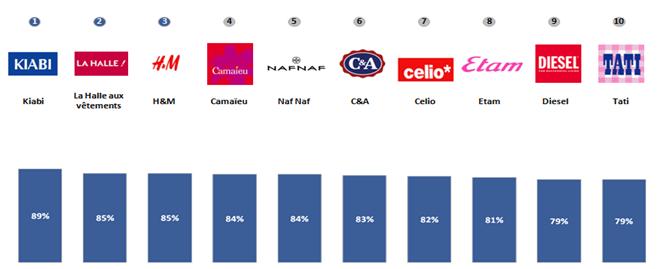
The Promise Consulting Inc.-Huffingtonpost.fr barometer also looks at the brand awareness of clothing brands, although this is not the same thing as desirability. Of the brands represented in this top 10, four only sell unisex collections: Camaïeu (84%), Naf Naf (84%), Celio (82%) and Etam (81%). It’s also worth pointing out that only three foreign brands, all of them European, stand out in this
ranking: H&M (85%) is a Swedish chain, C&A (83%) is a clothing manufacturer of Dutch origin with headquarters in Germany and Belgium, and Diesel (79%) is an Italian brand. Finally, five brands in this ranking have a purely low-cost positioning (Kiabi, La Halle aux vêtements, H&M, C&A and Tati) and four have a “budget” positioning (Camaïeu, Naf Naf, Celio and Etam). Diesel, a high-end jeans manufacturer with a marketing strategy now openly targeting young people, is the only brand in this ranking that is not low-cost.
“The study of clothing brands confirms the importance of complementing brand awareness with a measure of desirability, especially when it comes to clothing, a product that is not only functional, but also emotional, status-related and symbolic. For both men and women, the brands that emerge in the top three are characterized by low prices…. However, they are not neglecting their image, and frequent renewal of their collections is a key factor in their appeal. Of course, there are major disparities between men and women, and even between households with and without children, but the good behavior of purely French brands (or even those with a strong regional flavour, at least in their brand DNA), can be observed with both men and women: a lever for preserving a textile industry in France? “concludes Pr. Philippe JOURDAN, founding partner of Promise Consulting Inc / Panel On the Web, consologist, Editor-in-Chief of the Revue Française du Marketing and author of the Dunod book “A nouveaux consommateurs, nouveau marketing : zoom sur le Conso’Battant”.
Cette publication est également disponible en :

