
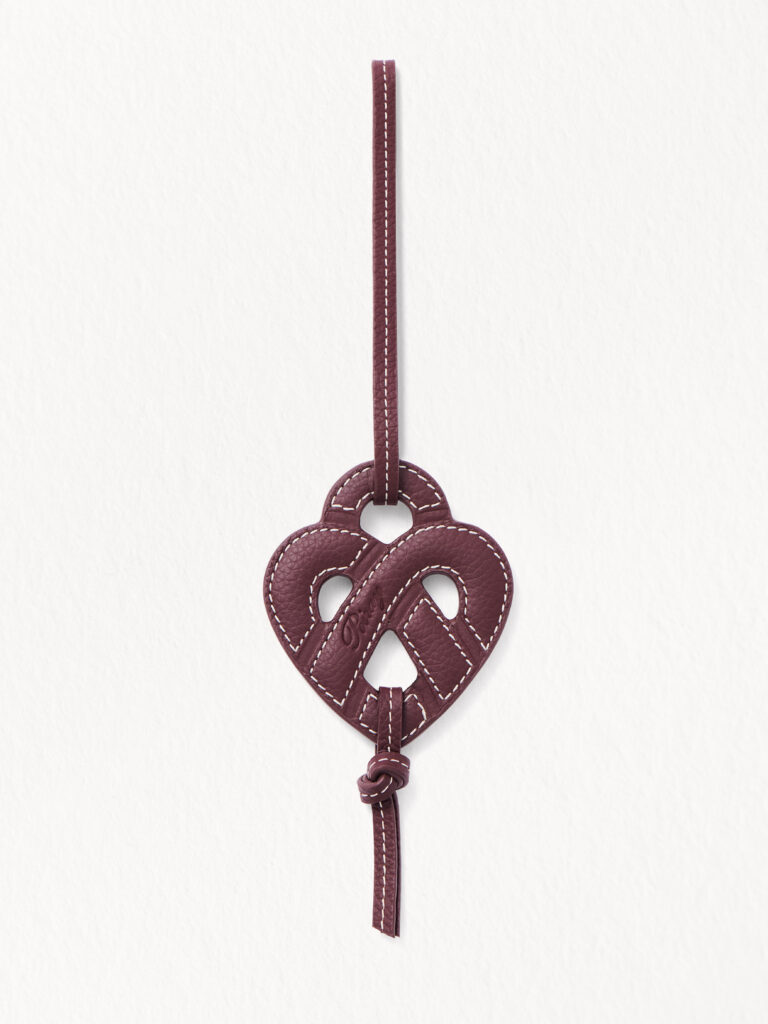
Sometimes a motif changes function without changing form. At Maison Poiray, the Cœur Entrelacé (Interlaced Heart) is just such a motif: originally conceived as a piece of bag jewelry, it has left the world of urban accessories to join the world of equestrianism, where it is now found on the saddle.
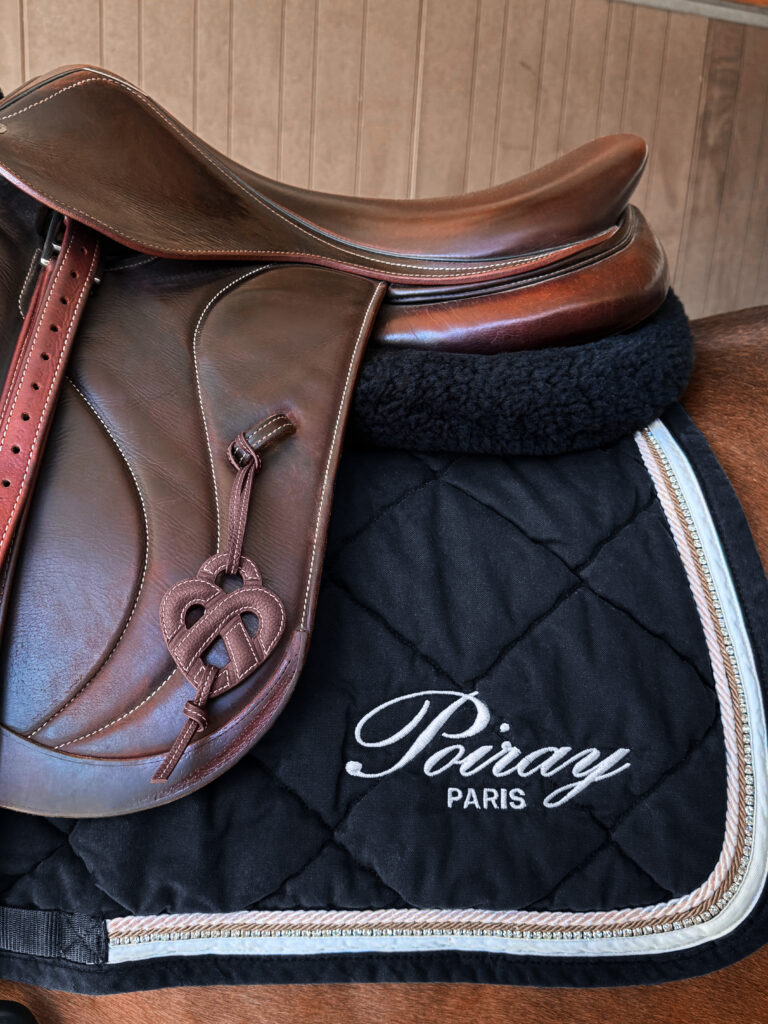
The gesture is seemingly simple. It consists in transposing an identifiable sign to another use. But this shift involves a material transformation. Whereas the bag jewel was an ornamental item, the saddle version imposes a constraint of use: resistance, suppleness, adaptation to leather already under tension. The choice of brown leather with white stitching is not decorative. It is a technical vocabulary specific to saddlery, where visible stitching structures as much as it reinforces.
In the image on page 1, the object appears attached to the saddle, suspended by a strap, in direct contact with the material. It no longer floats like a detachable accessory; it becomes part of the continuity of the leather. This integration changes the way it is read: the jewel ceases to be an addition and becomes a visual anchor.
The motif itself – an interlacing forming a symmetrical figure – retains its legibility. But its scale and environment change. On a bag, it dialogues with the movement of the body. On a saddle, it accompanies the animal’s movement. This transition from pedestrian to rider introduces another temporality: slower, more rhythmic.
Its inclusion in the Year of the Horse, on the occasion of the Chinese New Year, provides a symbolic framework for this evolution. Yet the piece’s interest lies less in this reference than in the continuity it establishes between two territories: leather goods and equestrian equipment. Historically, these worlds share the same artisan origins. Leather is worked to last, to bend without breaking, to mark time.
Priced at 120 euros, the object retains its relative accessibility within the jewelry world. But here again, price is not the main issue. What’s at stake here is coherence: extending an existing motif without diluting it, by finding a use for it that respects its initial construction.
This jewel of a saddle doesn’t seek to redefine codes. It displaces them. And it’s in this displacement – discreet, almost silent – that the piece finds its rightness.
Cette publication est également disponible en :

