
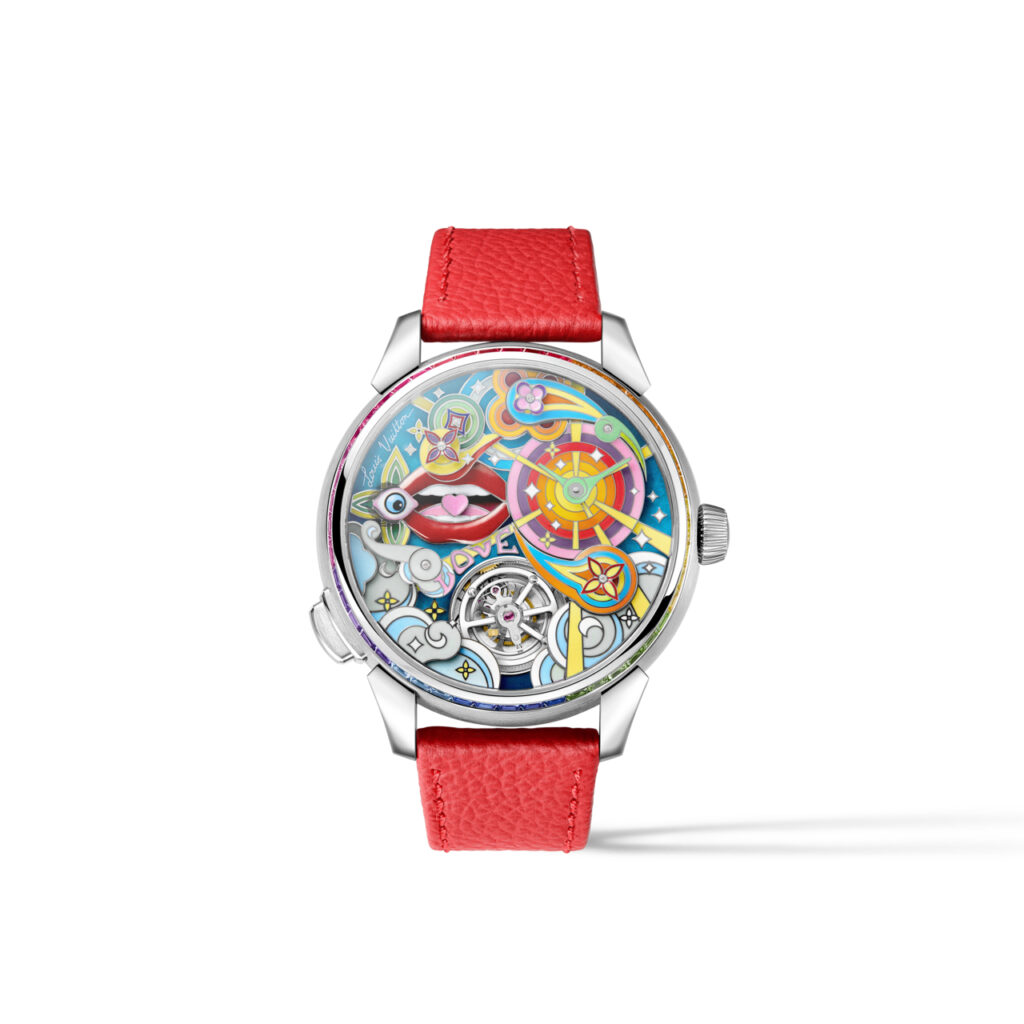
The Tambour Taiko Arty Automata is something of a miniature theater. Not a set on a movement, but a mechanical stage where enamel, featherwork, gem-setting and tourbillon respond to each other in a 42 mm space. Here, Maison Louis Vuitton pursues a clear trajectory: to turn watchmaking from an extension of its territory into an autonomous language.
The object arrives at a precise moment. Since the relaunch of Tambour in 2023, Louis Vuitton has been tightening its watchmaking discourse around La Fabrique du Temps, based in Meyrin, in the canton of Geneva, where designers, engineers and craftsmen are brought together to design the Maison’s watches. The Tambour, introduced in 2002, remains the formal foundation of this ambition: an identifiable case, here displaced to an automaton piece that assumes more narrative than restraint.
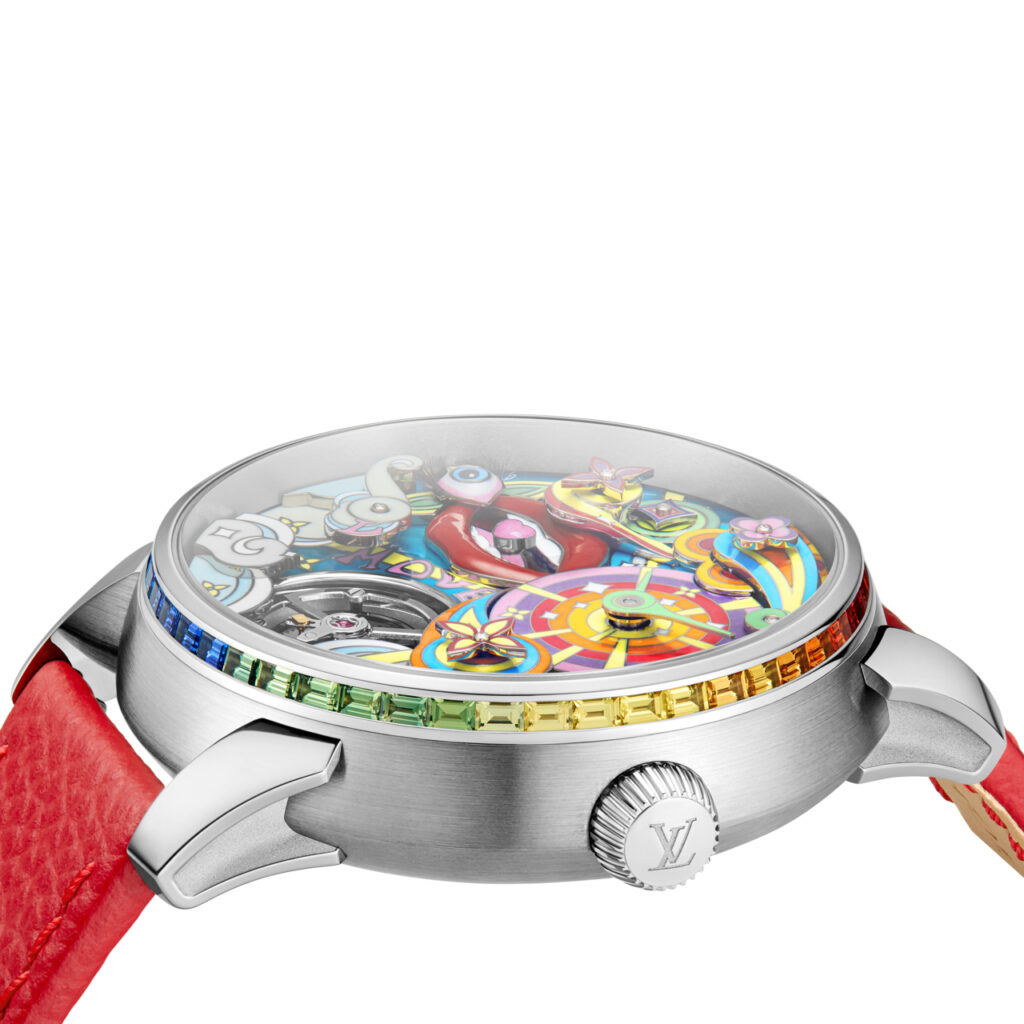
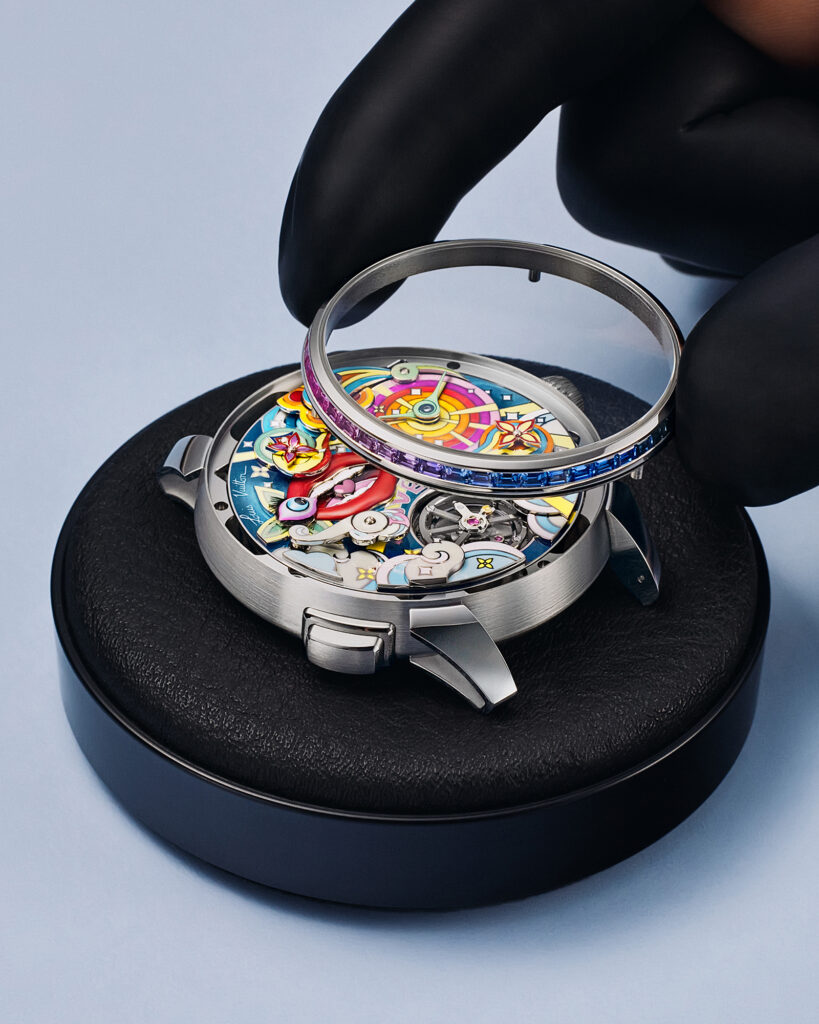
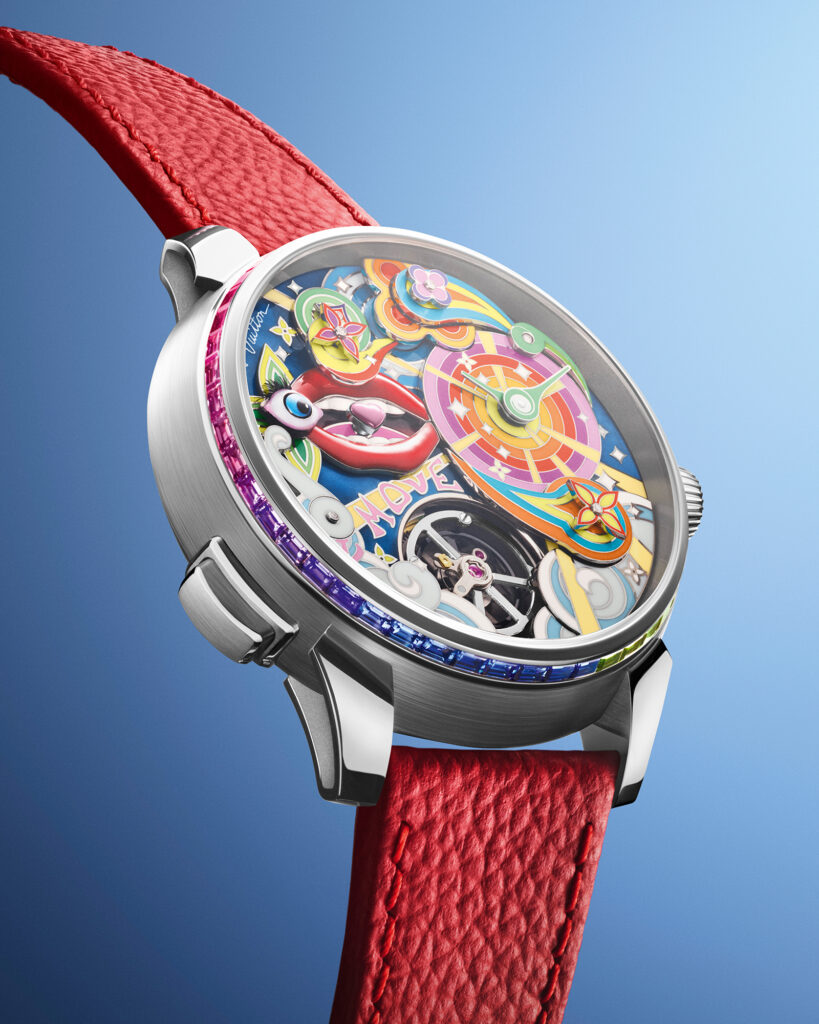
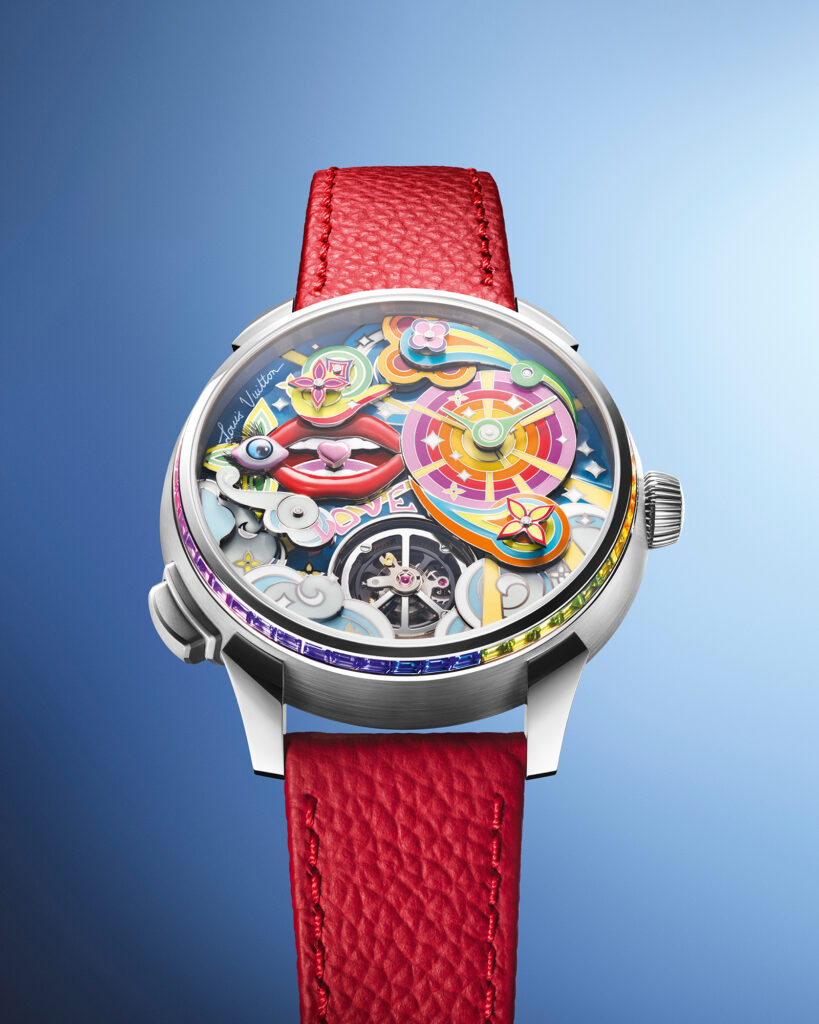
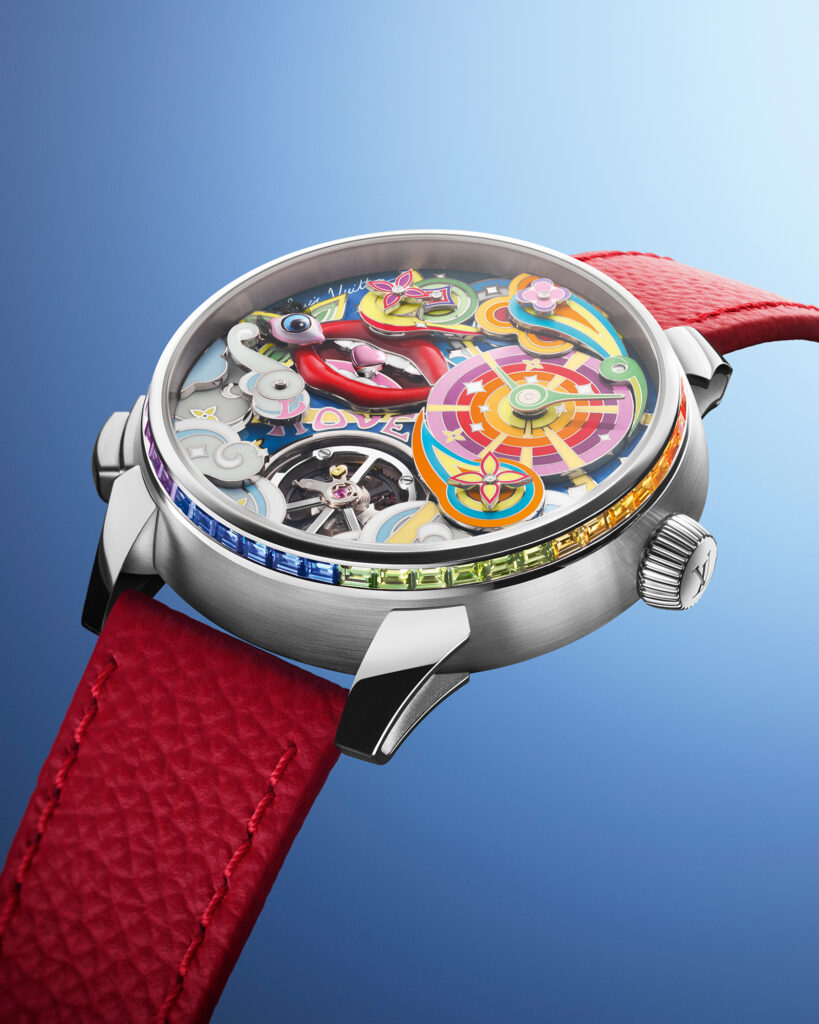
The Tambour Taiko case in 18-carat white gold measures 42 mm in diameter and 13.6 mm thick. The bezel accommodates 43 colored sapphires and five baguette-cut rubies, for a total of 2.64 carats, while the dial features seven round diamonds. These numbers are less important for their decorative value than for what they organize: a continuous, almost circular chromatic reading around a dial built in relief.
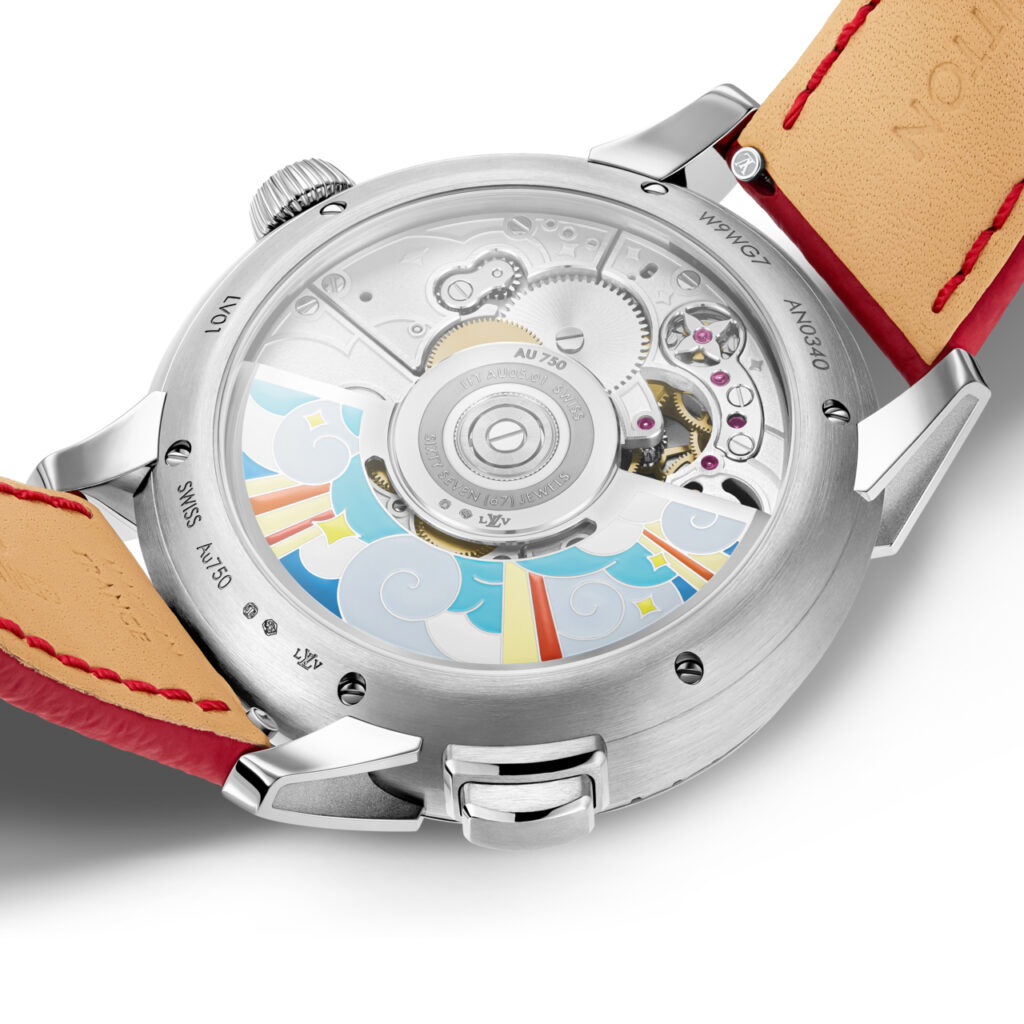
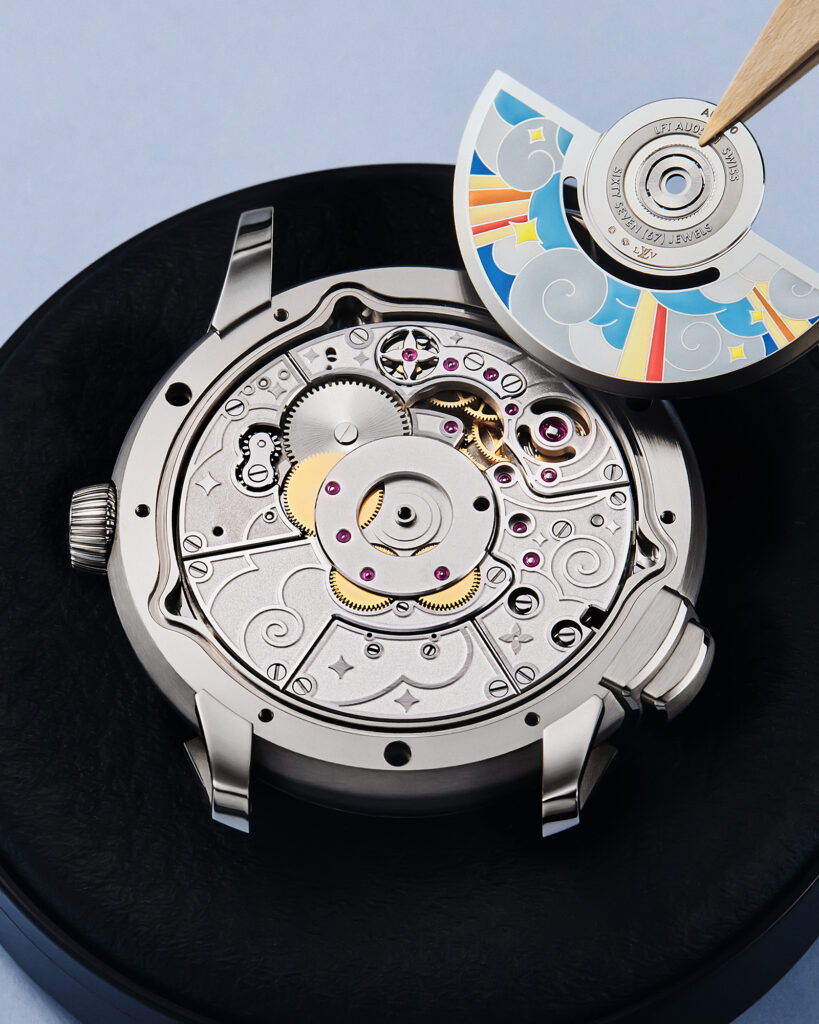
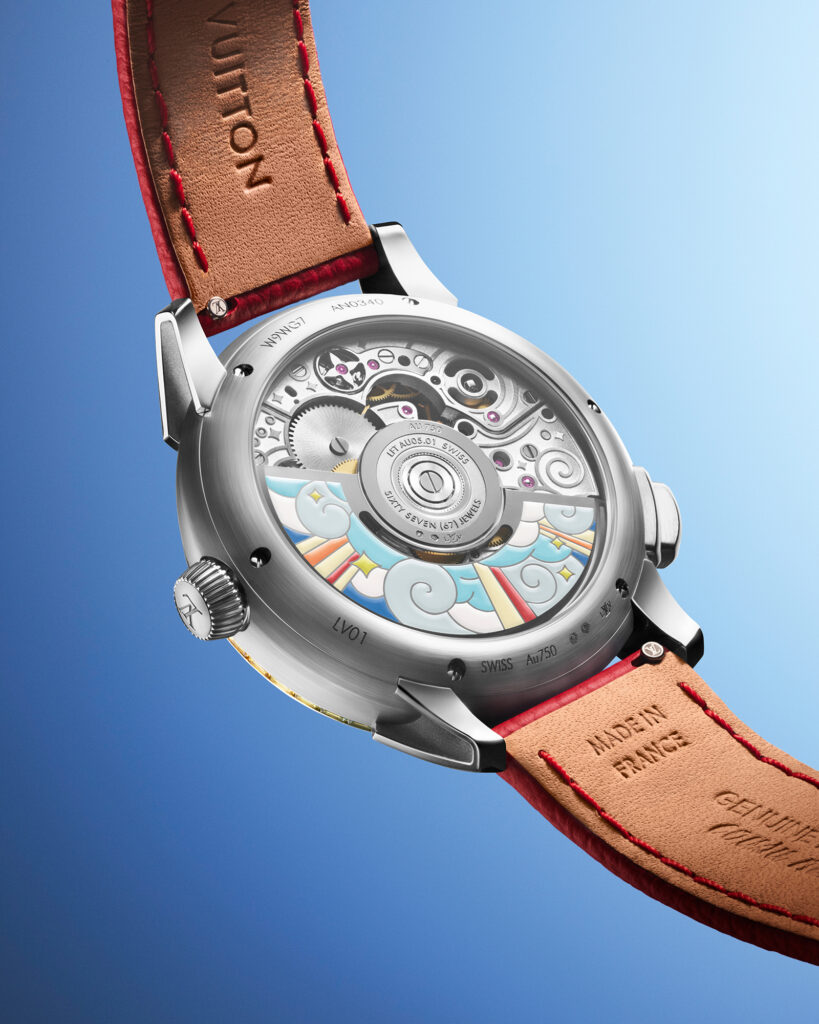
At the center of the piece, the image is never still. The LFT AU05.01 automatic caliber, developed and assembled by La Fabrique du Temps Louis Vuitton, features 363 components, 67 jewels, a 65-hour power reserve and a frequency of 28,800 vibrations per hour. It drives an automaton mechanism composed of seven animations, in parallel with a flying tourbillon positioned at six o’clock.
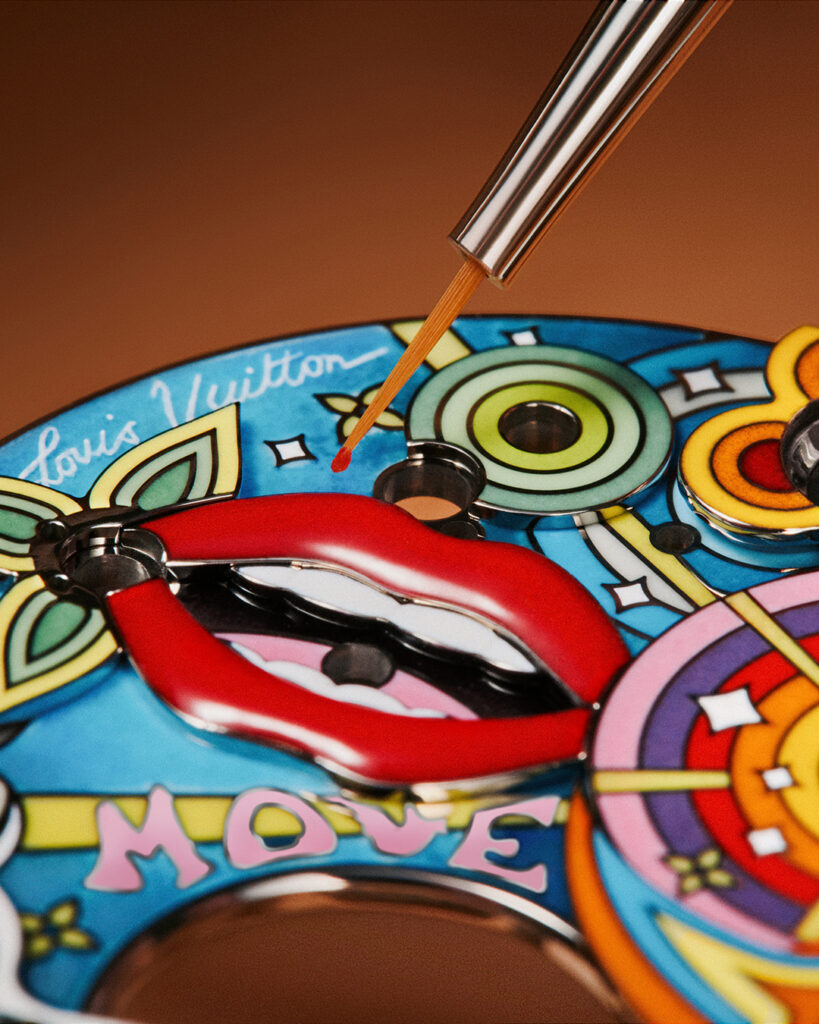
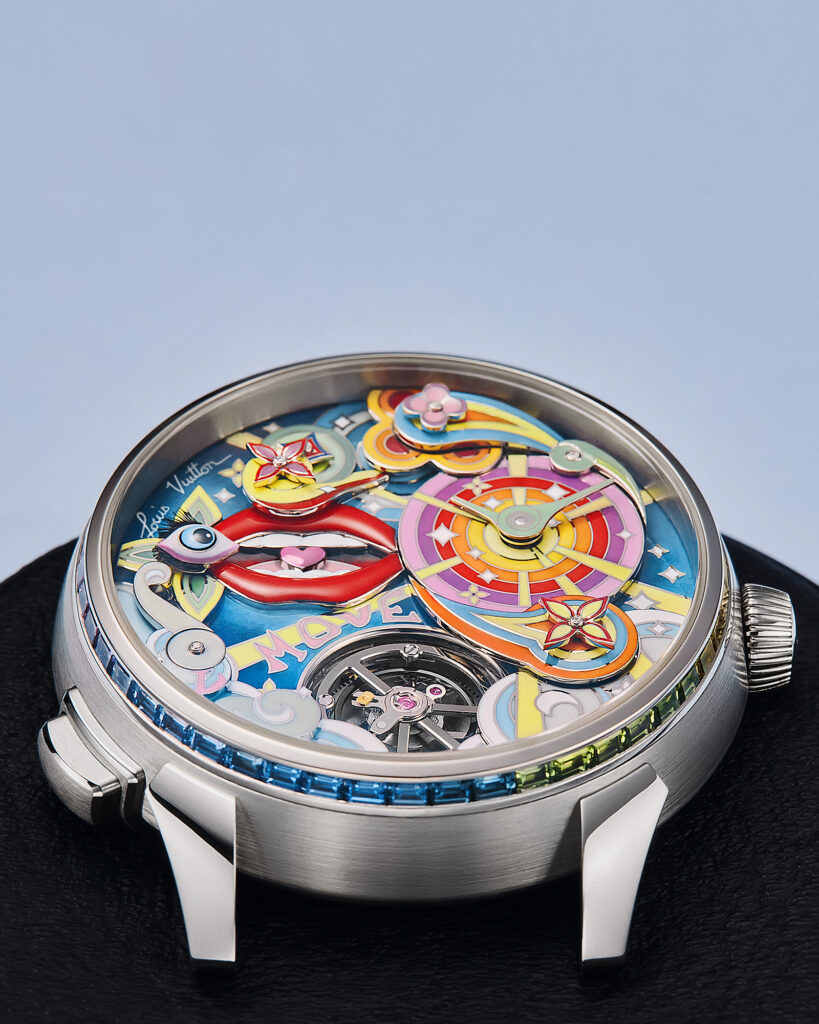
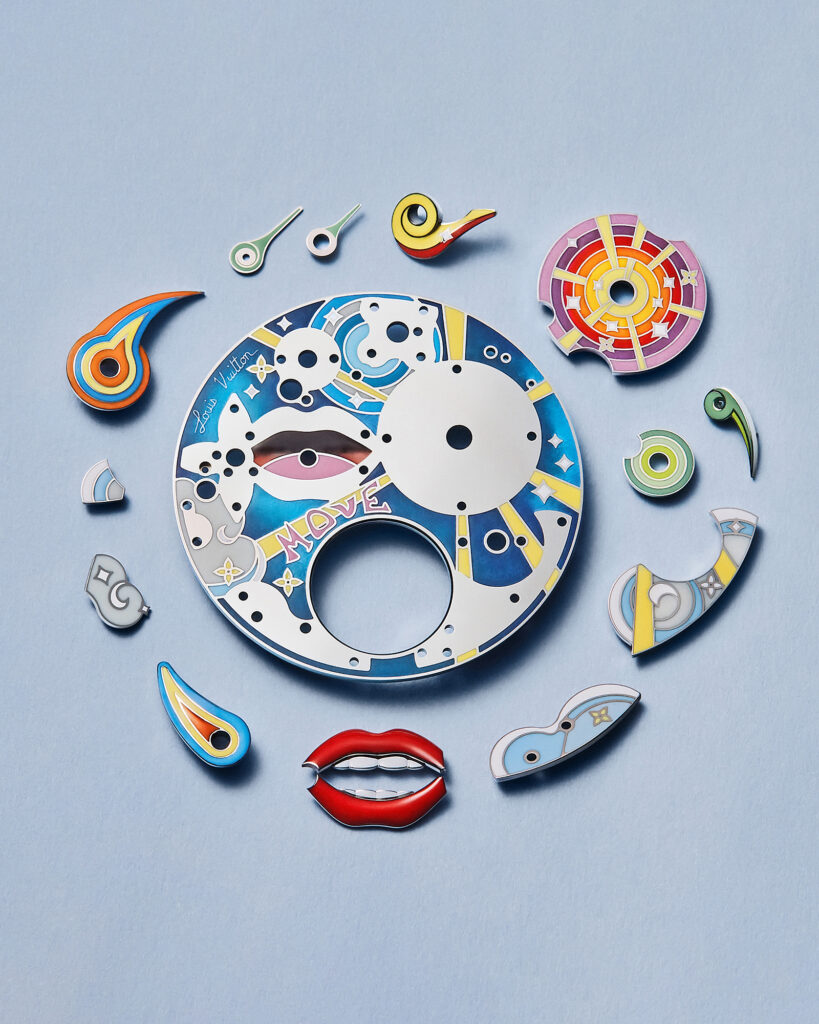
The dial is composed of twenty miniature elements spread over four heights. Four Monogram flowers with diamond-cut pistils, an eye lined with real feathery lashes, red lips holding a pink heart, the word LOVE which becomes MOVE: the whole thing could tip over into pop anecdote. Yet it’s held together by mechanical constraint. Pressing the pusher at eight o’clock triggers rotations, oscillations, the movement of the letter and the movement of the gaze. Fantasy is visible; discipline remains hidden beneath the dial.
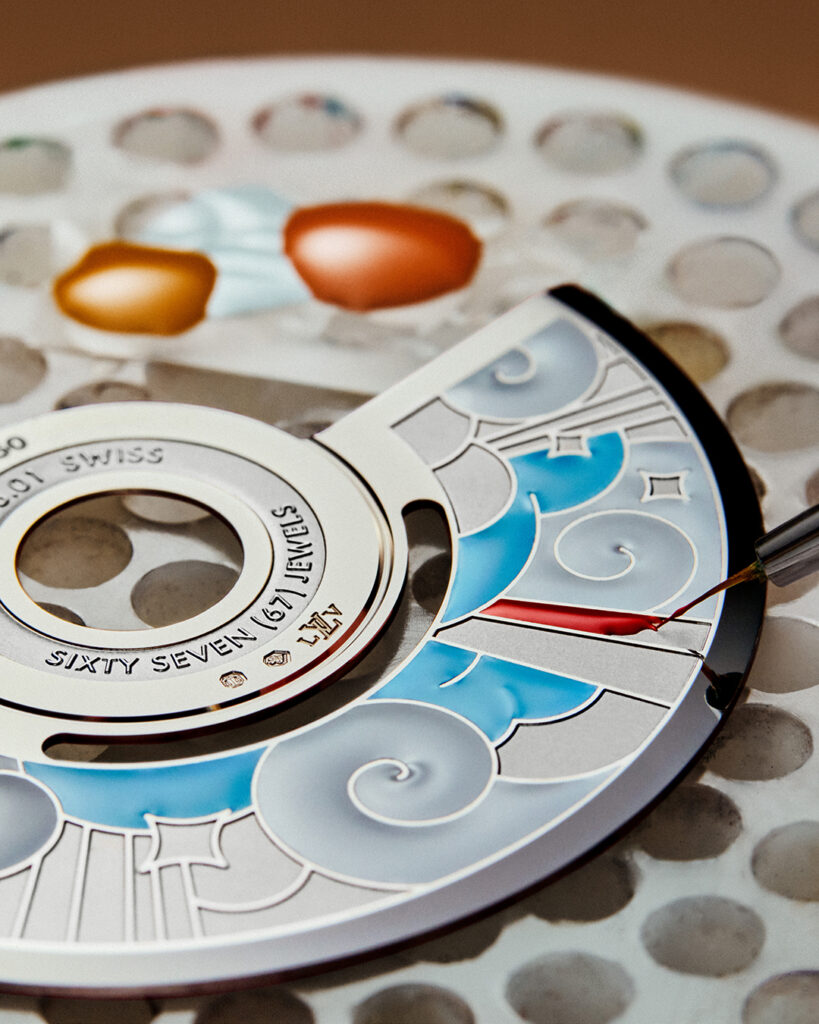
Perhaps this is the real issue: how to produce movement without losing your touch. Champlevé enamel imposes a slow sequence. Surfaces are hollowed, filled and fired in descending order of temperature, color by color. Red, pink and violet are identified as the most sensitive to firing. Twenty-three shades of enamel were required for this dial, representing over 250 hours of manual labor.
This handcrafted density prevents the piece from becoming a mere graphic demonstration. Successive layers of vitreous enamel create a domed volume over the eye, lips and heart. The 18-carat white gold rotor extends the scene on the movement side, hand-decorated by La Fabrique des Arts using the miniature painting technique, with opaline blue clouds and sun rays.
Tambour Taiko Arty Automata doesn’t seek neutrality. It boasts a solar, saturated, almost psychedelic aesthetic, with a clear reference to the graphic language of the Seventies. This is precisely what makes it interesting in a Haute Horlogerie landscape often dominated by technical monochromy, cold skeletonization or heritage. Here, Louis Vuitton opts for narrative complication: a watch that doesn’t just tell the time, but stages the very idea of momentum.
The piece says something about the Maison’s contemporary watchmaking strategy. After acquiring La Fabrique du Temps in 2011, Louis Vuitton has gradually shifted its center of gravity from accessory object to full-fledged watch manufacturer. The Tambour Taiko Arty Automata is part of this evolution: it asks the collector not just to recognize a name, but to observe a mechanism, a dial, a sequence of gestures.
In this watch, the automaton is not a whim. It becomes a kind of signature: that of a Maison that has understood that collector’s watches can no longer be won by precision alone, but by the ability to bring together mechanical architecture, craftsmanship and cultural imagination. Here, time doesn’t pass. It enters the scene.
Cette publication est également disponible en :

