
In 1970, three words appeared on the dial of the Polaris II: High Precision Guarantee. They signed a 4 Hz caliber and a promise of accuracy. More than five decades later, Jaeger-LeCoultre takes up those three words to make them a hallmark. It is no longer read on the dial but on the back, on the caseback.
The seal was introduced in April 2026, at Watches & Wonders, on the Master Control Chronomètre collection. The Maison now indicates that it will gradually extend to the other collections from 2027. What matters is no longer the launch of a line, but the application of a standard.
A week inside a machine
The protocol rests on a purpose-built machine. Rather than testing each constraint separately, it combines them. Two days of dynamic cycles replay an active week: fixed positions, movements in several positions, shocks, temperature variations. On the third day, the watch enters a “stabilized rest” in a fixed position, the equivalent of the weekend. The Maison states that a patent application is pending.
The parameters are quantified. Shocks range from 25 to 50 G. Temperature oscillates between 18 °C, rest, and 35 °C, intense physical effort. Altitude is simulated from sea level up to 1,004 meters, that of the Manufacture-Atelier in Le Sentier. This is the only test carried out on the caliber alone; the others are carried out on the cased watch.
The movement under the loupe
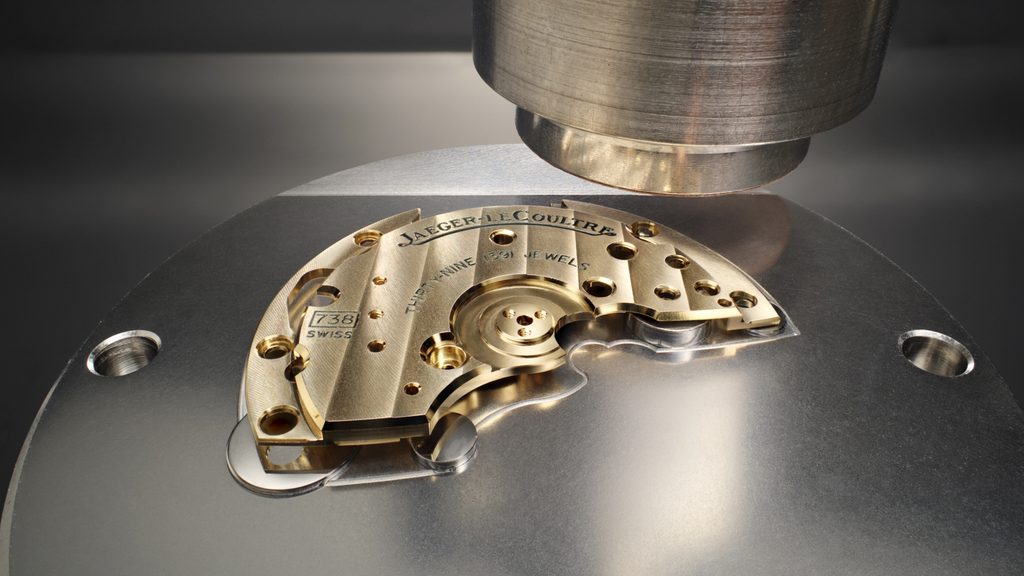
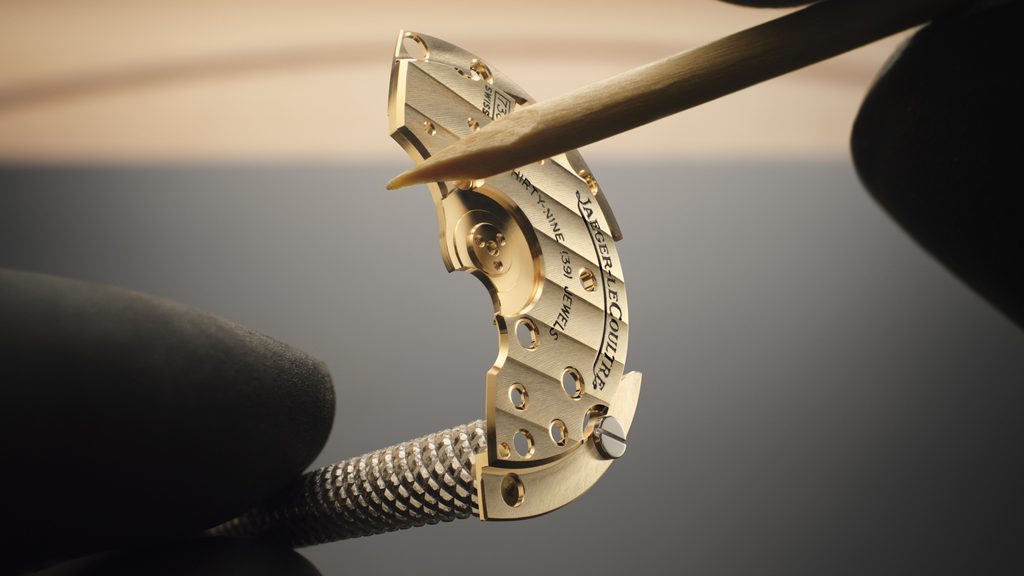
The hallmark does not measure rate alone. To obtain it, the movement must combine at least six of the eight traditional finishing techniques: anglage, polishing, circular satin-finishing, linear satin-finishing, moldings, Côtes de Genève, perlage, blocking. Jaeger-LeCoultre presents this requirement as a matter of precision: ornamentation is carried out to the micron, to serve the movement as much as to showcase it.
An old Geneva reflex
Watchmaking has always sought a third party to attest to what it promises. Observatory competitions, in Geneva, Neuchâtel or Besançon, were the first stage. In 1946, Calibre 170, the Maison’s first tourbillon pocket watch, won the one in Neuchâtel. Quartz put an end to these contests in the late 1960s, and the COSC was born in 1973. The Poinçon de Genève, established in 1886, already protected provenance and standards. The major manufactures ended up writing their own rules. Jaeger-LeCoultre had created, as early as 1992, the Contrôle 1 000 Heures, launched with the Master Control.
The HPG extends this lineage. On the inaugural collection, each caliber is first COSC-certified, then goes through the Maison’s more comprehensive protocol. The two levels remain distinct: one comes from an independent body, the other from an internal standard.
What the scope changes
A seal is worth only what it allows one to know. On a single collection, the question hardly arises. Extended to several, it requires answering reference by reference: which watch received it, on what date, for which caliber. The announced timetable is gradual and does not yet say which model will be eligible and when. Before comparing two pieces, it is therefore the actual certification of each that must be checked.
The engraved caseback carries a sign. It remains for the documentation to make its scope legible.

Four test parameters: altitude (0 to 1,004 m, caliber alone) · multidirectional shocks (25 to 50 G) · positions (moving and fixed phases) · temperature (18 to 35 °C).
Finishing: at least six techniques out of eight.
Timeline: introduction at Watches & Wonders, April 2026 · gradual extension from 2027.

Cette publication est également disponible en :


