
Two independent movements, two crowns: Futur Antérieur Gold makes the distribution of indications its construction principle.
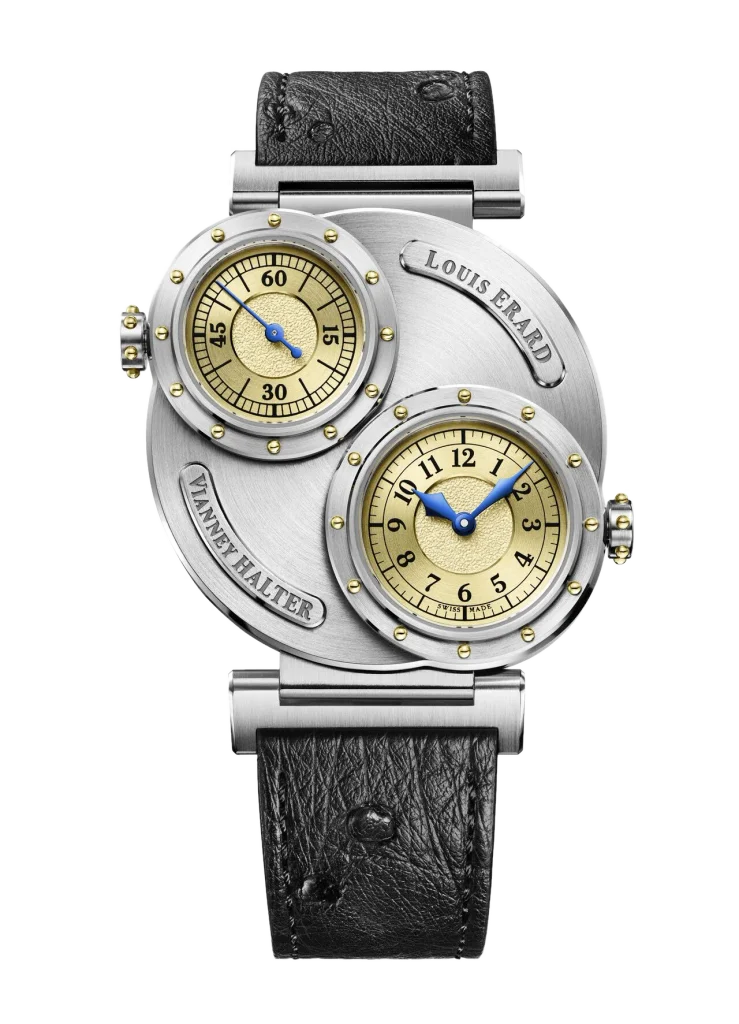
The seconds have their own engine here. On Futur Antérieur Gold, Louis Erard and Vianney Halter place two Sellita SW100 automatic movements side by side. One drives the seconds, the other the hours and minutes. The separation extends to the two crowns: the object makes visible a mechanical autonomy rarely necessary for simply reading the time.
A declared architecture
Louis Erard’s product sheet describes a steel case measuring 38 × 44 mm, 8.85 mm thick, assembled from 67 components. The two bezels each carry twelve rivets. The Gold version is announced as a series of 178 pieces.
This accumulation of parts is not enough to establish chronometric superiority. Its interest lies elsewhere: making construction the very subject of the watch. The two indications coexist, but their components remain distinct. The eye can thus follow the seconds without regarding them as a mere appendage of the hours dial.
A design explained by the mechanics
To appreciate a watchmaking collaboration, the name associated with the dial is a starting point. The arrangement of the mechanisms provides a more precise criterion here. It allows the volumes, the crowns and the bezels to be read as the consequences of a stance.
Futur Antérieur thus offers less a new function than another way of showing existing functions. It is in this gap between utility and technical staging that the piece finds its interest: the time remains familiar, while its organisation becomes the object of attention.
Sources — editorial verification
Louis Erard x Vianney Halter — Futur Antérieur Gold — 30 October 2026. Accessed on 3 November 2026.
Also on Luxsure: Audemars Piguet relaunches the Offshore through colour · Raketa, time in reverse as a discreet manifesto · Bell & Ross and S.T. Dupont: when the watch becomes a ritual object · S.T. Dupont x Franck Muller Master Lighter, mechanics displaced
Cette publication est également disponible en :


